
Eid al-Adha: Islam's Holiday of Sacrifice and Sharing
 Add to Chrome
TABLE OF CONTENTS
On May 27, 2026, an estimated 2 billion Muslims will wake before dawn, put on their finest clothes, and gather for morning prayers — then divide freshly sacrificed meat into three equal piles: one for family, one for friends, one for the poor.
At a Glance
| Date (2026) | May 27 (10th of Dhul Hijjah, 1447 AH) |
| Where observed | Muslim communities worldwide; public holiday in Saudi Arabia, UAE, Indonesia, Pakistan, Egypt, Turkey, Nigeria, and 30+ other countries |
| Type | Religious |
| Origin | Commemorates Prophet Ibrahim’s willingness to sacrifice his son in obedience to God, who replaced the son with a ram |
| Also known as | Kurban Bayramı (Turkish), Eid-el-Kabir (Nigeria), Tabaski (West Africa), Hari Raya Haji (Malaysia/Singapore) |
Origins & History
The story begins with a dream — and a command no parent wants to hear.
Prophet Ibrahim, well into old age, had prayed for a righteous son. When that son, Ismail, finally arrived and grew old enough to walk beside his father, Ibrahim began having a recurring dream: he was sacrificing Ismail with his own hands. In the Islamic tradition, dreams of prophets are not random — they are a form of divine communication.
So Ibrahim told his son. What Ismail said next turned this from a story of fear into a story of trust:
“Father, do what you are ordered to do. If Allah wills, you will find me patient.” (Quran 37:102)
The two set out. On the journey, Shaytan (Satan) appeared three times, trying to convince Ibrahim to disobey. Each time, Ibrahim responded by throwing stones at him — an act still reenacted by millions of pilgrims during Hajj at the pillars of Mina.
Ibrahim laid his son down, blade in hand. According to some traditions, he blindfolded himself so he would not see Ismail’s face. Then, at the final moment, the Angel Jibril (Gabriel) appeared with a ram caught by its horns. A voice called out:
“O Abraham, you have fulfilled the vision.” (Quran 37:104–105)
The sacrifice was never about the son’s life. It was a test of whether Ibrahim would surrender what he loved most. Once that surrender was proven, the test was over. As the Quran later states: “It is not their meat or their blood that reaches Allah, but your piety reaches Him” (22:37).
In the Jewish Torah and Christian Bible (Genesis 22), the son to be sacrificed is Isaac, not Ishmael. This is one of the key narrative differences among the three Abrahamic faiths, though all three share the core theme of obedience and divine mercy.
How People Celebrate
Eid al-Adha unfolds over three to four days. It starts early and starts loud.
Before sunrise, the sound of takbir fills the streets — Allahu Akbar, Allahu Akbar, La ilaha illa Allah — chanted from mosques, car radios, and groups walking together. Men, women, and children put on their best clothes, often bought new for the occasion. The morning Eid prayer (Salat al-Eid) draws enormous crowds: in Jakarta, rows of white-clad worshippers stretch across entire city squares; in Cairo, carpets spill out of mosques onto side streets.
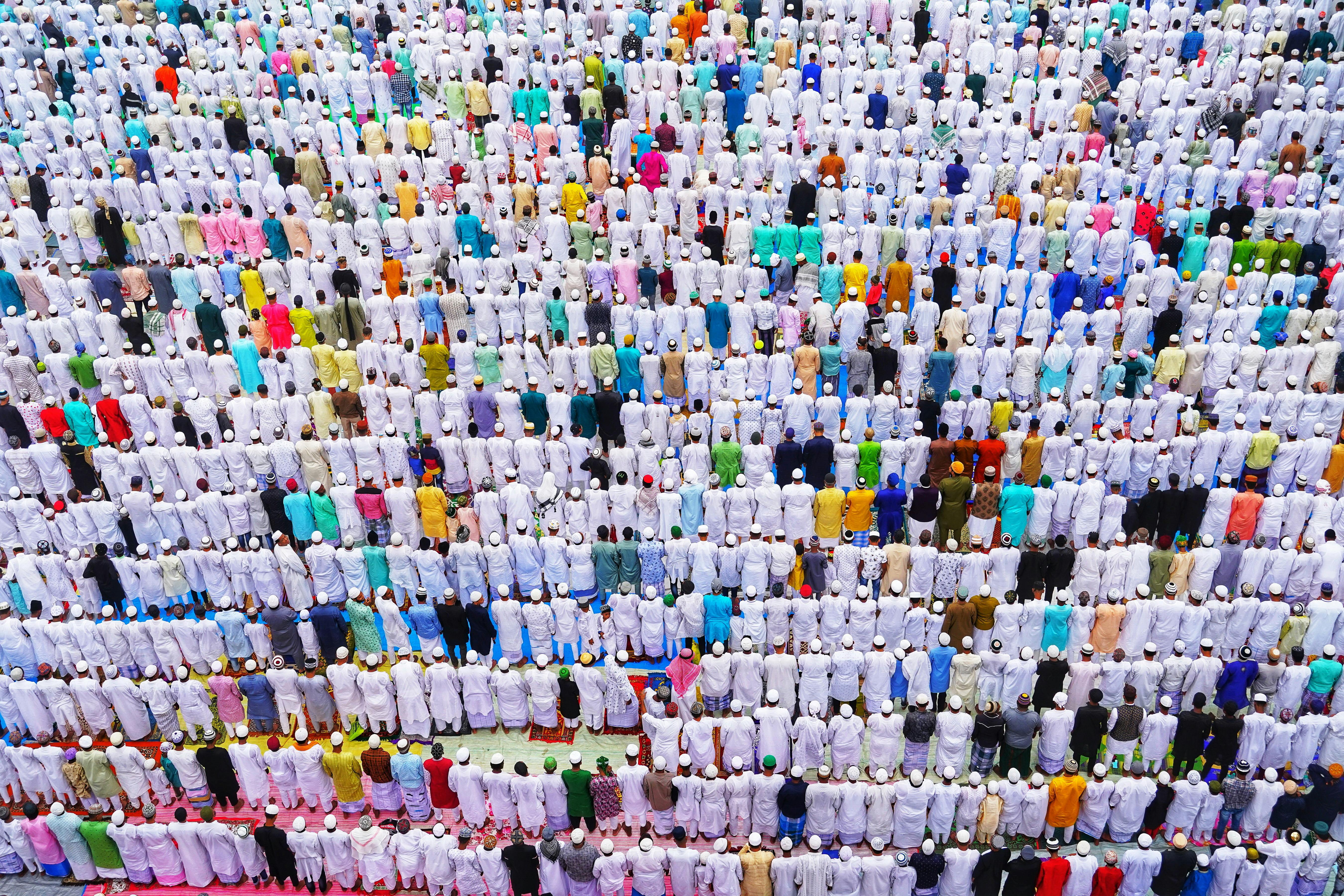
Then comes the centerpiece: the Qurbani — the ritual sacrifice of a sheep, goat, cow, or camel. The animal must be healthy, free of defects, and meet a minimum age. The slaughter is done with a single sharp cut while reciting Bismillah (“In the name of God”). The act is not about blood — it is about letting go. For every family that can afford it, the sacrifice says: I am willing to give up what I own, just as Ibrahim was willing to give up his son.
What happens to the meat is what makes Eid al-Adha unlike any other feast:
| Share | Recipient |
|---|---|
| One third | The family that offered the sacrifice |
| One third | Relatives, friends, and neighbors |
| One third | The poor and those in need |
In wealthy countries, charities ship frozen Qurbani meat to communities in need across borders — from refugee camps in Jordan to drought-affected regions in Somalia. The rule is simple: no one should go hungry on Eid.
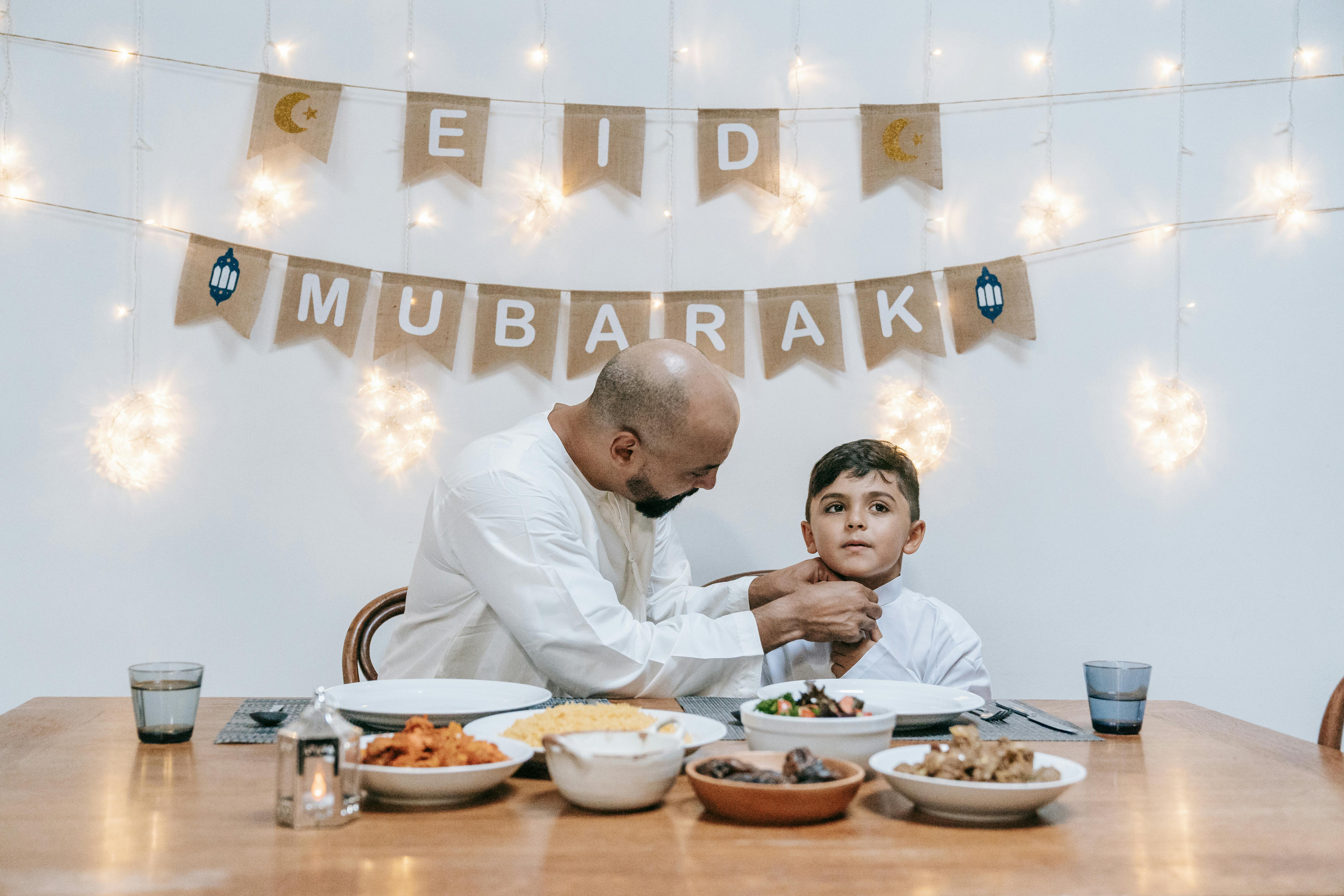
The rest of the day revolves around food. Along with Eid al-Fitr — which marks the end of Ramadan fasting — Eid al-Adha is one of the two holiest days in Islam. Where Eid al-Fitr is the “sweet Eid” (think dates, pastries, and celebratory breakfasts after a month of dawn-to-dusk fasting), Eid al-Adha is the “savory Eid” — built around the meat of the sacrifice. Grilled lamb skewers in Turkey. Biryani and korma in Pakistan. Mansaf — lamb cooked in fermented dried yogurt — in Jordan. Ma’amoul cookies stuffed with dates in Lebanon. Names differ, but the pattern is the same: cooking starts early, portions are generous, and unexpected guests are welcomed.
At the same time, over 1.7 million pilgrims in Mecca are completing the Hajj. They circle the Kaaba, walk between the hills of Safa and Marwa, and sacrifice an animal of their own in Mina — mirroring the same rituals that millions of families are performing at home.
Holiday Phrases
The universal greeting is “Eid Mubarak” (Arabic: عيد مبارك) — literally “Blessed Eid.” The standard reply is “Khair Mubarak” (“blessed goodness [to you too]”).
But every language has its own way of saying it:
| Language | Greeting | Pronunciation |
|---|---|---|
| Arabic | عيد مبارك (Eid Mubarak) | eed moo-BAH-ruck |
| Turkish | İyi Bayramlar | ee-YEE bye-RAHM-lar |
| Malay/Indonesian | Selamat Hari Raya Aidiladha | suh-LAH-maht ha-REE rah-YAH eye-dil-AHD-ha |
| Urdu | عید مبارک (Eid Mubarak) | eed moo-BAH-ruck |
| Persian | عید شما مبارک (Eid-e Shoma Mobarak) | eyd-e sho-MAH mo-bah-RAK |
| Hausa (West Africa) | Barka da Sallah | BAR-ka da SAL-lah |
| French | Bonne fête de l’Aïd | bon fet duh la-EED |
The name “Eid al-Adha” itself is worth unpacking: Eid means “festival” or “celebration,” and Adha means “sacrifice” — literally, “the Festival of the Sacrifice.” In Turkey it becomes Kurban Bayramı (Sacrifice Holiday), in Nigeria Eid-el-Kabir (the Great Eid), and in Senegal Tabaski — a Wolof word whose origins trace back to the sheep raised for the occasion. This kind of term — packed with cultural meaning that doesn’t fit into a single English equivalent — is exactly what makes untranslatable words so fascinating.
For readers curious about Arabic, the language behind “Eid Mubarak,” see our Arabic language guide. And if you’re dealing with holiday greetings across languages, our holiday translation guide has practical tips for getting them right.
Sources
- Indonesia Officially Announces Eid al-Adha 2026 — official announcement from Indonesia’s Ministry of Religious Affairs
- Moon Sighted: Eid-ul-Adha to be Celebrated on 27 May — Pakistan’s Central Ruet-e-Hilal Committee confirmation
- Dar al-Ifta Announces Eid al-Adha Will Be on May 27 — Egypt’s official religious authority
- Saudi Arabia Declares May 27 as Eid al-Adha — Saudi Supreme Court announcement
- Eid al-Adha: What Is the Feast of Sacrifice? — overview from Philippine News Agency
- Wikipedia: Eid al-Adha — history, rituals, and global observances
- Factsheet: Eid-ul-Adha — Religion Media Centre, UK
- Eid al-Adha Greetings in Different Languages — Alif Arabic
- How to Say Happy Eid in Different Languages — Embrace Relief