How to Translate a Safety Data Sheet Without Changing Critical Numbers
 Add to Chrome
TABLE OF CONTENTS
A safety data sheet is only useful if the next person who opens it can trust every number on the page. Translate the words and accidentally change a concentration, a CAS number, or a flash point, and the translated sheet is no longer the same document — it is a quieter kind of hazard.
A safety data sheet (SDS) — still sometimes called a material safety data sheet (MSDS) — is a regulated 16-section document. Under the UN Globally Harmonized System (GHS), and in the United States under OSHA’s Hazard Communication Standard, those sections have a fixed order and headings. The job is not to “make the file look translated.” It is to make the hazards understandable in another language without changing the data that tells a reader which chemical they have, how much is in the mixture, and what the measured properties are.
This guide is a translation workflow, not legal or regulatory advice. An SDS that will be issued for a given market still needs review by someone competent in that market’s rules.
The short version
- Freeze one source file — the latest version, with its revision date and version number recorded.
- Mark every do-not-touch string before anyone translates: identifiers, concentrations, limits, physical constants, codes, and pictograms.
- Know which job you are doing. Translating prose, looking up official hazard wording, and adapting a sheet for a new jurisdiction are three different tasks.
- Translate the file itself, not pasted text, so composition and property tables keep their rows.
- Drop in official target-language hazard and precautionary statements — do not paraphrase them.
- Check every number against the source, then have a qualified reviewer sign off before the sheet is issued.
Why a changed number is not a “small typo”
Some of the most important content on an SDS is not really language at all. It is a string that has to be copied character for character.
| What must stay the same | Where you usually find it | What goes wrong if it changes |
|---|---|---|
| CAS numbers and other unique identifiers | Section 3 (and often Section 1) | A mistyped CAS Registry Number can point to a different substance. OSHA lists the CAS number among the required identifiers in Section 3. |
| UN numbers (four-figure transport identifiers) and packing group | Section 14 | OSHA describes the UN number as the four-figure identification number of the substance, taken from the UN Recommendations on the Transport of Dangerous Goods. Changing a digit changes the shipment. |
| Concentrations and concentration ranges | Section 3 | A shifted decimal or a swapped row in a composition table changes what the mixture is. |
| Exposure limits (for example OSHA PELs or ACGIH TLVs, and any other limit the preparer lists) | Section 8 | A wrong limit, or a limit silently converted into another unit, is unsafe guidance. |
| Physical and chemical constants — flash point, boiling point, pH, density, vapor pressure, viscosity, and the rest of the Section 9 list | Section 9 | These are measured or reported values. Translation should not “improve” or convert them. |
| Acute toxicity figures such as LD50 | Section 11 | OSHA’s SDS brief gives LD50 as an example of the numerical measures of toxicity. The digits have to match the source. |
| Hazard and precautionary codes (H225, P210, and so on) | Section 2 (and the label) | The code is an identifier. The sentence next to it is official wording, not a free translation. |
| Revision date and version | Section 16 and the header | A date rewritten in an ambiguous format (03/04/2025) can be read as two different days. |
Two typographic traps show up constantly.
Decimal commas and decimal points. A European source may write a density as 0,79. An English-language sheet usually writes 0.79. The digits must stay the same. Only the separator convention of the target document should change, and only when you are sure which convention that document uses. Never “clean up” 0,79 into 79 or 0.079.
Units. Changing °C to °F, or mg/m³ to another unit, is not translation. It is a change to the data. Leave the source units in place unless a qualified author is deliberately adapting the sheet and recalculating correctly.
Dates. Prefer a month name or an unambiguous order such as 2025-04-03 or 3 April 2025, so a revision date cannot be read two ways.
Translation, official wording, and regulatory adaptation are not the same job
It helps to split the work into three buckets before anyone starts.
1. Translation of ordinary prose. First-aid advice, handling precautions written as sentences, storage recommendations, and similar free text can be translated — carefully, in context, and consistently.
2. Official wording that you look up, not invent. In the EU, Annex III of the CLP Regulation sets the legally prescribed text of hazard statements in each official language. H225 in English is “Highly flammable liquid and vapour.” In French it is “Liquide et vapeurs très inflammables.” A paraphrase that “means the same thing” is still the wrong sentence. In the United States, OSHA requires label information to follow the assigned wording in Appendix C of 29 CFR 1910.1200; keep the SDS statements consistent with that official wording rather than rewriting them. Signal words are similarly constrained (in English, Danger or Warning). Keep official GHS pictograms as official artwork — do not redraw them.
Section headings should also follow the official 16-section names in the target language, in the same order. Do not rename or reorder sections to “improve” the document.
3. Regulatory adaptation, which is not a translation task. An SDS that is merely translated may still be wrong for the destination market. OSHA requires the manufacturer or importer to ensure the SDS is in English, although the employer may also keep copies in other languages. REACH Article 31(5) requires the SDS to be supplied in an official language of the EU Member State(s) where the substance or mixture is placed on the market, unless that Member State provides otherwise. Exposure limits in Section 8, emergency telephone numbers in Section 1, and the legal references in Section 15 often have to reflect the destination jurisdiction — U.S. PELs are not automatically the right figures for an EU workplace. That work belongs with a competent SDS author, not with a translator silently swapping numbers.
OSHA also requires the 16-section headings, including Sections 12–15, so the sheet stays consistent with GHS, but it does not enforce the content of those four sections because they fall under other agencies. In other jurisdictions those sections may be fully in scope. Do not drop them because a U.S. source called them “non-mandatory.”
What to lock in each of the 16 sections
The headings below follow OSHA’s Hazard Communication Standard SDS brief, which uses the GHS 16-section order.
| Section | Heading | What to lock (and what may need authoring, not just translation) |
|---|---|---|
| 1 | Identification | Product identifier, supplier details. An emergency number valid in the source country may not be the right number for the destination. |
| 2 | Hazard(s) identification | Classification, signal word, pictograms, H/P codes. Replace statement text with official target-language wording; do not invent it. |
| 3 | Composition / information on ingredients | Chemical names can be translated or given official names; CAS numbers, other identifiers, and concentrations stay unchanged. |
| 4 | First-aid measures | Translate the instructions. Keep any stated timings, dilutions, or dose figures unchanged. |
| 5 | Fire-fighting measures | Translate the advice. Keep extinguishing-media names consistent; do not alter temperature or composition figures. |
| 6 | Accidental release measures | Translate the procedures. Keep quantities and concentration cut-offs unchanged. |
| 7 | Handling and storage | Translate the precautions. Keep stated temperatures, humidity limits, and incompatible-material lists consistent. |
| 8 | Exposure controls / personal protection | Copy exposure-limit values and units from the source unless a qualified author is adapting the sheet for the destination’s limits. Translate PPE descriptions carefully and consistently. |
| 9 | Physical and chemical properties | Lock every reported value and unit (flash point, boiling point, pH, density, vapor pressure, viscosity, and the rest of the list). |
| 10 | Stability and reactivity | Translate the conditions to avoid. Keep temperature limits and any numerical stability data unchanged. |
| 11 | Toxicological information | Lock LD50 and other numerical toxicity measures, species, and routes as stated. |
| 12 | Ecological information | Lock numerical toxicity, biodegradation, and partition-coefficient data where given. |
| 13 | Disposal considerations | Translate the guidance. Keep any waste-code numbers used in the source, and do not invent destination-specific codes unless an author is adapting the sheet. |
| 14 | Transport information | Lock the UN number, packing group, and hazard class. Official proper shipping names come from the applicable transport regulations (OSHA points to the UN Recommendations), not from a free translation. |
| 15 | Regulatory information | Inventory numbers and legal references often have to be adapted for the destination — that is authoring, not silent translation. |
| 16 | Other information | Keep the preparation or revision date unambiguous, and keep the version identifier aligned with the source. |
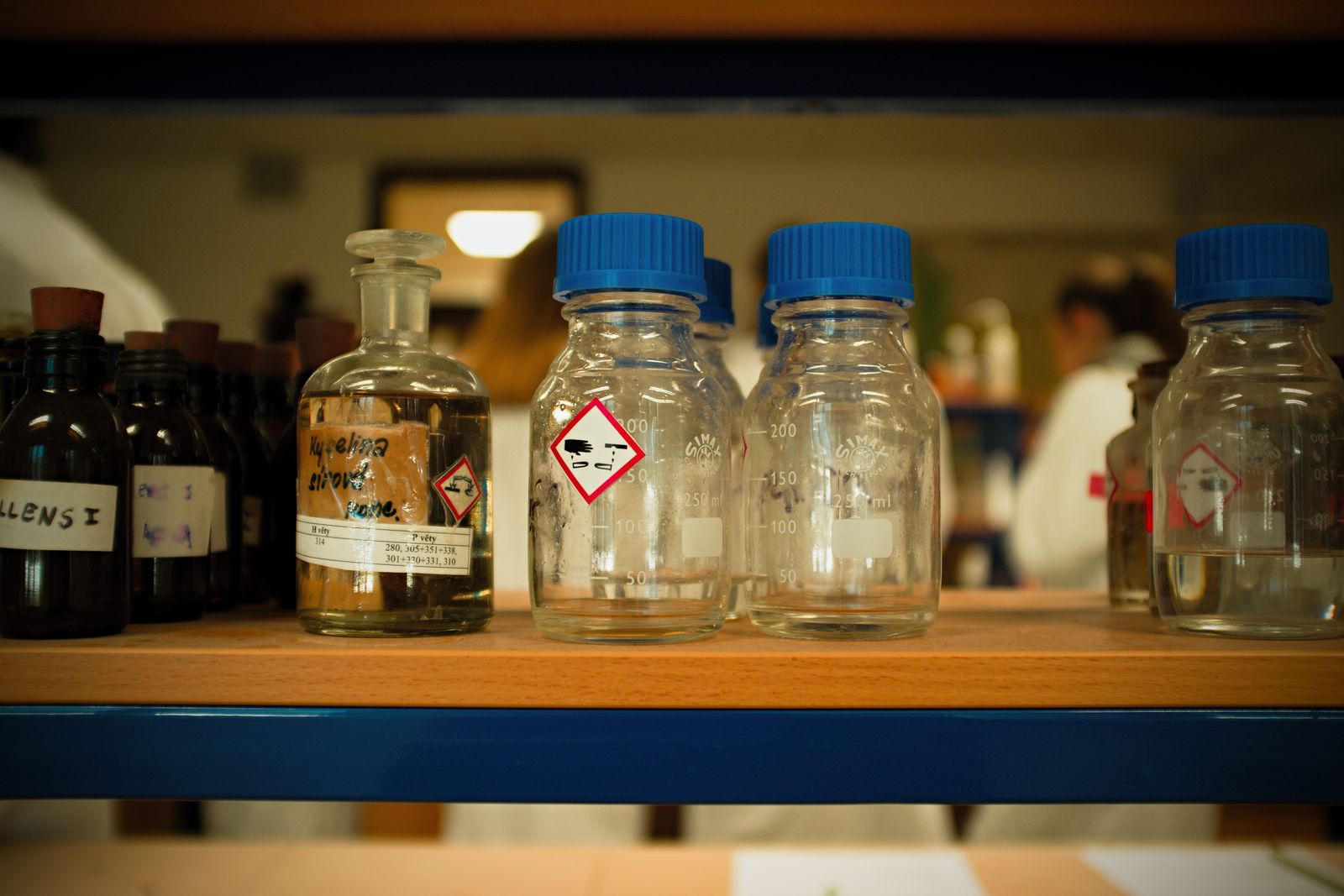
Pictograms, volume markings, and identifiers on the container have to agree with the SDS. If the label and the sheet diverge after translation, workers no longer have a single source of truth.
How to do it, in order
Step 1: Freeze the source
Start from the latest issued SDS, not from an older file that happens to be easier to edit. Record the product identifier, version, revision date, and source language. If your authoring software can export a Word file, use that. A PDF with selectable text is the next best starting point. If the only copy is a scan, OCR it first and check every number against the scan before anyone translates — an 8 read as a 3, or a comma read as a period, will sail through a later language review. A layout-preserving OCR workflow helps; the scanned-PDF guide covers that setup.
Step 2: Build a do-not-translate list
Before the first sentence is translated, extract or highlight:
- CAS, EC, UN, and any registration or inventory numbers
- Concentrations and ranges
- Every unit string
- Exposure limits and toxicity figures
- H, P, and (where used) EUH codes
- Pictograms
- The revision date and version
A simple two-column sheet (source string / “copy unchanged”) is enough. This is also the list you will use for the QA pass in Step 5.
Step 3: Translate the file, not copied text
Composition tables, exposure-limit tables, and Section 9 property tables are where rows slip. Paste-into-a-textbox workflows are a common way to lose a line or to let a number in one cell be treated as translatable text. Work in the original Word file or in the PDF itself, with a layout-preserving document translator or a translator who works inside the file. Our guides on translating a PDF without breaking tables and columns and what happens to tables during document translation walk through the structural risks.
OpenL Doc Translator’s PDF translator is built to retain tables, images, fonts, and page layout where supported, and it can return a bilingual version for review. It offers a free daily preview, so you can check the densest pages — typically Section 3 and Section 9 — before paying for the full file. Treat the output as a strong first draft for the review steps below, not as a finished, issuable SDS.

Section 9 is a list of reported properties, not a paragraph to be rewritten. The values and units on the page have to match the source, even when the surrounding labels change language.
Step 4: Replace hazard statements with official target-language text
For each H, P, and (where used) EUH code, look up the official sentence in the destination language — CLP Annex III in the EU, and wording consistent with OSHA Appendix C in the United States. Keep the codes themselves unchanged. Then check that the signal word is the official one for the target language. If you are translating into English, the official French Attention or German Achtung becomes Warning — not a borrowed Attention.
Step 5: Run a number-for-number check
Do this against the frozen source, not from memory:
- All 16 section headings are present, in order, with official names
- Every CAS, EC, UN, and registration number matches character for character
- Every concentration and range matches, and no table row has shifted
- Every unit string is intact, and any decimal-separator change was deliberate
- Section 8 limits are unchanged, or a qualified author has adapted them and recorded the jurisdiction
- Every Section 9 property and Section 11 toxicity figure matches
- H/P/EUH codes are unchanged, and the statements are official wording
- Signal word and pictograms are intact
- Cross-references between sections still point to the right place (for example Section 13 referring the reader to Section 8)
- The revision date is unambiguous
- The emergency number is still appropriate, or it has been flagged for authoring

A bilingual, side-by-side review is the fastest way to catch a number that moved or a statement that was paraphrased. Our bilingual document review checklist is a useful companion for that pass.
Step 6: Qualified review before you issue it
Treat the translated file as a draft until a bilingual reviewer and, where required, a competent SDS author or regulatory specialist have signed off. Machine translation and layout-preserving tools can take a lot of mechanical work off the table. They do not take responsibility for a safety-critical document.
FAQ
Can I use machine translation for an SDS?
For a first draft of the prose, yes — especially if the tool keeps the file structure and you have frozen the numbers first. For a sheet that will be issued or handed to workers, not without a qualified review. Official hazard statements should be looked up, not generated.
Do I have to provide an SDS in more than one language?
It depends on the market. In the United States, the manufacturer or importer must ensure the SDS is in English; employers may also maintain copies in other languages. In the EU, REACH Article 31(5) requires an official language of the Member State(s) where the substance or mixture is placed on the market, unless that Member State provides otherwise. Check the rule that applies to you.
Should I convert units for the destination country?
Not as part of translation. Unit conversion is a data change and, if it is needed at all, belongs with a qualified author who will recalculate and record it.
What if the only SDS I have is a scanned PDF?
OCR it first, then check every number by eye against the scan before translating. Numbers are the part worth a slow pass. See how to translate a scanned PDF with OCR and keep the layout.
Sources
- 29 CFR 1910.1200(g)(2) — OSHA Hazard Communication Standard — The SDS must be in English (employers may also keep other languages); required section numbers and headings, in order
- Hazard Communication Standard: Safety Data Sheets (OSHA 3514) — 16-section format, required identifiers including CAS numbers, exposure limits, physical properties, LD50, UN numbers, and the note that OSHA does not enforce the content of Sections 12–15
- 29 CFR 1910.1200 Appendix C — Assigned label elements and official hazard-statement wording under the Hazard Communication Standard
- REACH Regulation (EC) No 1907/2006, Article 31(5) — EU wording: the SDS shall be supplied in an official language of the Member State(s) where the substance or mixture is placed on the market, unless the Member State(s) concerned provide otherwise (point-in-time official text)
- CLP Regulation (EC) No 1272/2008, Annex III — Official hazard-statement wording in the official languages, including H225
- PDF Translator — OpenL Doc Translator — Layout retention where supported, bilingual review version, and free daily preview
- Chemical Chemistry Education Liquid icon — pancaokta, CC BY, via SVG Repo — Cover icon