Best AI Writing Assistants in 2026
TABLE OF CONTENTS
AI writing assistants have moved from novelty to necessity—but with dozens of tools competing for your attention, choosing the wrong one can cost you time, money, and quality. This guide cuts through the noise with honest assessments of the tools that actually matter in 2026.
The AI writing tool landscape has changed dramatically. Two years ago, a dozen venture-backed startups fought over the “AI writing assistant” category. Today, that category has largely been absorbed by general-purpose AI models (ChatGPT, Claude, Gemini), while the surviving dedicated tools have had to carve out specific niches to stay relevant.
That’s actually good news for users. The consolidation means better tools at lower prices—and the niche survivors tend to be genuinely excellent at their specific jobs.
This guide covers three types of tools: general-purpose AI assistants that happen to write extremely well, specialized writing platforms built for teams and enterprises, and refinement tools that polish and improve drafts you already have.
How We Evaluated These Tools
Every tool in this guide was assessed against the same criteria:
- Writing quality — Does the output require heavy editing, or is it close to publish-ready?
- Context handling — Can it maintain tone, style, and factual consistency across long documents?
- Specialization — Does it do anything that a general LLM can’t do on its own?
- Pricing fairness — Is the value proportional to the cost?
- Multilingual capability — Can it write naturally in languages other than English?
Tools that were once prominent but have since pivoted away from writing—such as Copy.ai (now a sales GTM platform) and Notion AI (a workspace feature, not a standalone product)—are not included.
Quick Picks
| Tool | Best For | Starting Price |
|---|---|---|
| ChatGPT | All-purpose writing, brainstorming | Free / $20/mo |
| Claude | Long-form, nuanced, structured content | Free / $20/mo |
| Gemini | Google Workspace users, research | Free / $19.99/mo |
| Jasper | Enterprise marketing teams | $69/mo |
| Writer | Brand compliance, regulated industries | $39/user/mo |
| Grammarly | Editing and refining existing drafts | Free / $12/mo |
| QuillBot | Paraphrasing, academic rewriting | Free / $4.17/mo |
| Sudowrite | Fiction and creative writing | $19/mo |
| Writesonic | SEO content and GEO optimization | $79/mo |
The Best AI Writing Assistants in 2026
1. ChatGPT — Best All-Purpose Writing Assistant
ChatGPT remains the default choice for most writers in 2026, and for good reason. The combination of GPT-4o’s broad capability, voice input, image understanding, and an enormous plugin ecosystem means it handles virtually any writing task you throw at it.
What it does well:
- Generates coherent, well-structured drafts on almost any topic
- Adapts tone quickly—casual, formal, technical, conversational
- Handles follow-up revisions without losing context
- Supports over 90 languages with strong quality in major ones
- Memory feature lets it learn your writing preferences over time
What it struggles with:
- Outputs can feel generic without detailed prompting
- Factual accuracy still requires verification—it confidently hallucinates
- Free tier throttles access to more powerful models during peak hours
Pricing:
- Free: GPT-4o with usage limits
- Plus: $20/month — higher limits, DALL·E image generation, advanced data analysis
- Pro: $200/month — unlimited access, o1 pro mode, extended thinking
Best for: Writers who want a single tool for brainstorming, drafting, editing, and research. The free tier is genuinely useful for light use.

2. Claude — Best for Long-Form and Nuanced Writing
Claude, built by Anthropic, has established a strong reputation among professional writers for one specific reason: it writes with more nuance and less generic filler than most LLMs. It excels at tasks that require holding a lot of context—long articles, book chapters, detailed reports, complex email chains.
What it does well:
- 200,000-token context window (API tier; claude.ai Pro offers extended context with Projects) handles book-length documents
- Maintains consistent voice and argument across very long outputs
- Less prone to hedging filler phrases (“Certainly! Great question!”)
- Better at following complex, multi-part instructions
- Strong at structured writing: research papers, technical docs, legal summaries
What it struggles with:
- Smaller plugin/integration ecosystem compared to ChatGPT
- Image generation not natively built in
- Some creative tasks feel overly cautious
Pricing:
- Free: Claude Sonnet with usage limits
- Pro: $20/month — priority access, longer context, Projects feature
- Team: $30/user/month — collaboration features, higher limits
Best for: Professionals writing long-form content—journalists, researchers, consultants, authors. If your work involves documents longer than a few pages, Claude’s context handling makes a real difference.
3. Gemini — Best for Google Workspace Users
Google’s Gemini has matured considerably since its launch. For anyone already embedded in the Google ecosystem—Docs, Gmail, Drive, Slides—Gemini offers the most seamless integration of any AI writing tool. The Flash 2.0 update in 2025 significantly improved response speed without sacrificing quality.
What it does well:
- Deep integration with Google Docs, Gmail, Drive, and Slides
- Multimodal input: can analyze images, PDFs, and audio in writing workflows
- NotebookLM integration for research-grounded writing
- Strong performance on code documentation and technical content
- Real-time web grounding reduces hallucination for current events
What it struggles with:
- Output quality is slightly behind ChatGPT and Claude on pure creative writing
- Privacy concerns remain for users outside Google’s enterprise offerings
- Google AI Pro pricing is tied to storage bundles, which feels awkward
Pricing:
- Free: Gemini 2.0 Flash with basic limits
- Google AI Pro: ~$20/month (varies by region) — Gemini 2.5 Pro access, 5TB storage, NotebookLM Plus
Best for: Teams already using Google Workspace who want AI writing assistance without switching tools. The in-Docs experience is the best of any native integration available.
4. Jasper — Best for Enterprise Marketing Teams
Jasper has made a significant pivot. After facing intense pressure from general-purpose LLMs commoditizing its core product, it relaunched in 2025 as “the first multi-agent platform built for marketers.” This is not just marketing language—the product genuinely delivers capabilities that ChatGPT doesn’t offer out of the box.
What it does well:
- Brand Voice feature locks outputs to your company’s specific tone and style
- Knowledge Base ingests your products, positioning docs, and style guides
- Multi-agent workflows can research, draft, optimize, and schedule content in sequence
- Integrations with Salesforce Marketing Cloud, HubSpot, and Braze
- Campaign management tools for multi-channel content at scale
- Forrester-verified enterprise ROI data (342% ROI cited in their 2025 study)
What it struggles with:
- Expensive relative to general AI tools for individual users
- Setup requires significant onboarding investment
- Enterprise features are overkill for solo creators or small teams
Pricing:
- Creator: $49/month (1 user)
- Pro: $69/month (up to 5 users)
- Business: Custom pricing — full agent platform, Salesforce/Braze integrations

Best for: Marketing teams at mid-size to large companies that need consistent brand-aligned content at scale. Not worth the price for individuals or small teams.
5. Writer — Best for Regulated Industries and Brand Compliance
Writer is the least well-known tool in this guide, but it’s arguably the most sophisticated for enterprise use cases. It runs on its own proprietary LLM (Palmyra), with specialized variants trained for medical and financial domains—something no other writing tool offers. A hospital network drafting patient discharge summaries, or a financial firm producing regulatory disclosures, can fine-tune Palmyra on their own terminology without exposing that data to OpenAI or Anthropic’s servers.
What it does well:
- Palmyra LLM can be fine-tuned on company-specific data without sending that data to a third-party model
- Style Guide enforcement catches off-brand language in real time as writers type
- Compliance checks flag regulated content (HIPAA, financial disclaimers) automatically
- AI agent builder (no-code) lets teams automate repetitive writing workflows
- Knowledge Graph connects proprietary company data to writing outputs
What it struggles with:
- Requires substantial setup—not a tool you open and immediately use productively
- Pricing is steep for small teams
- Creative writing quality trails the general-purpose LLMs
Pricing:
- Team: $39/user/month (up to 20 users)
- Enterprise: Custom
Best for: Healthcare, legal, financial services, and any enterprise where compliance, brand consistency, and data privacy are non-negotiable requirements.

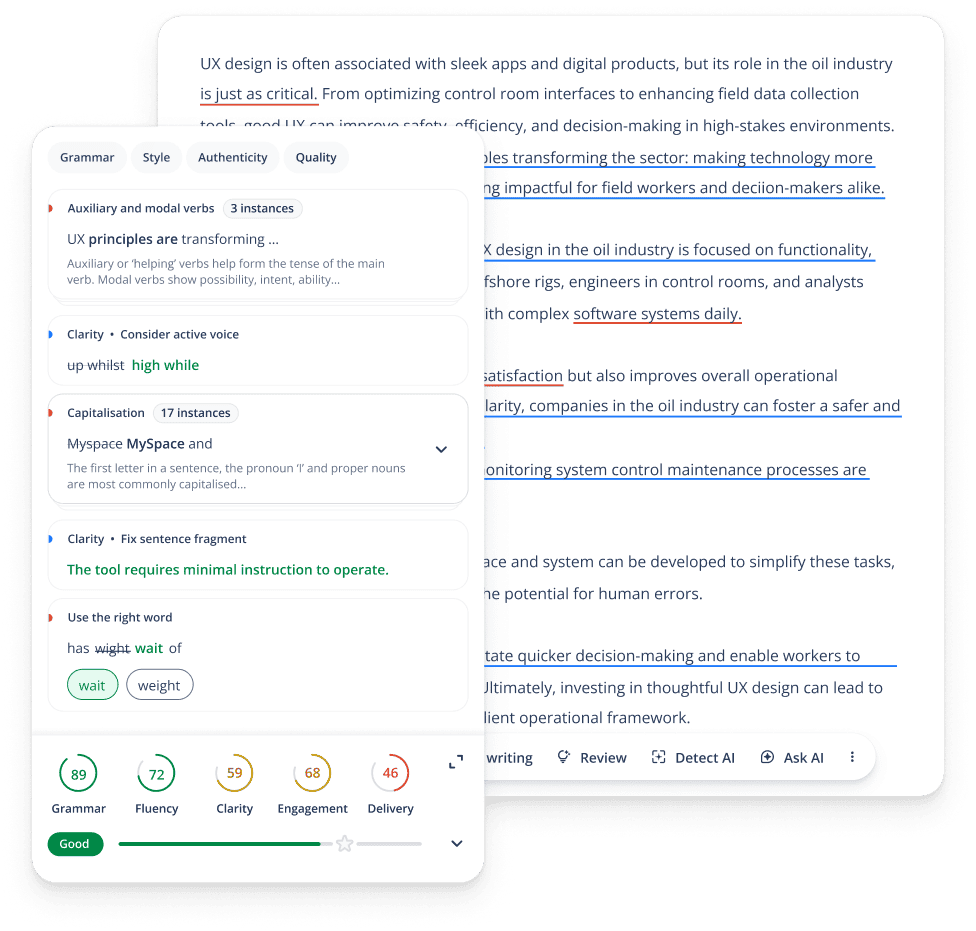
6. Grammarly — Best for Editing and Polishing Drafts
Grammarly has always been strongest at the editing layer, and that hasn’t changed. The 2025 rebrand (replacing “Premium” with “Pro”) came with expanded AI generation features under Grammarly GO, but editing and refinement remains where it genuinely beats the competition.
The key differentiator: Grammarly works inside your existing tools. It integrates with Microsoft Word, Google Docs, Gmail, Slack, LinkedIn, and hundreds of other platforms as a browser extension. You don’t have to change your writing environment.
What it does well:
- Real-time grammar, spelling, punctuation, and style feedback as you type
- Tone detection warns when phrasing might land poorly
- Paragraph-level clarity suggestions for dense or confusing writing
- Authorship feature helps distinguish AI-generated from human-written content
- 2,000 AI prompts/month on Pro tier for generation within documents
- Works across almost every writing surface via browser extension
What it struggles with:
- AI generation quality is behind pure LLMs—best used for editing, not drafting
- Can be overly prescriptive about grammar rules that are legitimately stylistic choices
- Free tier has become quite limited
Pricing:
- Free: Basic grammar and spelling
- Pro: $12/month — full corrections, tone analysis, 2,000 AI prompts, plagiarism detection
- Enterprise: Custom — unlimited AI prompts, admin controls
Best for: Anyone who wants better writing across all their tools without switching workflows. Grammarly Pro at $12/month is one of the best value propositions in this category.
7. QuillBot — Best for Paraphrasing and Academic Rewriting
QuillBot occupies a specific and useful niche: making existing text clearer, more formal, or structurally different without changing the meaning. Academic writers, ESL writers, and content teams repurposing existing material use it heavily.
The 2025 addition of QuillBot Flow introduced a more conversational AI assistant alongside the core paraphrasing tools, but the paraphraser remains its standout feature.
What it does well:
- Seven paraphrase modes (Standard, Fluency, Formal, Academic, Creative, Simple, and Custom)
- Grammar checker is strong on academic and formal writing conventions
- Citation generator supports APA, MLA, and Chicago formats
- Summarizer works well on long academic papers and articles
- Very affordable pricing makes it accessible for students
What it struggles with:
- Not a drafting tool—it refines existing text, not creates from scratch
- Creative writing output is weak compared to purpose-built tools
- FTC settlement in 2024 related to a review generation service (unrelated to the core product)
Pricing:
- Free: Limited paraphrasing, basic grammar
- Premium: ~$4.17/month (annual) — unlimited paraphrasing, all modes, advanced grammar
Best for: Students, academics, ESL writers, and content teams who need to rephrase, simplify, or formalize existing drafts. At $4.17/month, it’s the best value tool in this guide.
8. Sudowrite — Best for Fiction Writers
Sudowrite is the only tool in this guide built exclusively for fiction. It uses a proprietary model called Muse (trained specifically on narrative fiction) alongside commercial LLMs, and the difference is noticeable—it understands story structure, pacing, and character voice in ways that ChatGPT doesn’t. In practice: ask ChatGPT to continue a tense scene and it may resolve the conflict too quickly; ask Sudowrite and it tends to maintain suspense, vary sentence rhythm, and match the voice you’ve already established.
What it does well:
- Story Bible feature maintains consistent characters, settings, and timeline across a novel
- “Describe” function generates multi-sensory scene descriptions
- “Brainstorm” offers story direction suggestions when you’re stuck
- Visual canvas for mapping narrative structure
- 1,000+ community plugins for genre-specific writing styles
- Strong onboarding that actually teaches effective use
What it struggles with:
- Long-form plot coherence is still an LLM limitation—it can lose threads across chapters
- Controversial in writing communities: some authors feel it enables plagiarism-adjacent workflows
- Not useful for non-fiction, business writing, or marketing content
Pricing:
- Hobby & Student: $19/month — 225,000 AI credits
- Freelancer: $29/month — 1,000,000 credits
- Professional: $59/month — unlimited credits
Best for: Novelists, screenwriters, and short story writers who want an AI collaborator that understands narrative. Not for anyone outside the fiction writing space.
9. Writesonic — Best for SEO and GEO Content
Writesonic has undergone the most dramatic transformation of any tool in this guide. In 2025–2026, it pivoted from AI writing assistant to a full Generative Engine Optimization (GEO) platform—meaning it now focuses on making your content visible not just in Google search, but inside ChatGPT, Gemini, Perplexity, and other AI search systems.
If you’re producing content primarily to rank and drive traffic, this specialization is genuinely valuable.
What it does well:
- Tracks how your content surfaces across ChatGPT, Gemini, Google AI Overviews, and more
- 10-step AI Article Writer integrates competitor research and SEO briefs
- GEO sentiment analysis—understanding how AI systems describe your brand
- Built-in Ahrefs and Google Analytics integrations
- Site audit, topic clustering, and internal linking automation
- Botsonic for building AI chatbots trained on your content
What it struggles with:
- Pricing has increased significantly with the GEO pivot—entry point is now $79/month
- GEO tracking features require higher-tier plans
- Overkill for writers who don’t need SEO/traffic optimization
Pricing (annual billing):
- Starter: $79/month — ChatGPT tracking, 15 AI articles/month
- Basic: $199/month — adds Gemini and Google AI Overview tracking
- Growth: $399/month — full GEO suite, 50 articles/month
- Enterprise: Custom
Best for: Content marketing teams and SEO professionals who need to optimize for the AI search era. Individual bloggers will find the price hard to justify.
Full Comparison Table
Multilingual rating reflects the tool’s ability to generate natural-sounding output in non-English languages. Long-form rating reflects context retention and quality over documents longer than 2,000 words.
| Tool | Best Use Case | Free Tier | Paid Entry | Multilingual | Long-Form |
|---|---|---|---|---|---|
| ChatGPT | General writing | ✅ | $20/mo | ✅ Excellent | ✅ Good |
| Claude | Long-form / nuanced | ✅ | $20/mo | ✅ Good | ✅ Excellent |
| Gemini | Google Workspace | ✅ | ~$20/mo | ✅ Good | ✅ Good |
| Jasper | Enterprise marketing | ❌ | $49/mo | ✅ Good | ✅ Good |
| Writer | Compliance / enterprise | ❌ | $39/user/mo | ✅ Good | ✅ Good |
| Grammarly | Editing / polishing | ✅ | $12/mo | ⚠️ Edit-only | ⚠️ Edit-only |
| QuillBot | Paraphrasing / academic | ✅ | $4.17/mo | ✅ Good | ⚠️ Rewrite-only |
| Sudowrite | Fiction writing | ❌ | $19/mo | ⚠️ English-focused | ✅ Excellent |
| Writesonic | SEO / GEO content | ⚠️ Trial | $79/mo | ✅ Good | ✅ Good |
Which AI Writing Assistant Should You Choose?
If you write occasionally and don’t want to pay anything: Start with the free tier of ChatGPT or Claude. Both are genuinely capable without a subscription for light use.
If you write long-form content professionally: Claude Pro at $20/month is the best investment. The context window and output quality justify the cost within the first few pieces you write.
If you’re in a Google Workspace environment: Gemini AI Pro adds AI writing directly inside your existing tools without switching apps.
If you run a marketing team at a mid-size company: Jasper’s brand voice and workflow automation features pay for themselves if you’re producing high volumes of content that needs to stay on-brand.
If you’re in healthcare, legal, or finance: Writer is the only tool with built-in compliance checking and domain-specific LLM variants.
If you want better writing without changing your tools: Grammarly Pro at $12/month installs everywhere and gives you real-time feedback on every surface you use.
If you’re a student or academic: QuillBot at $4.17/month is the best value tool for paraphrasing, summarizing, and citation formatting.
If you write fiction: Sudowrite is the only purpose-built tool—nothing else in this list understands narrative the way it does.
If content drives traffic and revenue: Writesonic’s GEO platform is ahead of the curve on AI search optimization, but budget accordingly.
AI Writing and Translation: A Natural Combination
One workflow that’s become increasingly common: using an AI writing assistant to create English content, then distributing it globally in multiple languages. A blog post, product page, or email campaign written with Claude or ChatGPT can reach 10x the audience when properly translated.
This is where OpenL fits into the workflow. OpenL’s document translation handles the full cycle—PDFs, DOCX files, PowerPoints, and web content—preserving formatting while delivering accurate translations across 100+ languages. For teams already using AI to produce content faster, automated translation removes the last bottleneck in global distribution.
The combination of AI writing assistance and AI translation means a two-person team can now produce and distribute multilingual content at a scale that would have required a full localization department five years ago.
For a deeper look at translation workflows, see our guide on how to translate a Word document or learn more about AI translation tools compared head-to-head.
Conclusion
The AI writing assistant market in 2026 has matured into something genuinely useful. General-purpose models (ChatGPT, Claude, Gemini) have become capable enough that they replace most dedicated writing tools for everyday use. The specialized tools that survive—Jasper, Writer, Sudowrite, Writesonic—do so by solving problems that general LLMs don’t address well: brand governance, compliance, narrative structure, and AI search optimization.
The practical advice: start with what’s free. Claude and ChatGPT’s free tiers are powerful enough to handle most writing tasks. If you hit a specific wall—brand consistency, compliance requirements, fiction structure, SEO integration—there’s a specialized tool built for that exact problem.
The era of paying $50/month for a wrapper around GPT that just does copywriting is over. What’s left is better.
Ready to take your content global? Try OpenL to translate your AI-written content into 100+ languages—without losing formatting or tone.