Czech: Central Europe’s Bridge Language
TABLE OF CONTENTS
Czech is the language of Prague, and the word “robot”. It is also a living bridge: speak it, and you can follow most Slovak and catch a good share of Polish.
Czech at a Glance
| Native name | čeština (český jazyk) |
| Family | Indo-European → Slavic → West Slavic → Czech–Slovak |
| Speakers | About 9.8 million native (2021) and roughly 12 million in total |
| Official in | Czech Republic; one of the 24 official languages of the EU |
| Script | Latin alphabet with diacritics (háček ˇ, acute ´, ring ˚) |
| Regulated by | Institute of the Czech Language, Czech Academy of Sciences |
| ISO code | cs / ces |
Classification: Where Czech Sits Among the Slavic Languages
Czech is a West Slavic language. Its closest relative is Slovak, followed by Polish and Silesian; the other members of the branch are Kashubian and the two Sorbian languages of eastern Germany. Linguists group Czech and Slovak together as a single “Czech–Slovak” subgroup.
That position is why “bridge language” fits. Czech and Slovak speakers understand each other more easily than any other pair of West Slavic languages, according to a 2015 intelligibility study by Golubović and Gooskens. The EU’s 2012 Eurobarometer survey also found Czech was the foreign language most often used in Slovakia.
Where Czech Is Spoken
About 10 million people speak Czech in the Czech Republic, where 98% of citizens reported it as their first language in the 2012 Eurobarometer, one of the highest shares in the EU. Czech is a recognized minority language in Slovakia, Poland, Austria, Croatia, Romania, Bosnia and Herzegovina, and Ukraine.
There is also a historic diaspora in the United States. Czechs emigrated mainly between 1848 and 1914, settling heavily in Texas, Nebraska, and Wisconsin. In the 2000 US census, Czech was still the most common home language after English in a few Nebraska and Kansas counties.
A Short History: Hus, the Bible, and a Revival
Czech first appears in writing as glosses in Latin and German texts of the 12th century. Two moments shaped the modern language:
- Jan Hus (early 1400s) helped standardize Czech spelling and pushed for written Czech to follow the spoken language. Czech orthography later influenced the spelling of other Balto-Slavic languages.
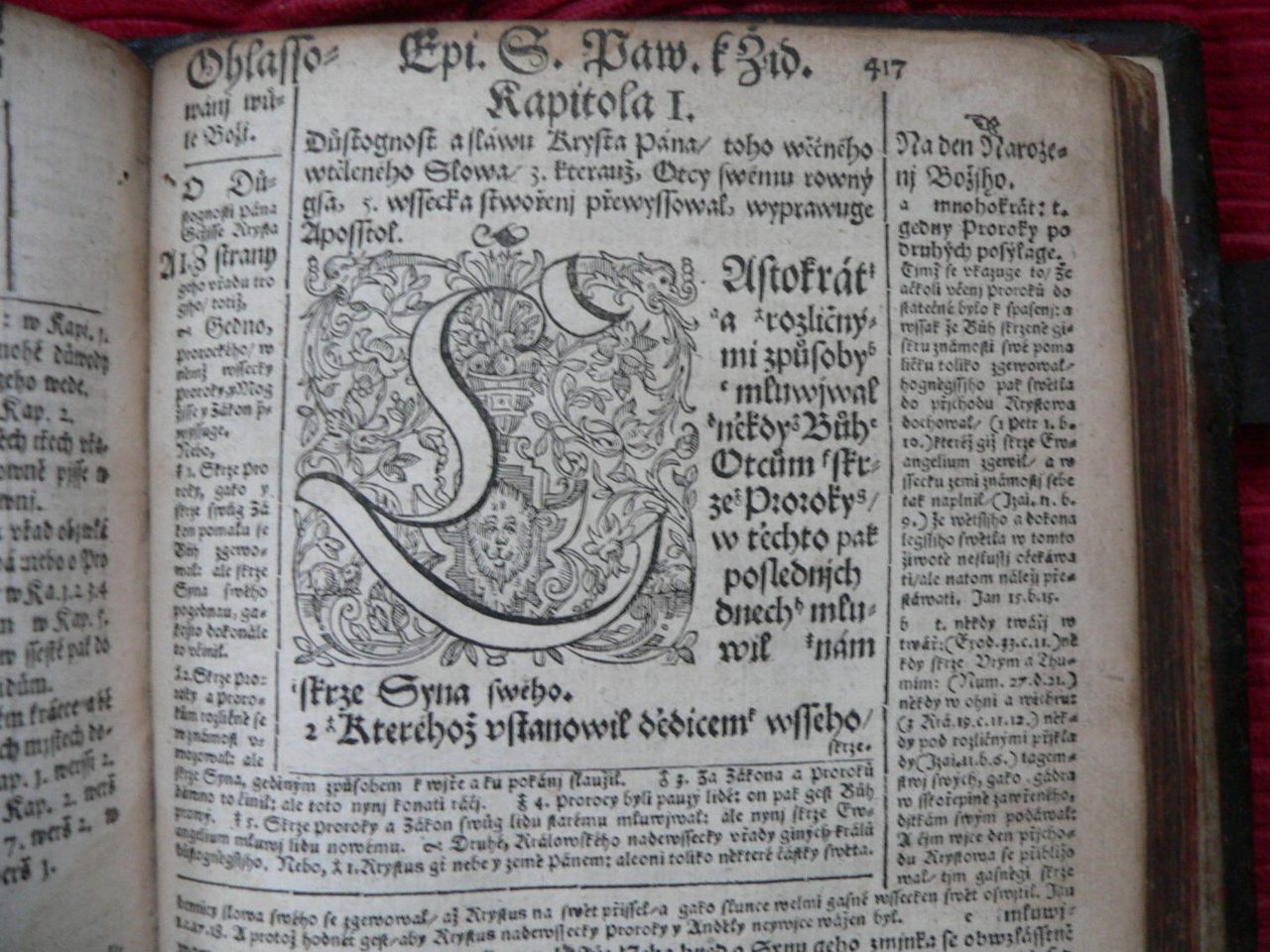
- The Bible of Kralice (1579–1593), the first complete Czech Bible translated from the original languages, became the model for “good” written Czech.
After the Habsburgs defeated the Bohemian Revolt in 1620, German became dominant among the upper classes. Czech nearly lost its place as a language of culture. In the late 18th and 19th centuries, the Czech National Revival brought it back. The irony: the key grammar of that revival, by Josef Dobrovský (1809), was written in German, and Dobrovský himself doubted Czech could return as a major language. Josef Jungmann and others used his book to prove him wrong.
Pronunciation: The ř and Words Without Vowels
Czech spelling is very regular. With one exception (the digraph ch), one letter means one sound, so once you learn the alphabet you can read almost any word aloud.
The hard part is a few sounds English doesn’t have.
Ř: the letter famous for being hard
Ř is a raised alveolar trill: a rolled r and a “zh” sound (as in measure) made at the same time. It is often called unique to Czech. In fact it also occurs in some Kashubian dialects and once existed in Polish, but it is very rare among the world’s languages. You hear it in the name of composer Antonín Dvořák and in řeka (“river”).
Sentences with no vowels
In Czech, r and l can act as vowels. The best-known tongue twister has no vowels at all:
Strč prst skrz krk — “Stick your finger through your throat.”
Rules that help
| Feature | What it means for you |
|---|---|
| Stress always on the first syllable | No stress patterns to memorize |
| Vowel length is marked (á, é, í, ó, ú/ů) | Long vs. short changes meaning, but the spelling tells you |
| Unstressed vowels aren’t reduced | Every vowel is pronounced clearly, unlike English “uh” |
| Háček softens letters | č = “ch”, š = “sh”, ž = “zh”, ň = “ny” |
Grammar: Seven Cases and Flexible Word Order
Grammar is where Czech earns its reputation. Nouns, adjectives, pronouns, and numbers all change their endings by case, gender, and number.
The 7 Czech cases
Czech schoolchildren learn the cases by number, so you’ll hear “the fourth case” for the accusative.
| No. | Case | Main use |
|---|---|---|
| 1 | Nominative | Subject |
| 2 | Genitive | Possession, “of”, many prepositions |
| 3 | Dative | Indirect object, “to” |
| 4 | Accusative | Direct object |
| 5 | Vocative | Addressing someone |
| 6 | Locative | After prepositions of place or topic |
| 7 | Instrumental | “With”, “by means of” |
Here is one word, kočka (“cat”), with an adjective in several cases:
| Case | Czech | English |
|---|---|---|
| Nominative | malá kočka | small cat |
| Genitive | bez malé kočky | without the small cat |
| Accusative | vidím malou kočku | I see the small cat |
| Vocative | malá kočko! | small cat! |
| Instrumental | s malou kočkou | with the small cat |
Why word order is flexible
Because endings show who does what, Czech can move words around for emphasis. Petr zabil Pavla means “Peter killed Paul”. Pavla zabil Petr means the same thing, with the focus on Peter as the killer. The ending -a on Pavla marks him as the object either way.
Other things to know
- Four genders, really. Masculine, feminine, and neuter, with masculine split into animate and inanimate.
- Verb aspect. Most verbs come in pairs: imperfective for ongoing actions (psát, to be writing) and perfective for finished ones (napsat, to write down).
- Numbers change grammar. “Two crowns” uses the nominative plural (dvě koruny), but “five crowns” switches to the genitive plural (pět korun).
- Past tense shows gender. Dělal means “he did” and dělala means “she did”.
Czech vs Slovak (and Polish)
| Czech | Slovak | Polish | |
|---|---|---|---|
| Group | West Slavic, Czech–Slovak | West Slavic, Czech–Slovak | West Slavic, Lechitic |
| Stress | First syllable | First syllable | Second-to-last syllable |
| Cases | 7 | 6 (no separate vocative) | 7 |
| Special letters | ř, ě, ů | ä, ľ, ŕ, ĺ, ô | ą, ę, ł, ż, ś |
| Understanding a Czech speaker | — | High | Partial |
Czech and Slovak were never cleanly separated before the 15th century. Separate written standards developed later. During the First Czechoslovak Republic (1918–1938), “Czechoslovak” was the official language on paper, but both written standards were used in practice.
After Czechoslovakia split in 1993, younger people heard less of the other language and understanding dropped somewhat. The 2015 study still found a high level of mutual intelligibility among young adults. Slovak tends to be more regular. In the locative, for example, Praha becomes v Praze in Czech but v Prahe in Slovak.
Common Czech Phrases
| English | Czech | Rough pronunciation |
|---|---|---|
| Hello (formal) | Dobrý den | DOH-bree dehn |
| Hi / Bye (informal) | Ahoj | AH-hoy |
| Please / You’re welcome | Prosím | PROH-seem |
| Thank you | Děkuji | DYEH-koo-yih |
| Yes / No | Ano / Ne | AH-noh / neh |
| Excuse me | Promiňte | PROH-mihn-yteh |
| Goodbye | Na shledanou | NAHS-khleh-dah-noh |
| Do you speak English? | Mluvíte anglicky? | MLOO-vee-teh AHN-glihts-kih? |
| I don’t understand | Nerozumím | NEH-roh-zoo-meem |
| Cheers! | Na zdraví! | nah ZDRAH-vee |
One fun fact you can tell your friends: English took robot from Czech. Karel Čapek’s 1920 play R.U.R. popularized it, from robota (“forced labor”). We covered that story in Robot: The Czech Theater Word That Named Machines.
Is Czech Hard to Learn?
For English speakers, Czech is hard, but not among the hardest. The US Foreign Service Institute puts Czech in its Category III. That means about 44 weeks (1,012 class hours) to reach professional working proficiency. Polish, Russian, Slovak, and Hungarian are in the same group. German takes about 36 weeks, and Japanese or Mandarin take 88.
| Easier than it looks | Harder than it looks |
|---|---|
| Spelling matches pronunciation | Seven cases with many noun patterns |
| Fixed first-syllable stress | Ř and long consonant clusters |
| Latin alphabet | Verb aspect pairs |
| Many international loanwords | Spoken “Common Czech” differs from textbook Czech |
That last point surprises many learners. Around Prague and across most of Bohemia, people speak Common Czech (obecná čeština), which simplifies some endings. You might hear malý město where a textbook says malé město (“small town”). Expect to learn the standard first, then tune your ear to the street.
Tips for Learning Czech
- Learn nouns with their gender and genitive form. Hrad, hradu (castle) tells you more than hrad alone, and it unlocks the right declension pattern.
- Practice ř in steps. Start with a rolled r, then add the “zh” of measure at the same time. Use řeka and Dvořák as your test words.
- Learn the case through prepositions. Do and z always take the genitive, so learn do Prahy (“to Prague”) as one chunk.
- Use Slovak as a bonus. Once you’re intermediate, Slovak films and podcasts are surprisingly understandable and give you more listening practice.
If you’re deciding between Slavic languages, our guides to Polish and Ukrainian show how those cases and sounds compare.
Translating Czech with AI
Czech’s rich endings are a real test for machine translation. A single noun can have more than a dozen forms, and because word order shows emphasis, a literal translation can lose the point of a sentence. Diacritics matter too: byt means “apartment”, but být means “to be”.
When you need to read a Czech email, menu, or contract, OpenL can translate Czech to and from English and many other languages. It’s a quick way to check your own Czech sentences while you study. For important documents, have a fluent speaker review the result.
Sources
- Czech language — Wikipedia — speaker numbers, classification, phonology (ř, syllabic consonants), cases, Common Czech, Slovak comparison
- Czech language — Encyclopaedia Britannica — earliest records, Jan Hus, 1593 Bible standard, grammar overview
- Foreign Language Training — U.S. Department of State (FSI) — Czech in Category III, ~44 weeks / 1,012 class hours
- Golubović & Gooskens (2015), “Mutual intelligibility between West and South Slavic languages,” Russian Linguistics — Czech–Slovak intelligibility
- Europeans and Their Languages — Special Eurobarometer 386 (2012) — 98% first-language share, Czech as most-used foreign language in Slovakia
- Czech phrasebook — Wikivoyage — common phrases and pronunciation
- robot (n.) — Online Etymology Dictionary — origin of “robot” from Czech robota