
Dragon Boat Festival: The Holiday That Started with a Poet's Death
 Add to Chrome
TABLE OF CONTENTS
The drumbeat starts slow—thump, thump, thump—then accelerates as 20 paddlers dig their blades into the water in perfect rhythm. On shore, families unwrap steaming bamboo leaves to reveal glossy pyramids of sticky rice. This is the Dragon Boat Festival, and it all started because a heartbroken poet walked into a river 2,300 years ago.
At a Glance
| Date (2026) | June 19 (fifth day of the fifth lunar month) |
| Where celebrated | China, Taiwan, Hong Kong, Macau, Singapore, Malaysia, plus dragon boat races in 85+ countries |
| Type | Traditional cultural festival, national public holiday in China |
| Origin | Commemorates Qu Yuan (c. 340–278 BC), with roots in pre-Qin harvest and disease-prevention rituals |
| UNESCO status | Intangible Cultural Heritage of Humanity (2009) |
| Public holiday | June 19–21 in mainland China (3 days, no makeup workdays); June 19 in Hong Kong, Macau; June 19 in Taiwan |
Origins & History
The Poet Who Drowned for His Country
Qu Yuan was born around 340 BC into the royal clan of Chu, a powerful state in the Yangtze River valley during the Warring States period. As a trusted minister under King Huai, he advocated for political reform and an alliance with the State of Qi to resist the expanding Qin empire. Jealous rivals at court slandered him, and Qu Yuan was banished—not once, but twice.
During nearly two decades of exile, he wrote some of China’s earliest named poetry. His most famous work, Li Sao (“Encountering Sorrow”), runs 372 lines and is considered the foundation of Chinese Romanticism. When Qin general Bai Qi captured the Chu capital of Ying in 278 BC, Qu Yuan learned the news and walked into the Miluo River holding a heavy stone. He drowned on the fifth day of the fifth lunar month.
According to Sima Qian’s Records of the Grand Historian (c. 94 BC)—the only surviving ancient biography of Qu Yuan—local people raced boats to the spot where he disappeared and threw lumps of rice into the water so fish would eat the rice instead of his body. These acts became dragon boat racing and eating zongzi.
Whether the legend is entirely historical is debated. Sima Qian wrote a century after Qu Yuan’s death and may have projected his own experience as a wrongfully punished official onto the poet. Still, Qu Yuan’s story has anchored the festival for over two millennia. In 2008, China made the Dragon Boat Festival a national public holiday, and in 2009, UNESCO inscribed it on the Representative List of the Intangible Cultural Heritage of Humanity—the first Chinese festival to receive that recognition.
Older Than Qu Yuan
Modern scholarship suggests the festival actually predates Qu Yuan’s death. Three earlier layers help explain traditions that don’t connect to the poet story:
The “Poison Month.” The fifth lunar month—midsummer—was traditionally seen as dangerous. Heat brought disease, venomous snakes and centipedes emerged, and epidemics spread. The fifth day of the fifth month (“double five”) was considered the most inauspicious day. Many customs—hanging aromatic plants, drinking realgar wine, wearing herbal pouches—were originally protective rituals, not memorial acts.
Dragon worship. The ancient Baiyue people of southern China worshipped dragons as water gods. Dragon boat racing and rice offerings may have originated as rites to ensure good harvests and calm waters. Qu Yuan’s story was layered on top of a much older seasonal festival.
Summer harvest. The fifth lunar month marked the winter wheat harvest in southern China. Eating glutinous rice dumplings and gathering for community feasts fit an agricultural celebration pattern found across East Asia.
The festival we know today is a layered tradition: harvest ritual, seasonal protection against disease, and memorial for a drowned poet, fused into a single holiday.
How People Celebrate
Dragon Boat Racing
The most visible tradition. Long, narrow wooden boats—sometimes over 20 meters—carry 20 to 60 paddlers who row in unison to a drummer’s beat. A carved dragon head at the bow and tail at the stern give the boats their name. Races are held on rivers, lakes, and harbors, ranging from village competitions to international televised events.
The race format has standardized: 200 m sprints, 500 m standard races, and 2,000 m endurance courses. The International Dragon Boat Federation (IDBF), founded in 1991, now has over 85 member nations, and dragon boat was a demonstration sport at both the Tokyo 2020 and Paris 2024 Olympics. In 2026, the ICF Dragon Boat World Championships will bring roughly 1,000 athletes from over 40 countries to Hangzhou, China.
Eating Zongzi
Zongzi (粽子)—pyramid-shaped glutinous rice wrapped in bamboo or reed leaves and steamed for hours—is the festival’s defining food. The fillings split China along a familiar culinary line:
| Region | Style | Common fillings |
|---|---|---|
| Northern China | Sweet | Red bean paste, jujubes (red dates), nuts, plain with sugar |
| Southern China | Savory | Pork belly, salted duck egg yolk, mushrooms, Chinese sausage |
| Sichuan | Spicy | Sticky rice mixed with Sichuan pepper and chili, stuffed with cured pork |
| Yunnan | Regional | Cloud ham with wild mushroom |
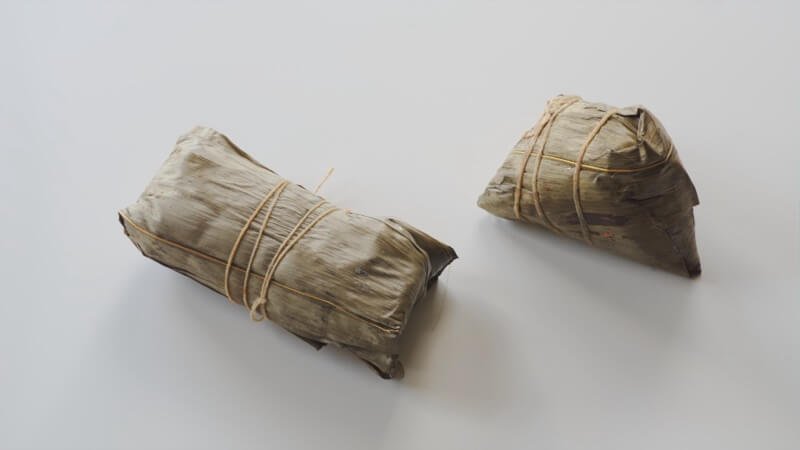
The English name for zongzi has never fully settled. “Sticky rice dumpling” is the most common functional translation, but “Chinese tamale” appears in some U.S. contexts (the leaf-wrapped, steamed format is roughly analogous). The Chinese government has formally registered “zongzi” as the standard term in global use, following the same path as jiaozi, baozi, and tofu—culturally specific foods that entered English through transliteration, much like the untranslatable words that carry cultural meaning no single English word can capture.
Wrapping zongzi is a family activity. The skill of folding bamboo leaves into a tight pyramid without gaps—so the rice steams evenly without leaking—is passed down through generations. Children learn to wrap them, badly at first, alongside grandparents who can fold a perfect zongzi without looking.
Hanging Mugwort and Calamus
Bundles of mugwort (艾草, àicǎo) and calamus (菖蒲, chāngpú) are hung on door frames during the festival. Calamus leaves are sword-shaped—symbolically cutting away evil—and mugwort has documented insect-repellent and antifungal properties. Ancient Chinese observed that the fragrance deterred mosquitoes and flies during the hot summer months, giving the custom a practical basis beneath the ritual meaning.
Wearing Herbal Pouches
Children wear small silk pouches (香包, xiāngbāo) filled with dried herbs—mint, mugwort, clove, angelica root—tied around the neck or fastened to clothing with five-color silk thread. The pouches are meant to ward off disease and insects, but they’re also a traditional craft: embroidered with auspicious patterns, they’re often given as gifts. In some regions, young women make pouches as tokens for romantic partners.
Five-Color Silk Threads
Braided threads of blue, red, white, black, and yellow—representing the five elements (wood, fire, metal, water, earth)—are tied around children’s wrists and ankles. The threads are worn until the first rainfall after the festival, when they’re cut off and thrown into a stream or river, symbolically carrying away disease and bad luck.
Realgar Wine
Realgar wine (雄黄酒, xiónghuáng jiǔ)—rice wine mixed with powdered realgar, an arsenic sulfide mineral—was traditionally drunk during the festival to repel snakes, centipedes, scorpions, and other “five poisons” believed to be active in summer. Adults would dab it on children’s foreheads, sometimes drawing the character 王 (wáng, “king”) to invoke the tiger’s protective power.
Modern note: Realgar is toxic. The traditional drinking custom has largely been replaced by sprinkling the wine around doorways, or simply abstaining. The Bai She Zhuan (Legend of the White Snake), a famous Chinese folktale, hinges on a woman forced to drink realgar wine during the festival—revealing her true form as a snake spirit.
Around the World
East Asian Variations
The Dragon Boat Festival is not exclusive to China. Several East Asian cultures celebrate the fifth day of the fifth lunar month with related but distinct traditions:
South Korea — Dano (단오). Korea’s Dano predates Chinese cultural exchange in some respects and has its own character. The Gangneung Danoje Festival was recognized by UNESCO in 2005. Traditional activities include swinging on large rope swings (a women’s activity, believed to bring health), ssireum (Korean wrestling), and eating suritteok—rice cakes flavored with surichwi (mugwort). Dragon boat racing is not a traditional Korean Dano activity. (For more on the language, see our Korean language guide.)
Japan — Tango no Sekku (端午の節句). Japan adopted the festival by the 8th century, but it evolved dramatically. Since 1948, May 5 (the Gregorian date, not the lunar one) has been Kodomo no Hi (Children’s Day), a national holiday. Families fly koinobori (carp-shaped windsocks) outside their homes—one carp for each child—and display samurai dolls inside. Chimaki (rice dumplings wrapped in bamboo leaves) and kashiwa mochi (rice cakes wrapped in oak leaves) are the festival foods.
Vietnam — Tết Đoan Ngọ. Vietnamese tradition frames the fifth day of the fifth month as the moment to “kill internal parasites.” The core ritual is eating fermented sticky rice (cơm rượu) and seasonal fruits first thing in the morning—a practice rooted in the belief that the body’s parasites surface on this day and can be eliminated with sour, fermented foods. Dragon boat racing exists in coastal Vietnam but is not as central as in southern China.
Dragon Boat Racing Goes Global
Dragon boat racing has become a genuinely international sport in the last three decades:
- 85+ countries are members of the International Dragon Boat Federation (IDBF)
- Demonstration sport at Tokyo 2020 and Paris 2024 Olympics
- 2026 ICF Dragon Boat World Championships (Hangzhou, September 30–October 3): ~1,000 athletes from 40+ countries
- 2026 IDBF Club Crew World Championships (Hualien, Taiwan, September 1–6)
- Ice dragon boat racing has emerged: in January 2026, 14 university teams from Oxford, Cambridge, and across China competed on frozen rivers in Harbin
Outside Asia, dragon boat festivals are now annual fixtures in cities including Toronto, Vancouver, Sydney, Auckland, Amsterdam, Stockholm, Cape Town, and Dubai. The sport’s appeal is egalitarian—a dragon boat crew requires 20 paddlers, a drummer, and a steerer, rewarding synchronized teamwork over individual athleticism.
Holiday Phrases
The Great Greeting Debate: 快乐 vs 安康
For most of living memory, the standard Dragon Boat Festival greeting was simple:
端午节快乐 (Duānwǔ jié kuàilè) “Happy Dragon Boat Festival”
Then, around 2015–2016, a new argument spread through Chinese social media: “How can you say ‘happy’ about a day that commemorates someone’s suicide? You should wish people health and safety instead.” The alternative quickly gained ground:
端午节安康 (Duānwǔ jié ānkāng) “Wishing you peace and well-being this Dragon Boat Festival”
Today, 安康 is the safer choice on WeChat and in formal contexts, especially in mainland China. But the debate is not settled. Critics call it “moral abduction” (道德绑架)—pointing out that:
- The festival is older than Qu Yuan and was never purely a mourning day
- No one objects to “Happy Easter” or “Merry Christmas” despite those holidays’ somber theological origins
- People in Taiwan and Hong Kong use 快樂 without controversy
A third option neatly sidesteps the entire debate:
吃粽子了吗? (Chī zòngzi le ma?) “Have you eaten zongzi yet?”
This is deeply authentic—asking about food is how Chinese people actually connect during holidays, in the same register as the everyday greeting 吃了吗 (chī le ma, “Have you eaten?”). No one will debate whether it’s appropriate.
How to Say It in 10 Languages
The Dragon Boat Festival has no native translation in most languages—these are modern equivalents created for cross-cultural communication. Some preserve the original name (Duanwu), while others translate the imagery (dragon boat).
| Language | Greeting | Notes |
|---|---|---|
| Chinese (Mandarin) | 端午节安康 / 端午节快乐 | 安康 preferred in mainland China; 快乐 common in Taiwan, HK, diaspora |
| Cantonese | 端午節快樂 | Romanized as “Tuen Ng Festival” in Hong Kong |
| Japanese | 端午の節句おめでとう | Celebrated as Children’s Day (May 5) |
| Korean | 단오 잘 보내세요 | ”Have a good Dano” |
| Vietnamese | Chúc mừng Tết Đoan Ngọ | ”Happy Đoan Ngọ Festival” |
| French | Joyeuse Fête des Bateaux-Dragons | Literal: “Happy Dragon Boat Festival” |
| German | Frohes Drachenbootfest | Literal: “Happy Dragon Boat Festival” |
| Spanish | Feliz Festival del Barco Dragón | Used in Spanish-language dragon boat communities |
| Portuguese | Feliz Festival do Barco de Dragão | Used in Brazil (São Paulo has a dragon boat scene) |
| Indonesian | Selamat Festival Perahu Naga | Used in Indonesia, where dragon boat racing has grown rapidly |
What Do You Call the Food?
Zongzi resists easy translation. Across Chinese-speaking communities alone, it goes by multiple names:
| Name | Region / Community |
|---|---|
| 粽子 (zòngzi) | Mandarin Chinese (standard) |
| 肉粽 (bah-chàng) | Hokkien / Taiwanese / Singapore / Malaysia |
| 糉 (zung2) | Cantonese |
| Bakcang / Bacang | Indonesia, Malaysia (Hokkien origin) |
| Machang | Philippines (Hokkien origin) |
| Chimaki (粽) | Japan |
The linguistic variety reflects the food’s journey through trade routes and diaspora communities across Southeast Asia. A dish that started as millet wrapped in leaves in pre-Qin China now appears, in adapted forms, from Tokyo to Manila to Jakarta. It’s a vivid example of how language and culture intertwine—a single food can carry half a dozen names, each marking a different chapter of migration and adaptation.
For translating festival greetings, zongzi packaging, or cultural content across 100+ languages, OpenL handles culturally specific terms with context awareness—so 端午节安康 doesn’t accidentally become “Happy Holiday.”
FAQ
Is it okay to say 端午节快乐? Yes—in Taiwan, Hong Kong, and most overseas Chinese communities, 快樂 is the standard greeting and nobody questions it. In mainland China, 安康 has become more common since ~2016, but 快樂 is still widely used offline. If you want to play it safe, just ask “吃粽子了吗?”
Where can I watch dragon boat races in 2026? Major races include the ICF World Championships in Hangzhou (September 30–October 3) and the IDBF Club Crew Worlds in Hualien, Taiwan (September 1–6). For the festival itself on June 19, Hong Kong’s Stanley International Championships runs that exact day. Local races happen in Toronto, Vancouver, Sydney, Auckland, and dozens of other cities worldwide.
How long does zongzi last? Freshly made zongzi keep 3–5 days refrigerated and 1–3 months frozen. Vacuum-sealed commercial zongzi can last 6–12 months at room temperature. Reheat by steaming (best), boiling, or microwaving with a damp paper towel.
Sources
- UNESCO — Dragon Boat Festival — Official inscription (Ref. RL 00225, 2009)
- Wikipedia — Qu Yuan — Biography and literary works of the poet
- Wikipedia — Dragon Boat Festival — Comprehensive festival overview
- China Highlights — Dragon Boat Festival 2026 — 2026 date and traditions
- Travel China Guide — Dragon Boat Festival — Customs and regional variations
- News18 — June 2026 Calendar — June 2026 festival dates
- ICF — ICF Dragon Boat Committee Q1 2026 — 2026 international dragon boat events
- IDBF — Club Crew World Championships 2026 — Official dates for Hualien event
- CGTN — Egypt Nile Dragon Boat Festival — 2026 international dragon boat event
- Harbin Ice Dragon Boat — January 2026 ice dragon boat race
- Skritter Forum — Duanwu Greetings — Discussion of 快乐 vs 安康
- Hinative — Dragon Boat Festival Greetings — User discussion of proper greetings