Catalan: Europe's Largest Stateless Language
TABLE OF CONTENTS
Catalan was once punishable by death. Today it has more speakers than Danish, Finnish, or Greek — and in 2026, Spain declared its EU official status “only a matter of time.”
Classification
Catalan is a Western Romance language that sits at the crossroads of two Romance branches. Historically, it belongs to the Gallo-Romance group — its closest relative is Occitan (spoken in southern France), not Spanish. But centuries of contact with Castilian have pulled it toward the Ibero-Romance orbit, giving Catalan a hybrid profile unmatched among Romance languages. If you know Spanish or French, you’ll recognize about 85% of Catalan vocabulary — but the remaining 15% contains some surprises.
It descends from Vulgar Latin and began diverging around the 9th century in the eastern Pyrenees. The earliest known text with Catalan features is the Homilies d’Organyà, a collection of sermons from the late 11th or early 12th century.
Catalan uses the standard Latin alphabet with a few additions: the acute accent (é, í, ó, ú), the grave accent (à, è, ò), the diaeresis (ï, ü), and the middle dot (ŀl) — the punt volat — used in the digraph l·l to indicate that both L’s are pronounced separately (as in col·lecció), unlike the palatal ll.
Where It’s Spoken
Catalan is spoken by approximately 10 million people across four countries.
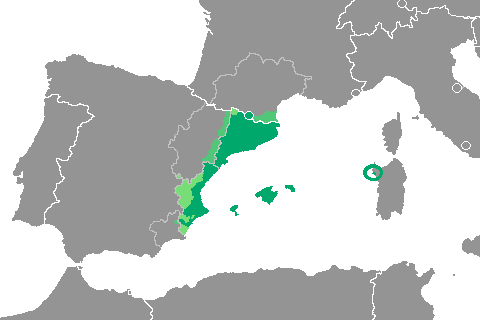
It has official status in Andorra (where it is the sole official language) and co-official status in three Spanish autonomous communities:
| Territory | Population | Status |
|---|---|---|
| Catalonia (Spain) | ~7.7 million | Co-official with Spanish and Aranese |
| Valencian Community (Spain) | ~5 million | Co-official with Spanish (as Valencian) |
| Balearic Islands (Spain) | ~1.2 million | Co-official with Spanish |
| Andorra | ~80,000 | Sole official language |
| Northern Catalonia (France) | ~450,000 | Recognized minority language only |
| Alghero, Sardinia (Italy) | ~40,000 | Semi-official municipal status |
| La Franja (Aragon, Spain) | ~45,000 | Recognized but not official |
It’s the 9th most spoken language in the European Union by number of speakers — ahead of Swedish, Danish, Finnish, and Greek. Yet unlike all of those, it has no EU official status.

The Fight for Official Status
In January 2026, Spanish Foreign Minister José Manuel Albares declared that making Catalan an official EU language is “only a matter of time.” Spain has been negotiating behind the scenes with skeptical member states, tying the push to a political agreement between the ruling Socialist Party and the Catalan pro-independence party Junts.
The stakes are real: EU official status would unlock funding for language technology, integrate Catalan into the EU’s eTranslation platform, and support the Catalan government’s goal of 600,000 new speakers in five years. In 2025, the newly created National Pact for the Language set aside 140,000 adult Catalan course places for 2026, plus 50,000 additional places for recently regularized immigrants.
At the municipal level, Barcelona is introducing a rule in 2026 requiring knowledge of Catalan to renew residence permits — a controversial move aimed at reversing the decline in habitual use.
Despite high rates of passive understanding (over 90% of Catalonia’s population can speak Catalan), only 32.6% use it habitually. The language is described by linguists as “minoritised” rather than “minority” — always competing with Spanish and French, the dominant languages in its territories.
Dialects & Varieties
Catalan is divided into two main dialect blocks, a classification first established by linguist Manuel Milà i Fontanals in 1861:
| Eastern Catalan | Western Catalan |
|---|---|
| Central Catalan (Barcelona area) | North-Western Catalan |
| Balearic (Majorca, Minorca, Ibiza) | Valencian |
| Northern (Roussillon, France) | |
| Alguerese (Sardinia, Italy) |
Mutual intelligibility is very high — estimated at 90–95% between varieties. The main differences are in vowel reduction and a handful of vocabulary items.
The Vowel Divide
This is the single biggest difference between Eastern and Western varieties. In unstressed positions:
| Western (Valencian, NW) | Majorcan (Balearic) | Central/Eastern | |
|---|---|---|---|
| /a/ | stays [a] | → [ə] (schwa) | → [ə] |
| /e, ɛ/ | stay [e, ɛ] | → [ə] | → [ə] |
| /o, ɔ/ | stay [o] | stay [o] | → [u] |
| /u/ | stays [u] | stays [u] | stays [u] |
So the word cançó (“song”) is pronounced [kanˈso] in Valencia, [kənˈso] in Majorca, and [kənˈsu] in Barcelona. If you’ve learned some Spanish, the Western system will feel more familiar — vowels stay closer to their stressed forms.
Valencian: One Language, Two Names
Valencian is the variety spoken by roughly one-third of all Catalan speakers. It has its own language academy, the Acadèmia Valenciana de la Llengua (AVL), and maintains a distinct written standard alongside the Institut d’Estudis Catalans (IEC) standard used in Catalonia and the Balearics.
Key Valencian features:
- Final /r/ preserved in all contexts — unique among modern Catalan varieties
- Three-way demonstratives (este/“this”, eixe/“that”, aquell/“that over there”) — unlike the two-way system of Central Catalan
- -e ending for 1st person present: parle (“I speak”) vs. Central parlo
- Characteristic vocabulary: espill (mirror), xiquet (boy), eixir (to exit)
Balearic: The Salat Article
The Balearic Islands have Catalan’s most distinctive dialect feature: the salat article. Instead of the standard el/la/els/les, Balearic speakers use es/sa/ets/ses, derived from Latin ipse (“that very one”) rather than ille:
| Standard | Balearic | English |
|---|---|---|
| el llibre | es llibre | the book |
| la casa | sa casa | the house |
| els amics | ets amics | the friends |
| les taules | ses taules | the tables |
Balearic also has cases of stressed /ə/ (schwa), a vowel that appears only unstressed in all other varieties. Where a Barcelonan says set [ˈsɛt] (“thirst”), a Majorcan says [ˈsət].
History
The Golden Age (12th–15th Centuries)
Catalan’s story begins with the expansion of the Crown of Aragon. As Catalan counts pushed south from the Pyrenees, conquering Muslim-held territories, the language spread to Valencia, the Balearic Islands, and eventually across the Mediterranean to Sardinia, Sicily, and even as far as Athens.
By the 15th century, Catalan was the language of a Mediterranean empire. The city of Valencia became a literary and cultural capital, producing works like the chivalric novel Tirant lo Blanch (1490) — the book Miguel de Cervantes would later call “the best book of its kind in the world.”
Suppression Before Franco
The idea that Catalan was suppressed only under Franco is a common misconception. In reality, the pressure began centuries earlier:
- 1700: Louis XIV banned Catalan in France’s Northern Catalonia, calling its use “disgusting and contrary to the honor of the French nation.”
- 1714–1716: After the War of the Spanish Succession, King Philip V issued the Nueva Planta Decrees, abolishing Catalan institutions and banning the language from administration and education.
- 19th century: Catalan was progressively banned from cemeteries (1838), business signage (1860), notarial acts (1862), and theater (1867).
Yet the 19th century also saw the Renaixença — a cultural renaissance movement that revived Catalan literature, led by poets like Jacint Verdaguer. This laid the groundwork for Modernisme, the artistic movement that produced Antoni Gaudí and gave Barcelona its architectural identity.
The Franco Years (1939–1975): Active Linguicide
The Franco regime represents the most intense period of language suppression in Catalan history, described by scholars as an attempted “cultural and identity genocide.”
| Domain | Measures |
|---|---|
| Government | Catalan banned entirely; Spanish the sole idioma nacional |
| Education | Teaching in Catalan criminalized; students punished for speaking it |
| Public space | All advertising, signage, and business communication required in Spanish only |
| Media | Catalan forbidden in newspapers, radio, cinema |
| Personal names | Parents forbidden from registering children with Catalan names |
| Book publishing | Double censorship: ideological and linguistic |
| Punishment | Fines, imprisonment, torture, or execution for language “offenses” |
A police directive instructed citizens: “Hable el idioma del imperio” — “Speak the language of the empire.” Catalan was dismissed as a mere “dialect,” and speaking it was equated with being an “enemy of Spain” — even in children’s literature.
In 1940, former Catalan president Lluís Companys was executed by firing squad at Montjuïc Castle in Barcelona. He remains the only democratically elected European president to have been executed.
Scholars have characterized the Francoist language policy as “active linguicide” — designed not just to police public use, but to instill guilt and inferiority associated with speaking Catalan, pushing speakers toward voluntary abandonment.
Resistance and Revival (1975–Present)
Franco died in 1975. With Spain’s transition to democracy, the 1978 Constitution recognized linguistic pluralism, and the 1979 Statute of Autonomy restored Catalan’s co-official status in Catalonia.
But Catalan survived the dictatorship not because of legal protections, but because of what happened in homes, at kitchen tables, and in underground gatherings. The Nova Cançó (New Song) movement of the 1960s — singer-songwriters like Lluís Llach and Joan Manuel Serrat — gave a generation a soundtrack for resistance. Clandestine publishers produced Catalan translations of Shakespeare, despite the risk of imprisonment.
Irish writer Colm Tóibín, who lived in Barcelona during the late Franco period, captured the mood: “Catalan, the language, was considered a way of being free… people considered that a fundamental way of resisting.”
The Generalitat launched a series of normalization campaigns in the 1980s, with slogans like “El català, cosa de tots” (“Catalan, everybody’s business”) and “El català: eina de feina” (“Catalan: a tool for work”). By designating Catalan as the llengua pròpia (“own language”) of Catalonia, the government gave it priority in education, administration, and public media.
Today, Catalan produces 6,000 book titles annually (12% of Spain’s total), is broadcast on 80+ TV channels and 100+ radio stations, and is taught at over 150 universities worldwide, including 22 in the UK and 24 in the US.
There’s a striking irony in Catalan’s story: banning the language arguably strengthened its emotional hold. One researcher observed that “banning a language may be an effective way of preserving it” — speakers resent authoritarian intrusion into their culture and resist more fiercely. But the work is unfinished. The language is widely known but not widely used, and the tension between institutional success and daily decline remains Catalan’s central challenge.
Phonology
Catalan’s sound system sets it apart from its Iberian neighbors in several ways.
Vowels: Seven Stressed, Plus the Schwa
Where Spanish has a simple five-vowel system (/a, e, i, o, u/), Catalan distinguishes seven stressed vowels (/a, ɛ, e, i, ɔ, o, u/) — two more than Spanish. (Balearic varieties add an eighth: stressed /ə/.) The extra distinctions matter for meaning: déu [ˈdew] (“ten”) vs deu [ˈdɛw] (“god”), or ós [ˈos] (“bear”) vs os [ˈɔs] (“bone”). This gives Catalan a vocalic richness closer to Italian than to Spanish.
The Schwa
The neutral vowel /ə/ — the same “uh” sound at the end of English sofa — appears everywhere in Eastern Catalan as the reduced form of /a, e, ɛ/ in unstressed syllables. This is unfamiliar to Spanish speakers but comes naturally to English speakers. Words like Barcelona are pronounced [bəɾsəˈlonə], not [baɾθeˈlona].
Stress-Timed Rhythm
Spanish is syllable-timed — every syllable gets roughly equal duration. Catalan, like English, is stress-timed — unstressed syllables are compressed between stressed beats. This makes Catalan sound more like Portuguese or English than the “machine-gun” rhythm of Spanish.
Consonant Clusters and Voiced Fricatives
Unlike Spanish, which tends to simplify consonant groups, Catalan preserves many final consonant clusters: serp (“snake”), trist (“sad”), porc (“pig”). This gives Catalan a grittier, more consonant-heavy texture than its neighbors.
Like Spanish, Catalan voices stops between vowels (amiga [əˈmiɣə]), but unlike Spanish, it also has voiced fricatives like /z/ and /ʒ/ — sounds absent from most Spanish varieties.
Grammar
The Periphrastic Past: Unique in Romance
Catalan’s single most distinctive grammatical feature is how it forms the past tense. Alone among Romance languages, Catalan uses the verb anar (“to go”) + infinitive to form a past — not a future:
| Catalan | English |
|---|---|
| Ahir vaig parlar amb ella. | Yesterday I spoke with her. |
| Vam arribar a les vuit. | We arrived at eight. |
| Què vas dir? | What did you say? |
Every other Romance language uses “go” + infinitive for the future (French je vais parler, Spanish voy a hablar — “I’m going to speak”). Catalan does the opposite. This periphrastic past coexists with the simple preterite (parlí = I spoke), but in everyday speech the anar form dominates.
The Personal Article
Catalan places a personal article before first names — a feature shared with some Sardinian and Occitan varieties but absent from all major Romance languages:
| Catalan | English |
|---|---|
| En Joan arriba demà. | Joan arrives tomorrow. |
| La Maria és metgessa. | Maria is a doctor. |
| Na Caterina (Balearic) | Caterina |
En (masculine) and la or na (feminine) precede proper names in most contexts. Foreigners often find this jarring — “the Maria” sounds wrong in English — but it’s as natural to a Catalan speaker as “Mr.” or “Mrs.” once was in formal English.
The Haver-hi Construction
For “there is / there are,” Catalan combines the verb haver (“have”) with the locative clitic hi:
- Hi ha tres estudiants a l’aula. — “There are three students in the classroom.”
- Hi havia molta gent. — “There were many people.”
The hi is mandatory — *ha tres estudiants is ungrammatical. The same clitic can appear with other verbs to mark existential or locative meaning: Aquí hi treballen forners (“There are bakers working here”).
Clitic Pronouns: Stacked and Transformed
Catalan’s weak object pronouns are a challenge even for experienced learners. They attach to verbs, combine with each other, and change form depending on position:
| Standalone | Before verb | After verb | Meaning |
|---|---|---|---|
| el | El veig | Vull veure*‘l*** | I see him / I want to see him |
| la | La compro | Vaig a comprar*-la*** | I buy it / I’m going to buy it |
| li + el | L’hi dono | — | I give it to him/her |
These combinations — me’l, te’ls, li’n, l’hi — stack together in sequences with no direct English equivalent. Pronoun placement and combination is consistently cited as the hardest part of Catalan grammar for learners.
Gender and Number
Catalan nouns are masculine or feminine. Unlike Spanish with its telltale -o/-a pattern, masculine Catalan nouns typically end in a consonant or -e — a legacy of losing final Latin -o (verd/verda “green” vs. Spanish verde). Adjectives must agree: un llibre interessant → una idea interessant.
Vocabulary & Loanwords
Catalan vocabulary reflects its position as a linguistic crossroads. The core lexicon is Gallo-Romance, shared with Occitan: finestra (window), formatge (cheese), parlar (to speak). But layers of influence have enriched it:
- Arabic (via medieval Al-Andalus): albergínia (eggplant), sucre (sugar), cotó (cotton)
- French: bricolatge (DIY), xofer (chauffeur), bistec (beefsteak)
- Spanish: cansar-se (to get tired), desayuno → desdejuni, though many Castilianisms are flagged as “barbarisms” in formal Catalan
- Italian (via maritime trade): piano, macarrons
- English (modern): clic, xat, màrqueting
One fun detail: the word paella comes from Valencian Catalan, where it originally meant “frying pan” (from Latin patella). The dish and its name are arguably Catalonia’s most successful global export.
Common Phrases
| Catalan | Pronunciation | English |
|---|---|---|
| Bon dia | [bɔn ˈdi.ə] | Good morning |
| Bona tarda | [ˈbɔ.nə ˈtaɾ.ðə] | Good afternoon |
| Bona nit | [ˈbɔ.nə ˈnit] | Good night |
| Com estàs? | [ˈkɔm əsˈtas] | How are you? (informal) |
| Molt bé, gràcies | [ˈmol ˈbe ˈgɾa.si.əs] | Very well, thanks |
| Si us plau | [siwsˈplaw] | Please |
| Gràcies (or Merci) | [ˈgɾa.si.əs] / [ˈmɛɾ.si] | Thank you |
| De res | [də ˈrɛs] | You’re welcome |
| Adéu | [əˈðew] | Goodbye |
| Fins després | [finz dəsˈpɾes] | See you later |
| Parles anglès? | [ˈpaɾ.ləz əŋˈglɛs] | Do you speak English? |
| Bon profit! | [ˈbɔm pɾuˈfit] | Enjoy your meal! |
| Salut! | [səˈlut] | Cheers! / Bless you! |
A few things to notice: Merci (from French) is used casually alongside gràcies — a remnant of Catalonia’s northern connections. Bon profit is the equivalent of French bon appétit — there’s no direct Spanish equivalent, and Spaniards often borrow it.
Is It Hard to Learn?
For English speakers, Catalan is one of the easier languages to learn. The FSI classifies it in the same general tier as Spanish, French, and Italian — roughly 550–600 class hours to professional proficiency. Thousands of Romance cognates (centre, important, família) are already familiar, the default word order matches English, and there’s no case system to memorize. The schwa and stress-timed rhythm, covered in Phonology above, feel more natural to English speakers than Spanish’s rigid syllable timing.
What Makes It Harder
| Challenge | Details |
|---|---|
| Clitic pronouns | The hardest part. Me’l, te’ls, li’n — these stack and transform. No English equivalent. |
| Grammatical gender | Every noun is masculine or feminine; adjectives must agree |
| Verb conjugations | Person, number, tense, mood — plus two past tenses (periphrastic vs. simple) and the subjunctive |
| Resource scarcity | Far fewer textbooks, apps, and media compared to Spanish or French. Duolingo offers only Spanish→Catalan, not English→Catalan. |
The Spanish Advantage
If you already speak Spanish or another Romance language, Catalan becomes significantly easier — often achievable in 3–4 months at conversational level. The two languages share roughly 85% lexical similarity, similar syntax, and parallel grammatical structures.
But that same proximity also causes negative transfer — Spanish habits that produce errors in Catalan. The interference happens at every level:
| What Spanish speakers tend to do | Why it’s wrong in Catalan |
|---|---|
| Pronounce every vowel clearly, skipping the schwa | Eastern Catalan reduces unstressed /a, e, ɛ/ to [ə]. Barcelona is [bəɾsəˈlonə], not [baɾθeˈlona]. |
| Merge open and closed e and o (é vs è, ó vs ò) | Catalan distinguishes /e/–/ɛ/ and /o/–/ɔ/. Déu [ˈdew] (“ten”) ≠ deu [ˈdɛw] (“god”). |
| Omit the partitive clitic en: say Jo vull instead of Jo en vull (“I want some”) | Catalan requires en where Spanish uses nothing — one of the most common beginner errors. |
| Use Spanish words with a Catalan accent: insertar for “to insert” | The real Catalan word is inserir. These “barbarisms” are the telltale sign of a Spanish speaker writing Catalan. |
Research shows that even Spanish-dominant bilinguals raised in Barcelona may never fully distinguish Catalan’s mid-vowel contrasts — a phenomenon linguists call “functional deafness” to the /e/–/ɛ/ distinction. The challenge isn’t learning new rules; it’s unlearning Spanish habits that are almost right but not quite.
Tips for Learning Catalan
Start with the sounds. Focus on the schwa and the open/closed vowel contrasts early. Catalan pronunciation is more forgiving than Spanish in some ways (the schwa is your friend), but the vowel distinctions matter for meaning.
Use the Spanish bridge — carefully. If you know Spanish, Catalan media with Spanish subtitles is an efficient way in. Just stay alert to false friends and habit interference.
Look to the Generalitat’s free resources. The Catalan government has invested heavily in language learning tools. Parla.cat offers free online courses at multiple levels. TV3 (Catalan public television) streams online with subtitles.
Read the news in Catalan. Ara, El Punt Avui, and VilaWeb are daily news outlets. Reading even 10 minutes a day builds vocabulary fast.
Learn set phrases first. Catalan’s greetings and polite formulas go a long way in Catalonia. Locals genuinely appreciate the effort — most visitors never try — and switching to Catalan even for basic pleasantries changes the dynamic of any interaction.
Do a language exchange. Platforms like Tandem and HelloTalk have active Catalan-speaking communities. Barcelona’s language exchange meetups are famously social and welcoming.
AI Translation & Catalan
Catalan’s relationship with machine translation tells the story of a language caught between success and marginalization.
In February 2026, DeepL added Catalan to its translation platform alongside Basque, Galician, and Aragonese — a major milestone that recognized Catalan’s economic and cultural weight. Catalonia alone accounts for nearly 19% of Spain’s GDP.
The open-source AINA Project, housed at the Barcelona Supercomputing Center, has built the CATalog corpus: over 17.4 billion words across 34 million documents. Its Catalan-Spanish translation model, trained on roughly 92 million parallel sentences, now outperforms Google Translate on BLEU scores (55.1 vs. 53.2) — proof that well-funded open-source projects can beat commercial systems when the training data is curated properly.
But Catalan’s situation is precarious. As of 2026, the European Union’s eTranslation platform and IATE terminology database still exclude Catalan — not for technical reasons, but because Catalan lacks EU official status. Maite Melero of the Barcelona Supercomputing Center puts it bluntly: “Official status would bring more demand and sustained investment in linguistic tools for Catalan.”
For everyday users, OpenL supports Catalan translation across text, documents, and images — practical when you need to translate a PDF, a webpage, or a conversation into or out of Catalan. The language’s unique features — the periphrastic past, the clitic pronoun system, the schwa-heavy phonology — make it an interesting test case for any machine translation engine. The tools are getting better fast. The question is whether institutional support will keep up.
For more on translating with AI, see our guides on OpenL vs DeepL and the best free online translators in 2026.
Sources
- Catalan language — Wikipedia — speaker numbers, classification, history
- Catalan dialects — Wikipedia — Valencian, Balearic, and other varieties
- Catalan grammar — Wikipedia — periphrastic past, clitic pronouns, personal article
- History of Catalan — Wikipedia — origins through modern period
- The rebirth of Catalan: how a once-banned language is thriving — The Local — Franco-era suppression and revival
- Catalan could become an official EU language — EuroWeekly News — January 2026 EU status push
- First year of the National Pact for Language — ARA — 2025–2026 language policy in Catalonia
- DeepL adds Catalan — Novobrief — February 2026 DeepL expansion
- AINA Catalan-Spanish Translator — Hugging Face — open-source translation model details
- European AI will not speak Catalan if it is not an official language — ARA — eTranslation exclusion, Maite Melero interview
- Can machine translation really help minority languages in Europe? — UAB — Alvarez Vidal & Koponen (2026) value scenarios study
- Catalan language — Queen Mary University of London — university courses, speaker statistics
- How Long Does It Take to Learn Catalan? — Preply — FSI classification, timelines
- Essential Catalan phrases — Omniglot — common phrases and pronunciation