Finnish: A Complete Guide to Cases, Agglutination & Sisu
 Add to Chrome
TABLE OF CONTENTS
With around 5.8 million native speakers, Finnish stands as one of the few European languages that belongs entirely outside the Indo-European family—a linguistic island in a continent dominated by Germanic, Romance, and Slavic tongues.
Introduction

Finnish belongs to the Finnic branch of the Uralic language family, making it a distant cousin of Estonian and Hungarian but completely unrelated to Swedish, Norwegian, or any other Scandinavian language. While Finland sits geographically in Northern Europe, its language traces its roots to the Ural Mountains region thousands of years ago—a heritage that gives Finnish a grammar and vocabulary unlike anything in the Indo-European world.
Finnish is the official language of Finland alongside Swedish, and it holds official status as one of the 24 languages of the European Union. It is spoken by approximately 84 percent of Finland’s 5.6 million residents, with Swedish-speaking Finns making up around 5 percent. Beyond Finland’s borders, Finnish-speaking communities exist in Sweden, Russia, and among diaspora populations in North America and Australia.
The language has also left a quiet mark on global technology: Linus Torvalds, creator of the Linux kernel, is a native Finnish speaker, and Nokia—once the world’s largest mobile phone manufacturer—was born in Finland. Whether you are learning Finnish for business, travel, or the sheer challenge of it, understanding its core structures will open a window into one of Europe’s most distinctive linguistic traditions.
Where Finnish Is Spoken
- Finland: ~5.4 million speakers; the dominant language of government, education, media, and daily life; co-official with Swedish
- Sweden: A significant Finnish-speaking diaspora, particularly in the Stockholm area and northern Sweden; Meänkieli (Tornedal Finnish), spoken in the Torne Valley near the Swedish-Finnish border, is recognized as an official minority language in Sweden
- Russia (Karelia): Small Finnic-speaking communities; Karelian, a closely related language, is spoken in the Republic of Karelia
- United States: Diaspora communities concentrated in Minnesota, Michigan, and the Upper Midwest, descendants of late 19th and early 20th century immigration waves
- Canada: Finnish communities in Ontario and British Columbia
- Australia: A smaller but established Finnish diaspora, particularly in Victoria and New South Wales
Takeaway: Finnish is the gateway to the broader Finnic language world. Proficiency in Finnish gives you a significant head start with Estonian (partially mutually intelligible) and a structural foundation for understanding other Uralic languages.
Myth Busting
Myth 1: “Finnish is a Scandinavian language.” Reality: Finnish is Uralic, not Germanic. It shares no common ancestor with Swedish, Norwegian, Danish, or Icelandic. Finland’s geography is Nordic, and Swedish is co-official there, but Finnish itself is as different from Swedish as English is from Japanese. The confusion is understandable—Finland is a Nordic country—but linguistically, Finnish stands apart.
Myth 2: “Finnish is impossible to learn.” Reality: Finnish grammar is remarkably regular. Unlike English, French, or German, Finnish has almost no exceptions to its rules. Spelling is nearly perfectly phonetic—every letter is pronounced the same way every time, and you read exactly what you see. The challenge is volume (15 cases, agglutinative morphology, a large suffix inventory), not irregularity. Many learners find Finnish more predictable and internally consistent than English.
Myth 3: “Finnish is related to Japanese or Korean.” Reality: The old “Ural-Altaic” hypothesis once grouped Finnish, Hungarian, Turkish, Mongolian, Korean, and Japanese into a single language family based on superficial structural similarities (all are agglutinative). Modern linguistics has thoroughly debunked this. Finnish’s only confirmed relatives are other Uralic languages: Estonian, Karelian, Sami, and more distantly, Hungarian.
Myth 4: “Nobody speaks Finnish outside Finland.” Reality: Finnish-speaking communities are found across Sweden (with official minority recognition), Russia, the United States, Canada, and Australia. Finnish music—especially heavy metal—has a global following, and Finnish gaming companies (Supercell, Rovio) have brought Finnish cultural products to hundreds of millions of users worldwide.
Distinctive Features

Agglutination
Finnish is a classic agglutinative language: meaning is built by stacking suffixes onto a root word, one after another, each adding a specific layer of information. A single Finnish word can express what English requires an entire phrase to say.
talo          house
talossa       in the house
talossani     in my house
talossanikin  in my house too
Each suffix has a precise, consistent meaning: -ssa (in), -ni (my), -kin (too/also). The suffixes stack in a fixed order, and each one is always the same—no irregular forms. This predictability is one of Finnish’s hidden advantages for learners: once you know a suffix, it works the same way on every word.
Finnish also builds compound words freely, sometimes producing famously long results. The word lentokonesuihkuturbiinimoottoriapumekaanikkoaliupseerioppilas (trainee assistant mechanic for jet turbine engines of aircraft) is a real compound, though it exists mainly as a curiosity. In everyday speech, compounds of two or three roots are common and natural.
Vowel Harmony
Finnish vowels are divided into three groups, and this division governs which suffix forms are used with any given word:
| Vowel group | Vowels | Example root |
|---|---|---|
| Back vowels | a, o, u | talo (house) |
| Front vowels | ä, ö, y | metsä (forest) |
| Neutral vowels | e, i | can appear with either group |
The rule is simple: suffixes must match the vowel class of the root. If the root contains back vowels, use the back-vowel form of the suffix; if it contains front vowels, use the front-vowel form.
talossa    in the house   (back vowel: -ssa)
metsässä   in the forest  (front vowel: -ssä)
Neutral vowels (e, i) are transparent—they do not determine the harmony class. A word like piste (point) follows the harmony of any non-neutral vowels present, or defaults to back harmony if only neutral vowels appear.
Consonant Gradation
Finnish consonants alternate between “strong” and “weak” grades depending on syllable structure. When a syllable is closed (ends in a consonant), the consonant at the start of that syllable weakens. This is called consonant gradation (astevaihtelu), and it is completely systematic.
kauppa  →  kaupan     (pp → p)   shop / of the shop
tyttö   →  tytön      (tt → t)   girl / of the girl
pankki  →  pankin     (kk → k)   bank / of the bank
The pattern applies to double consonants (pp, tt, kk) weakening to single consonants (p, t, k), and to certain consonant clusters. It looks daunting at first, but because it is rule-based and consistent, learners can internalize it as a pattern rather than memorizing exceptions.
No Grammatical Gender, No Articles
Finnish has no grammatical gender. Nouns are not masculine, feminine, or neuter—they are simply nouns. More strikingly, Finnish has a single third-person pronoun, hän, which means both “he” and “she.” There is no distinction.
Finnish also has no articles. There is no equivalent of “the” or “a/an.” Context, word order, and case endings carry the information that articles provide in English and most European languages. This eliminates an entire category of errors that plague learners of French, German, or Spanish.
Tip: Finnish speakers learning English often struggle with articles precisely because Finnish has none. The reverse is also true—English speakers learning Finnish must adjust to a world where definiteness is expressed through other means.
History of the Finnish Language

- Proto-Uralic origins (~6,000+ years ago): The common ancestor of all Uralic languages was spoken somewhere near the Ural Mountains. Speakers gradually migrated westward and northward, eventually splitting into distinct branches.
- Proto-Finnic period (~2,000–1,000 BCE): The ancestors of the Finns migrated to the Baltic region and began absorbing loanwords from neighboring Baltic and Germanic peoples. Words like kuningas (king, from Proto-Germanic) and hammas (tooth, from Baltic) entered the language during this period.
- Oral tradition (pre-16th century): Finnish was a spoken language with a rich oral poetry tradition. The epic poems later collected as the Kalevala were passed down orally for centuries. Finnish had no written form and no official status.
- Mikael Agricola and written Finnish (1540s): Agricola, a Finnish bishop and scholar, is called the “father of written Finnish.” He published the ABC-kirja (primer) in 1543 and translated the New Testament into Finnish in 1548. His written standard was based on southwestern dialects and established the foundation for modern written Finnish.
- Swedish rule (until 1809): Under Swedish governance, Finnish was the language of peasants and the rural population. Swedish dominated government, law, education, and the church. Finnish had no official status and was largely absent from written records.
- Russian Grand Duchy period (1809–1917): When Finland became an autonomous Grand Duchy of Russia, Finnish nationalism rose sharply. The Fennoman movement pushed for Finnish to be recognized as an official language. In 1863, Tsar Alexander II granted Finnish equal legal standing with Swedish—a turning point in the language’s history.
- Independence and standardization (1917–present): After Finnish independence in 1917, language standardization accelerated. Modern standard Finnish draws from both western and eastern dialect traditions, creating a unified written norm that coexists with a wide range of spoken varieties.
Vocabulary Layers
Finnish vocabulary reflects its long history of contact with neighboring peoples:
- Native Uralic core: vesi (water), kala (fish), käsi (hand), silmä (eye)
- Baltic loanwords: hammas (tooth), silta (bridge)—from ancient contact with Baltic-speaking peoples
- Germanic loanwords: kuningas (king), rengas (ring)—from Proto-Germanic and Old Norse contact
- Swedish loanwords: tuoli (chair, from Swedish stol), lasi (glass, from Swedish glas)—centuries of Swedish rule left a deep imprint
- Russian loanwords: tavara (goods), pappi (priest)—from eastern contact and the Russian period
- Modern coinages: Unlike most European languages, Finnish actively creates native terms for new concepts rather than borrowing. Tietokone (computer) is a native compound: tieto (knowledge/data) + kone (machine).
Grammar Essentials
The Fifteen Cases
Finnish uses grammatical cases to express relationships that English handles with prepositions and word order. Each case is formed by adding a suffix to the noun stem. The table below uses talo (house) as the example:
| Case | Suffix | Example | Meaning |
|---|---|---|---|
| Nominative | — | talo | house (subject) |
| Genitive | -n | talon | of the house |
| Partitive | -a / -ta | taloa | (some) house; ongoing action |
| Inessive | -ssa | talossa | in the house |
| Elative | -sta | talosta | out of the house |
| Illative | -Vn / -seen | taloon | into the house |
| Adessive | -lla | talolla | at / on the house |
| Ablative | -lta | talolta | from the house |
| Allative | -lle | talolle | to / onto the house |
| Essive | -na | talona | as a house |
| Translative | -ksi | taloksi | becoming a house |
| Abessive | -tta | talotta | without a house |
| Comitative | -ne- (+ possessive) | taloineen | together with the house |
| Instructive | -n (plural) | taloin | by means of houses |
| Accusative | -n / — | talon | house (completed object) |
Note: Linguists count Finnish cases differently depending on the framework—some analyses list 14, others 15. The comitative and instructive are sometimes treated as marginal or archaic forms rather than full productive cases. The 15-case count is the most widely cited in teaching grammars.
The six locative cases—inessive, elative, illative (interior) and adessive, ablative, allative (exterior/surface)—are the most frequently used after nominative, genitive, and partitive. The abessive, comitative, and instructive appear mainly in formal writing and set phrases.
The Partitive: Finnish’s Hardest Case
The partitive deserves special attention because it has no equivalent in English and governs a huge range of everyday sentences. The core idea is completeness: use the accusative/genitive for a completed, whole action; use the partitive for an ongoing, partial, or indefinite one.
1. Ongoing vs completed action
Luen kirjaa.    I am reading a book.   (partitive — in progress, not finished)
Luin kirjan.    I read the book.       (accusative — finished, the whole book)
2. Indefinite quantity
Juon kahvia.    I drink coffee.        (partitive — some coffee, unspecified amount)
Juon kahvin.    I drink the coffee.    (accusative — a specific, whole cup)
3. Negation always takes partitive
En näe taloa.   I don't see the house. (partitive — negation makes the object indefinite)
Näen talon.     I see the house.       (accusative — positive, completed perception)
4. Verbs that always require partitive Some verbs are inherently non-completive and always take a partitive object regardless of context: rakastaa (to love), odottaa (to wait for), etsiä (to look for), tarvita (to need).
Rakastan sinua.    I love you.          (always partitive — love is ongoing, not completed)
Odotan bussia.     I am waiting for the bus.  (always partitive)
The partitive also appears after numbers greater than one, after expressions of quantity, and in negative existential sentences (Talossa ei ole ovea — There is no door in the house). Mastering the partitive takes time, but the underlying logic—completeness and definiteness—is consistent once internalized.
Finnish negation works differently from most European languages. The negative word ei (not) conjugates for person and number, while the main verb stays in an uninflected stem form. Think of ei as a verb in its own right.
minä en puhu      I don't speak
sinä et puhu      you don't speak
hän ei puhu       he/she doesn't speak
me emme puhu      we don't speak
te ette puhu      you (plural) don't speak
he eivät puhu     they don't speak
In English, “don’t” stays the same and the subject pronoun changes. In Finnish, the negative verb changes and the main verb stays fixed. This is one of the features that makes Finnish feel genuinely different from Indo-European languages.
Word Order
Finnish default word order is subject-verb-object (SVO), the same as English. However, because case endings mark grammatical roles, word order is flexible and is used to signal emphasis and topic rather than grammatical function.
Koira söi kalan.    The dog ate the fish.   (neutral statement)
Kalan söi koira.    It was the dog that ate the fish.   (emphasis on "dog")
Both sentences are grammatically correct. The case endings (koira = nominative/subject, kalan = accusative/object) make the roles clear regardless of position.
No Future Tense
Finnish has no dedicated future tense. The present tense, combined with time adverbs or context, expresses future meaning:
Menen huomenna kauppaan.    I go to the store tomorrow.  (= I will go)
Tulen myöhemmin.            I come later.  (= I will come)
This is not unusual cross-linguistically—many languages handle futurity this way—but it surprises learners who expect a distinct future form.
Dialects and Regional Varieties
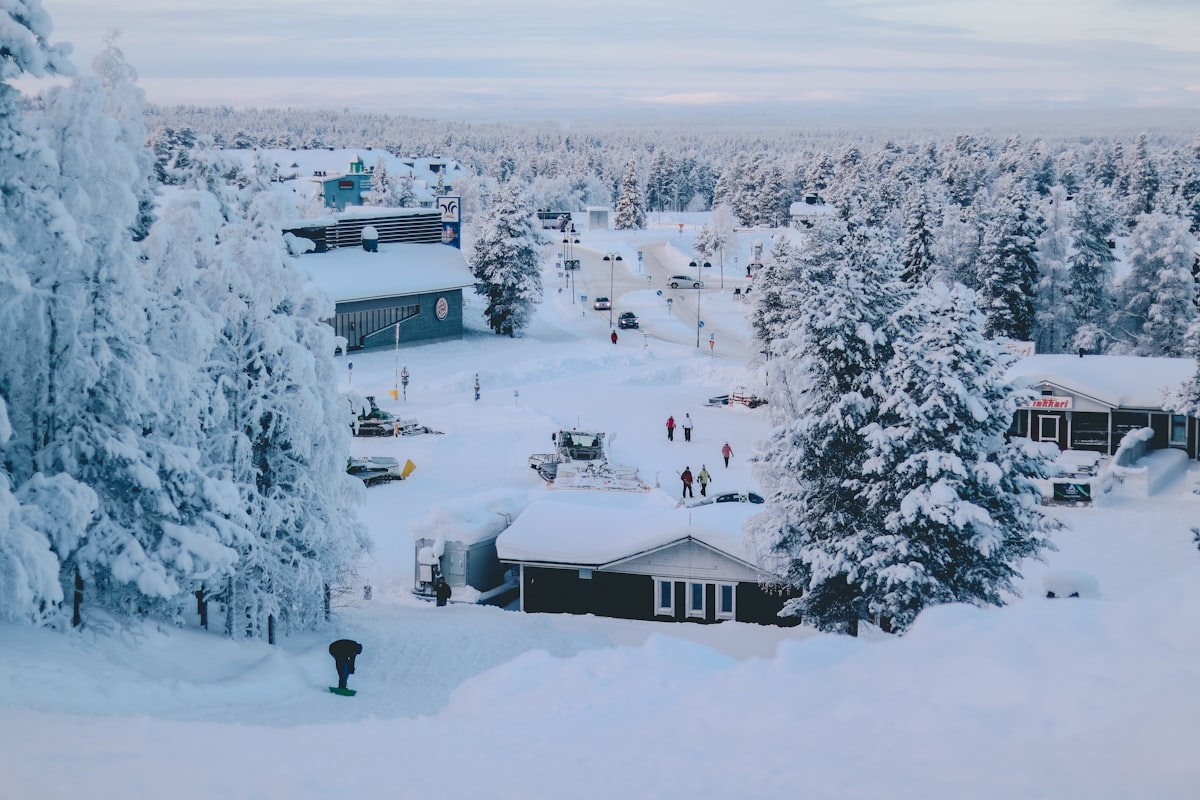
Finnish dialects fall into two broad groups: western dialects (including Southwestern Finnish, Häme/Tavastian, and Ostrobothnian varieties) and eastern dialects (including Savonian and Southeastern Finnish). The differences go beyond accent—vowel quality, diphthongs, and even some vocabulary shift noticeably between regions.
A few concrete examples show how Savonian (eastern) differs from standard Finnish:
Standard Finnish     Savonian             English
minä olen            mie olen             I am
sinä olet            sie olet             you are
ei ole               ei oo                is not
talo                 talo (same)          house
mitä                 mitä / mittee        what
Southwestern Finnish, by contrast, tends to shorten long vowels and simplify diphthongs in ways that can sound clipped to speakers from other regions. Ostrobothnian dialects in the west are known for their distinctive intonation and retention of older forms.
The more significant divide for learners is between kirjakieli (written/standard Finnish) and puhekieli (spoken/colloquial Finnish). These are not simply formal and informal registers—they differ in grammar, pronouns, and word forms to a degree that can feel like two separate languages.
kirjakieli          puhekieli           English
minä olen           mä oon              I am
sinä olet           sä oot              you are
he menevät          ne menee            they go
eivät ole           ei oo               are not
mikä se on          mikä se on          what is it
Textbooks teach kirjakieli. Real conversations happen in puhekieli. Learners who study only the written standard often find themselves unable to follow natural speech—and sounding stiff when they try to speak. Exposure to both forms from early on is essential.
Helsinki slang (Stadin slangi) is a distinct urban variety that developed in the early 20th century, historically influenced by Swedish, Russian, and later English. Words like stadi (Helsinki, from Swedish stad, city) and jätkä (guy, fellow) are classic examples. It remains a marker of Helsinki identity and appears frequently in music, film, and social media.
Common Pitfalls (and Fixes)
Pitfall 1: Confusing partitive and accusative/genitive The partitive case is one of Finnish’s trickiest features. It is used for ongoing or incomplete actions, mass nouns, and negation—situations where English uses no special marking at all.
❌ Juon kahvin. (genitive/accusative — implies you drank all of a specific coffee, completed) ✓ Juon kahvia. (partitive — I am drinking coffee, ongoing / some coffee)
The distinction matters: Luen kirjan means “I will read the book (to completion),” while Luen kirjaa means “I am reading the book (in progress).”
Pitfall 2: Getting vowel harmony wrong in suffixes Every suffix has two forms—one for back-vowel roots and one for front-vowel roots. Using the wrong form produces a spelling that no Finnish speaker would write.
❌ tytossa (back-vowel suffix on a front-vowel root) ✓ tytössä (front-vowel suffix: tyttö contains ö, so use -ssä)
Check the root’s vowels before adding any suffix. If the root contains ä, ö, or y, use the front-vowel form.
Pitfall 3: Speaking kirjakieli in casual conversation Textbook Finnish sounds unnatural in everyday speech. Finns use puhekieli in virtually all informal contexts.
❌ Minä menen nyt kotiin. (kirjakieli — sounds like a news broadcast) ✓ Mä meen nyt kotiin. (puhekieli — natural spoken Finnish)
Learn puhekieli alongside the written standard from the beginning, not as an afterthought.
Pitfall 4: Forgetting consonant gradation Consonant gradation changes the consonant at the beginning of a syllable when that syllable closes. Ignoring it produces forms that are simply wrong.
❌ kauppan (no gradation applied) ✓ kaupan (pp → p before a closed syllable: kau-pan)
The gradation patterns are systematic. Learn the main alternations (pp/p, tt/t, kk/k, mp/mm, nt/nn, nk/ng) early and apply them consistently.
Pitfall 5: Translating English prepositions word-for-word Finnish uses case endings where English uses prepositions. There is no separate word for “in,” “from,” or “to”—the case suffix carries that meaning.
❌ sisällä talo (trying to use a preposition + bare noun) ✓ talossa (inessive case suffix -ssa handles “in the house”)
Think of Finnish cases as built-in prepositions. Once you internalize the six locative cases, you will stop reaching for separate preposition words.
Finnish presents real challenges for AI translation systems. The agglutinative structure creates an enormous effective vocabulary—a single root can generate hundreds of valid word forms, most of which will never appear in training data. Case selection requires understanding the semantic and syntactic context of each noun, not just pattern matching. Vowel harmony means every suffix must agree with the root’s vowel class, a constraint that neural models sometimes violate. The gap between kirjakieli and puhekieli means that social media text, subtitles, and casual messages look very different from the formal Finnish that dominates written corpora. Research published in 2025 at the Nordic Conference on Computational Linguistics confirmed that large language models still struggle with morphological analysis of complex Finnish word forms. OpenL’s Finnish Translator addresses these challenges with context-aware models that handle case agreement, vowel harmony, and agglutinative morphology—supporting text, document, and image translation for both everyday communication and professional localization.
Learning Roadmap

The Foreign Service Institute (FSI) classifies Finnish as a Category IV language for English speakers—the hardest category—estimating approximately 1,100 hours (44 weeks of full-time study) to reach professional working proficiency. Finnish’s regularity means that time is spent building knowledge, not memorizing exceptions.
Weeks 1–2: Pronunciation and Survival
- Master the Finnish alphabet; every letter has one sound, and spelling is phonetic
- Learn vowel length distinctions—they change meaning: tuli (fire), tuuli (wind), tulli (customs)
- Memorize 15–20 survival phrases and basic numbers
Months 1–2: Core Grammar
- Learn the three most-used cases: nominative, genitive, and partitive
- Practice present tense conjugation and the negative verb (ei + stem)
- Internalize vowel harmony rules
- Build vocabulary to 500–800 words using sentence-based flashcards
Months 3–6: Expanding Fluency
- Add the six locative cases (inessive, elative, illative, adessive, ablative, allative)
- Study consonant gradation patterns systematically
- Begin reading adapted texts; listen to Yle Selkouutiset (simplified Finnish news broadcasts)
- Start learning puhekieli alongside kirjakieli
Months 6–12: Consolidation
- Handle all 15 cases with reasonable accuracy in writing
- Follow spoken Finnish (puhekieli) in podcasts and TV
- Read Finnish literature—start with Tove Jansson’s Moomin books in Finnish, then move to contemporary fiction
- Target 2,000–3,000 active vocabulary words
Daily Routine (40 minutes)
- 10 min: Flashcard review (sentence-based, not isolated words)
- 10 min: Listening (Yle Areena, Finnish podcasts, music)
- 10 min: Grammar drills (case endings, consonant gradation)
- 10 min: Writing or speaking practice
Key Phrases
Hei                              Hello / Hi
Moi                              Hi (informal)
Kiitos                           Thank you
Ole hyvä                         Please / You're welcome
Anteeksi                         Excuse me / I'm sorry
Kyllä                            Yes
Ei                               No
Mikä sinun nimesi on?            What is your name?
Nimeni on...                     My name is...
En ymmärrä                       I don't understand
Puhutko englantia?               Do you speak English?
Paljonko tämä maksaa?            How much does this cost?
Missä on vessa?                  Where is the restroom?
Apua!                            Help!
Näkemiin                         Goodbye (formal)
Moi moi                          Bye (informal)
Tip: Finnish does not have a formal/informal “you” distinction like French (tu/vous) or German (du/Sie). Sinä is used universally. Politeness is expressed through indirect phrasing, conditional verb forms, and tone—not through pronoun choice.
Two Mini Dialogues
At a kahvila (café):
A: Moi! Mitä saisi olla?              Hi! What can I get you?
B: Yksi kahvi, kiitos.                One coffee, please.
A: Mustana vai maidolla?              Black or with milk?
B: Maidolla. Paljonko se maksaa?      With milk. How much is it?
A: Kolme euroa viisikymmentä.         Three euros fifty.
B: Ole hyvä. Kiitos!                  Here you go. Thanks!
Asking for directions:
A: Anteeksi, missä on rautatieasema?  Excuse me, where is the train station?
B: Mene suoraan ja käänny oikealle.   Go straight and turn right.
A: Onko se kaukana?                   Is it far?
B: Ei, noin viisi minuuttia kävellen. No, about five minutes on foot.
A: Kiitos paljon!                     Thank you very much!
B: Ole hyvä!                          You're welcome!
The Finnish Concept of Sisu

No guide to Finnish would be complete without sisu—a word with no direct English equivalent that Finns consider central to their national identity. Sisu describes inner strength, stoic determination, and grit in the face of adversity: not simply perseverance, but the capacity to act under pressure when rational calculation would suggest giving up.
The concept runs through Finnish history—a small nation that survived harsh winters, wars of independence, and the Winter War against the Soviet Union in 1939–1940. For language learners, sisu is a useful frame. Finnish rewards the long game. The grammar is unlike anything in the Indo-European world, but the language is internally consistent, and every hour of study builds on the last.
Conclusion
Finnish is genuinely challenging for English speakers. The 15 cases, agglutinative morphology, and the kirjakieli/puhekieli divide require sustained effort. But Finnish is also one of the most logically consistent languages you can learn: phonetic spelling, regular grammar, almost no exceptions. The difficulty is in the volume of new patterns, not in unpredictability.
The payoff is access to a linguistic world that stands apart from the rest of Europe—from the ancient oral poetry of the Kalevala to contemporary Finnish literature, music, and technology. Start with pronunciation, lock in the three core cases, get comfortable with vowel harmony, and build from there.
Resources
Reference
- Finnish language — Wikipedia
- Finnish grammar — Wikipedia
- Finnish noun cases — Wikipedia
- Mikael Agricola — Wikipedia
Textbooks
- Suomen mestari series (Otava) — the standard classroom textbook series used in Finnish language courses, covering A1 through B2
- Finnish: An Essential Grammar by Fred Karlsson — the most thorough English-language reference grammar for Finnish
Online courses and apps
- Duolingo Finnish — free, good for building early vocabulary and basic grammar habits
- Clozemaster — sentence-based vocabulary practice, effective from intermediate level onward
- FinnishPod101 — audio and video lessons with grammar explanations
Listening and reading
- Yle Selkouutiset — simplified Finnish news broadcasts, ideal for A2–B1 learners
- Yle Areena — Finnish public broadcaster’s full streaming library, including subtitled content
- Uusi kielemme — free grammar explanations and exercises, one of the best free Finnish grammar sites in English
Translation