Hungarian: Why This Language Feels So Different
 Add to Chrome
TABLE OF CONTENTS
Hungarian is one of the few languages in Europe that has no relationship to its neighbors—surrounded by Slavic and Germanic tongues, it stands apart as a linguistic island with roots stretching back to the Ural Mountains.
Introduction

Hungarian, known to its speakers as Magyar, is the official language of Hungary and one of the most structurally distinctive languages in Europe. With approximately 14 million speakers worldwide, it is the largest member of the Uralic language family—a group that includes Finnish and Estonian but shares no common ancestor with the Indo-European languages that dominate the continent.
What makes Hungarian genuinely unusual is not just its family tree. Its grammar operates on principles that feel alien to speakers of English, French, German, or Russian: 18 grammatical cases, vowel harmony that governs every suffix, and an agglutinative structure that can pack an entire English sentence into a single word. Yet Hungarian is also a language of remarkable precision and expressiveness, with a literary tradition that produced Nobel Prize-winning authors and a musical culture that gave the world Liszt and Bartók.
Whether you are learning Hungarian, working with Hungarian translations, or simply curious about why this language feels so different, this guide covers everything you need to know.
Where Hungarian Is Spoken
Hungarian is spoken in more places than most people realize:
- Hungary: ~9.6 million speakers; the official language of government, education, and media
- Romania (Transylvania): ~1.2 million speakers, concentrated in the Szeklerland region; Hungarian has co-official status in several municipalities
- Slovakia: ~450,000 speakers, mainly in the southern regions bordering Hungary
- Serbia (Vojvodina): ~250,000 speakers; Hungarian is one of the official languages of the autonomous province
- Ukraine (Zakarpattia): ~150,000 speakers in the westernmost region
- Austria (Burgenland): ~30,000 speakers; Hungarian has regional recognition
- Diaspora: Significant communities in the United States, Canada, Germany, Australia, and Israel, largely descended from 20th-century emigration waves
Takeaway: The Hungarian-speaking world extends well beyond Hungary’s borders. This matters for translation work—regional varieties in Romania and Slovakia carry distinct vocabulary and cultural references that standard Hungarian may not capture.
Myth Busting
Myth 1: “Hungarian is the hardest language in the world.” Reality: Hungarian is consistently ranked among the most difficult languages for English speakers by the US Foreign Service Institute (Category III, requiring ~1,100 hours of study). But “hardest” is relative. The grammar is logical and rule-consistent—once you internalize the system, it becomes predictable. The difficulty is front-loaded: the first few months feel overwhelming, but progress accelerates.
Myth 2: “Hungarian is related to Turkish.” Reality: Hungarian and Turkish share some loanwords and both use agglutination, but they belong to entirely different language families. The resemblance is structural coincidence, not common ancestry. Hungarian’s closest living relatives are Mansi and Khanty, two small languages spoken in western Siberia.
Myth 3: “Hungarian and Finnish are mutually intelligible.” Reality: Hungarian and Finnish are both Uralic languages, but they diverged thousands of years ago. A Hungarian speaker and a Finnish speaker cannot understand each other any more than an English speaker and a Hindi speaker can—both Indo-European, but worlds apart in practice.
Myth 4: “Hungarian has no grammar rules, just exceptions.” Reality: Hungarian grammar is highly systematic. Vowel harmony, case suffixes, and verb conjugation all follow clear patterns. The challenge is that the patterns are unlike anything in Western European languages, so learners have no familiar framework to lean on.
Distinctive Features

Agglutination: Building Words Like Lego
Hungarian is a strongly agglutinative language, meaning it builds meaning by stacking suffixes onto a root word. Each suffix carries a specific grammatical meaning, and they attach in a fixed order.
A single Hungarian word can express what English requires an entire phrase to say:
ház            — house
házban         — in the house
házamban       — in my house
házaimban      — in my houses
megházasodik   — to get married (meg + ház + as + od + ik, literally "to become housed")
megszentségteleníthetetlenségeskedéseitekért
             — for your [plural] repeated acts of being unable to be desecrated
               (a famous example, grammatically valid)
The last example is often cited as a curiosity, but it illustrates a real feature: Hungarian compound words and suffix chains are theoretically unlimited in length, and all of them follow predictable rules.
Vowel Harmony
Every suffix in Hungarian has two or three forms, and which form you use depends on the vowels in the root word. This is vowel harmony: vowels within a word must “agree” in terms of whether they are front vowels or back vowels.
- Front vowels (tongue positioned forward, as in English “see” or German “über”): e, é, i, í, ö, ő, ü, ű
- Back vowels (tongue positioned back, as in English “father” or “too”): a, á, o, ó, u, ú
A back-vowel word takes back-vowel suffixes; a front-vowel word takes front-vowel suffixes:
ház (house) — back vowels → házban (in the house), házhoz (to the house)
kert (garden) — front vowels → kertben (in the garden), kerthez (to the garden)
Some words have mixed vowels and follow special rules. For learners, vowel harmony means you cannot simply memorize one form of a suffix—you must learn to recognize the vowel class of every word you encounter.
18 Grammatical Cases
Where Russian has 6 cases and German has 4, Hungarian has 18. Each case is expressed as a suffix and encodes a specific spatial, directional, or relational meaning. Rather than using prepositions (in, on, at, from, to), Hungarian encodes these relationships directly into the noun.
A selection of cases with the word ház (house):
| Case | Suffix | Form | Meaning |
|---|---|---|---|
| Nominative | — | ház | house (subject) |
| Accusative | -t | házat | house (object) |
| Inessive | -ban/-ben | házban | in the house |
| Illative | -ba/-be | házba | into the house |
| Elative | -ból/-ből | házból | out of the house |
| Superessive | -n/-on/-en/-ön | házon | on the house |
| Sublative | -ra/-re | házra | onto the house |
| Delative | -ról/-ről | házról | off/about the house |
| Adessive | -nál/-nél | háznál | at/near the house |
| Allative | -hoz/-hez/-höz | házhoz | to(ward) the house |
| Ablative | -tól/-től | háztól | away from the house |
The spatial cases follow a logical 3×3 grid — three locations (inside, on surface, near) × three directions (static, “into,” “out of”):
| Inside | On surface | Near | |
|---|---|---|---|
| Static | -ban/-ben (in) | -n/-on/-en/-ön (on) | -nál/-nél (at) |
| Moving toward | -ba/-be (into) | -ra/-re (onto) | -hoz/-hez/-höz (to) |
| Moving away | -ból/-ből (out of) | -ról/-ről (off) | -tól/-től (from) |
Once you see this pattern, the spatial cases become manageable — nine cases reduced to one simple grid.
Postpositions Instead of Prepositions
Where English puts relationship words before nouns (under the table, behind the door), Hungarian puts them after:
az asztal alatt   — under the table (literally: the table under)
az ajtó mögött    — behind the door (literally: the door behind)
a nyár alatt      — during the summer
This is consistent with Hungarian’s general tendency to place modifiers after the thing they modify—the opposite of English.
Definite and Indefinite Conjugation
Hungarian verbs conjugate differently depending on whether the object is definite (specific, known) or indefinite (general, unknown). This is a feature found in very few languages worldwide.
Látok egy házat.    — I see a house. (indefinite conjugation)
Látom a házat.      — I see the house. (definite conjugation)
The verb lát (to see) takes different endings based on whether “house” is a (the) or egy (a). This distinction must be tracked throughout every sentence.
History of the Hungarian Language
Origins in the Urals
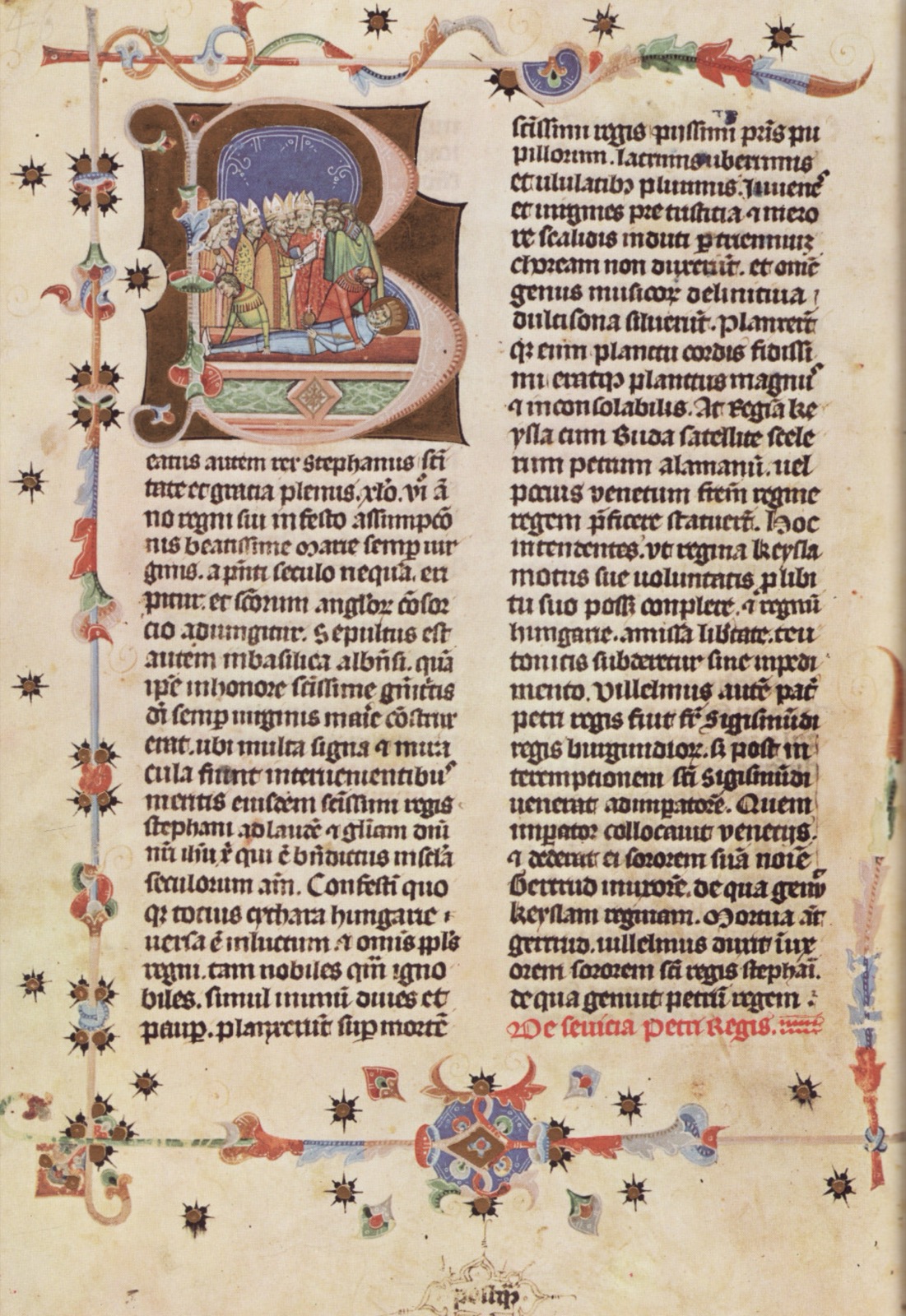
The ancestors of the Hungarian people spoke a proto-Ugric language in the region of the Ural Mountains, in what is now western Siberia and the eastern edge of European Russia. Around 500 BCE, the Ugric branch split: one group remained in Siberia (ancestors of today’s Mansi and Khanty speakers), while another began a long westward migration.
Over centuries, the migrating group—who called themselves Magyar—absorbed vocabulary from Turkic peoples they encountered on the Eurasian steppe. This is why Hungarian contains a layer of Turkic loanwords for concepts related to agriculture, animal husbandry, and social organization: búza (wheat), ökör (ox), gyümölcs (fruit).
The Conquest of the Carpathian Basin (895 CE)
Under the leadership of Árpád, the Magyar tribes crossed the Carpathian Mountains and settled the Pannonian Plain in 895 CE—the event Hungarians call honfoglalás (the conquest of the homeland). This placed them in the heart of Europe, surrounded by Slavic, Germanic, and later Romance-speaking peoples.
Contact with these neighbors left a significant mark on Hungarian vocabulary. Slavic languages contributed words for farming and Christianity; Latin became the language of the church and administration for nearly a thousand years; German influenced trade and urban life.
The Language Reform (Nyelvújítás, 1770–1840)
By the 18th century, Hungarian had fallen behind as a literary and scientific language. A deliberate movement called Nyelvújítás (language renewal) created thousands of new Hungarian words to replace Latin and German borrowings. Writers and intellectuals coined terms by combining existing Hungarian roots rather than borrowing from other languages.
Many everyday Hungarian words date from this period: irodalom (literature), természet (nature), villany (electricity), gőz (steam). The movement succeeded in making Hungarian a fully functional modern language capable of expressing scientific and philosophical concepts.
20th Century and Today
Hungarian survived the collapse of the Austro-Hungarian Empire (1918), which left large Hungarian-speaking communities outside the new borders of Hungary—a situation that persists today in Romania, Slovakia, and Serbia. The communist period (1945–1989) brought Soviet-influenced vocabulary, most of which has since faded. Post-1989 Hungary saw a wave of English loanwords, particularly in technology and business.
Today, Hungarian is a fully standardized modern language with a strong literary tradition, active media, and growing digital presence.
Vocabulary Layers
Hungarian vocabulary tells the story of the language’s long journey across continents:
- Uralic core: The oldest layer, shared with distant relatives like Finnish and Mansi. Basic words for nature, body, and kinship — víz (water; compare Finnish vesi), hal (fish; Finnish kala), kéz (hand; Finnish käsi)
- Turkic borrowings: Acquired during centuries on the Eurasian steppe before 895 CE (documented by linguist Ármin Vámbéry and later confirmed by modern comparative linguistics). Agriculture and social organization — búza (wheat), ökör (ox), gyümölcs (fruit), szám (number), bor (wine)
- Slavic borrowings: From neighboring Slavic peoples after settling the Carpathian Basin, as catalogued in Lajos Kiss’s Etymologisches Wörterbuch. Farming, religion, and daily life — asztal (table, from Slavic stol), kulcs (key, from Slavic ključ), péntek (Friday, from Slavic pętĭkŭ), király (king, from Slavic kralj)
- Latin and German: Centuries of Habsburg rule and Catholic administration — iskola (school, from Latin schola), polgár (citizen, from German Bürger), herceg (duke, from German Herzog)
- Nyelvújítás coinages (1770–1840): The language reform created thousands of new words from Hungarian roots — irodalom (literature), természet (nature), villany (electricity), gőzmozdony (locomotive, literally “steam-mover”)
- Modern English: Technology and business — komputer (computer), internet, menedzser (manager), szoftver (software)
Takeaway: The Nyelvújítás is unique in European history. Rather than borrowing foreign words for modern concepts, Hungarian intellectuals systematically built new words from native roots—a conscious act of linguistic self-sufficiency that shapes the language to this day.
Grammar Essentials
Verb Conjugation
Hungarian verbs conjugate for person, number, tense, mood, and the definiteness of the object. The present tense of lát (to see):
Indefinite (seeing something unspecified):
látok    — I see
látsz    — you see
lát      — he/she/it sees
látunk   — we see
láttok   — you (plural) see
látnak   — they see

Definite (seeing a specific thing):
látom    — I see it/him/her
látod    — you see it
látja    — he/she sees it
látjuk   — we see it
látjátok — you (plural) see it
látják   — they see it
Word Order and Emphasis
Hungarian’s default word order is Subject–Verb–Object, like English. But because cases mark grammatical roles, word order is used primarily for emphasis and information focus. The element immediately before the verb carries the strongest emphasis:
Péter látja a házat.    — Péter sees the house. (neutral)
A házat látja Péter.    — It's the house that Péter sees. (emphasis on house)
Péter a házat látja.    — It's the house (not something else) that Péter sees.
Negation
Negation in Hungarian is formed with nem (not) placed before the verb or the element being negated:
Nem látom a házat.      — I don't see the house.
Nem Péter látja.        — It's not Péter who sees it.
Possession
Hungarian expresses possession through suffixes on the possessed noun, not through a separate word like “my” or “your”:
ház      — house
házam    — my house
házad    — your house
háza     — his/her house
házunk   — our house
házatok  — your (plural) house
házuk    — their house
Dialects and Regional Varieties
Compared to many European languages, Hungarian dialects are remarkably uniform—speakers from different regions understand each other without difficulty. Linguists traditionally identify eight dialect groups, but the differences are mostly in pronunciation and a handful of vocabulary items.
The most significant distinction is between standard Hungarian (based on the Budapest dialect) and Transylvanian Hungarian spoken by approximately 1.2 million people in Romania — the largest Hungarian-speaking community outside Hungary. Transylvanian Hungarian preserves several archaic features that have disappeared from the standard language:
- Phonetic differences: Transylvanian dialects often retain a more open pronunciation of a and distinguish certain vowel sounds that Budapest Hungarian has merged.
- Vocabulary: Romanian loanwords appear for administrative and legal concepts (buletin for ID card, autogară for bus station). Some everyday words also differ: krumpli (potato) in Hungary vs pityóka in parts of Transylvania; villanyposta instead of e-mail.
- Grammar: Certain verb forms and postpositional constructions are used differently, reflecting older patterns preserved through relative isolation from Budapest’s linguistic influence.
In Vojvodina (Serbia), Hungarian has absorbed some Serbian vocabulary, particularly for food and local institutions. In Slovakia, the Hungarian-speaking community maintains a conservative standard but uses Slovak loanwords for bureaucratic terms.
For translation work, these regional differences matter most in legal, administrative, and marketing contexts. A document translated into standard Hungarian will be understood everywhere, but localized content for Romanian or Serbian Hungarian audiences benefits from awareness of regional vocabulary.
A Cultural Note: Names in Reverse
One detail that surprises many: Hungarian uses Eastern name order—family name first, given name second. In Hungary, Nagy Péter means “Péter Nagy,” not “Nagy, Péter.” This is the same convention used in Chinese, Japanese, and Korean, and it is unique among European languages. When translating Hungarian names into English, the order must be reversed—a common source of errors in official documents.
Hungarian and AI Translation
Hungarian presents specific challenges for machine translation that researchers have documented extensively:
- Agglutination: A single Hungarian word can correspond to multiple English words. Correctly segmenting and analyzing suffix chains requires sophisticated morphological processing.
- Vowel harmony: Suffix selection depends on the vowel class of the root, which must be tracked across the entire word.
- Definite/indefinite conjugation: The verb form depends on the definiteness of the object—a semantic distinction that AI models must infer from context.
- Free word order: The same meaning can be expressed in multiple word orders, each with different emphasis. Translating into Hungarian requires choosing the right order for the context.
- Low-resource status: Hungarian has far less training data than major languages like English, French, or Spanish, which historically limited translation quality.
Recent research has improved significantly. A 2022 study on neural machine translation for Hungarian showed that modern transformer-based models handle Hungarian morphology much better than earlier statistical approaches. In 2025, Hungarian-specific LLM benchmarks (OpenHuEval) were developed to evaluate model performance on Hungarian-specific linguistic features.
Despite these advances, Hungarian remains a language where AI output benefits from human review — especially for legal, medical, and literary texts where case suffixes carry precise meaning and register matters. Tools like OpenL, Google Translate, and DeepL all support Hungarian, with varying strengths across different text types. For critical documents, pairing AI translation with a native speaker review remains best practice.
Common Pitfalls (and Fixes)
Wrong vowel harmony ❌ kertban → ✓ kertben. The word kert (garden) has front vowels, so it takes the front-vowel form of the inessive case (-ben, not -ban).
Mixing definite and indefinite conjugation ❌ Látok a házat → ✓ Látom a házat. When the object is definite (has a/az before it), use the definite conjugation.
Treating Hungarian like a preposition language ❌ in ház → ✓ házban. Hungarian encodes spatial relationships as case suffixes, not separate words. There is no word for “in”—the meaning is built into the noun.
Ignoring long vowels Hungarian distinguishes short and long vowels with an accent mark (á, é, í, ó, ő, ú, ű). These are different phonemes, not just spelling variants. kor means “age/era”; kór means “disease.” Ignoring length changes meaning.
Literal translation of possession ❌ Én-nek van egy ház → ✓ Van egy házam or Nekem van egy házam. Hungarian expresses “I have a house” as “to me there is a house of mine”—possession is encoded in the noun suffix, not a verb like “have.”
Pronunciation Guide
Hungarian spelling is phonetic — each letter or digraph maps to exactly one sound, and every letter is pronounced. Once you learn the system, you can read any Hungarian word correctly. The tricky part for English speakers is the digraphs and unique vowels:
| Letter(s) | Approximate sound | Example |
|---|---|---|
| s | “sh” (as in ship) | sok (many) = “shok” |
| sz | “s” (as in sun) | szép (beautiful) = “sayp” |
| zs | “zh” (as in measure) | zseb (pocket) = “zheb” |
| cs | “ch” (as in church) | csésze (cup) = “CHAY-seh” |
| gy | soft “d” + “y” (like dew in British English) | nagy (big) = “nodj” |
| ty | soft “t” + “y” (like tune in British English) | atya (father) = “AH-tya” |
| ny | “ny” (as in canyon) | anya (mother) = “AH-nya” |
| ly | “y” (as in yes) | király (king) = “KEE-rahy” |
| ö / ő | rounded front vowel (as in German schön) | öt (five) |
| ü / ű | rounded front vowel (as in German über) | üveg (glass) |
Key rules:
- Long vowels (á, é, í, ó, ő, ú, ű) are the same sound as their short counterparts, just held longer. They change meaning: kor (age) vs kór (disease).
- Stress always falls on the first syllable, regardless of word length.
- Every letter is pronounced — there are no silent letters.
Learning Roadmap
The US Foreign Service Institute classifies Hungarian as a Category III language for English speakers, requiring approximately 1,100 hours of study to reach professional working proficiency.
Weeks 1–2: Foundations
- Learn the Hungarian alphabet (44 letters, including digraphs like cs, sz, zs, ny, gy, ty, ly)
- Begin recognizing vowel harmony patterns: identify front vs back vowel words
- Learn basic greetings and survival phrases
- Understand the concept of cases before memorizing them
Months 1–3: Core Grammar
- Learn the most common cases: nominative, accusative, inessive (-ban/-ben), illative (-ba/-be), superessive (-n/-on/-en/-ön)
- Practice present tense conjugation, both definite and indefinite
- Build vocabulary to 500 words using spaced repetition (Anki)
- Start with simple sentences using SVO order
Months 3–6: Expanding
- Add remaining cases systematically (group by spatial logic: inside/onto/near)
- Learn possession suffixes
- Study past and future tense
- Begin reading simple Hungarian texts with a dictionary
Months 6–12: Consolidation
- Handle all 18 cases with reasonable accuracy
- Use definite/indefinite conjugation naturally
- Watch Hungarian films and TV with subtitles
- Aim for 2,000+ active vocabulary words
Recommended resources:
- Colloquial Hungarian (Routledge) — structured grammar with exercises
- HungarianReference.com — free online grammar reference
- Anki with Hungarian frequency decks — vocabulary building
- Duolingo Hungarian — useful for early stages
- italki — find native Hungarian tutors for conversation practice
If you are learning other languages alongside Hungarian, check out our guide to the best language learning apps in 2026 and how to learn a new language in 30 days.
Key Phrases
Szia / Szervusz              — Hi / Hello (informal)
Jó napot kívánok             — Good day (formal)
Köszönöm                     — Thank you
Kérem / Legyen szíves        — Please / Would you be so kind
Elnézést                     — Excuse me / I'm sorry
Igen                         — Yes
Nem                          — No
Hogy hívják? / Hogy hívnak?  — What is your name? (formal / informal)
...vagyok / A nevem...       — I am... / My name is...
Nem értem                    — I don't understand
Beszél angolul?              — Do you speak English? (formal)
Mennyibe kerül?              — How much does it cost?
Hol van a mosdó?             — Where is the restroom?
Segítség!                    — Help!
Viszontlátásra               — Goodbye (formal)
Szia / Viszlát               — Bye (informal)
Egészségére!                 — To your health! (used both for toasting and after sneezes)
Two Mini Dialogues
- At a café
A: Jó napot! Mit kér?                    Good day! What would you like?
B: Egy kávét kérek, legyen szíves.       A coffee, please.
A: Tejjel vagy anélkül?                  With milk or without?
B: Tej nélkül. Mennyibe kerül?           Without milk. How much is it?
A: Ötszáz forint.                        Five hundred forints.
B: Köszönöm szépen! Thank you very much!- Asking for directions
A: Elnézést, hol van a metróállomás?     Excuse me, where is the metro station?
B: Menjen egyenesen, aztán forduljon jobbra.  Go straight, then turn right.
A: Messze van?                           Is it far?
B: Nem, kb. öt perc gyalog.             No, about five minutes on foot.
A: Nagyon köszönöm!                      Thank you very much!
B: Szívesen!                             You're welcome!
Conclusion
Hungarian rewards patience. Its grammar is genuinely unlike anything in Western European languages, and the first months of learning can feel disorienting. But the system is logical: vowel harmony follows clear rules, cases encode spatial relationships in a consistent three-by-three grid, and agglutination builds meaning in predictable layers.
The payoff is access to a rich literary tradition—from the 19th-century poet Sándor Petőfi to Nobel laureate Imre Kertész—and a culture that has produced some of the world’s most influential composers, mathematicians, and scientists. Hungarian is also a gateway to understanding how differently human languages can organize the same reality.
Start with vowel harmony and the most common cases, get comfortable with definite and indefinite conjugation, and build from there. The language that once seemed impossibly foreign will gradually reveal its internal logic.
If you need to translate Hungarian text—whether documents, websites, or business content—AI tools like OpenL can handle routine translations well. For high-stakes content, pair AI output with a native reviewer to catch the nuances that morphological complexity can obscure.
Resources
- Hungarian language — Wikipedia
- Hungarian grammar — Wikipedia
- History of the Hungarian language — Wikiwand
- A Complete Overview of the Hungarian Language — World School Books
- Case System in Hungarian Grammar — TalkPal
- Mastering Vowel Harmony in Hungarian — TalkPal
- HungarianReference.com — Vowel Harmony
- Neural machine translation for Hungarian — ResearchGate
- Is Hungarian Language Really That Hard to Learn? — Daily News Hungary