Lithuanian: Europe's Most Conservative Living Language
 Add to Chrome
TABLE OF CONTENTS
Want to hear how the earliest Indo-Europeans might have sounded? The French linguist Antoine Meillet had a short answer: go listen to a Lithuanian peasant.
Lithuanian at a Glance
| Native name | lietuvių kalba |
| Family | Indo-European → Balto-Slavic → Baltic → East Baltic |
| Speakers | About 2.8 million native speakers in Lithuania, plus roughly 1.5 million elsewhere (about 4 million native in total, 2022) |
| Official in | Lithuania; one of the 24 official languages of the EU |
| Script | Latin alphabet with 32 letters (diacritics: ą, č, ę, ė, į, š, ų, ū, ž, y) |
| Regulated by | Commission of the Lithuanian Language (Valstybinė lietuvių kalbos komisija) |
| ISO code | lt / lit |
Classification: A Baltic Language, Closest to Latvian
Lithuanian is an East Baltic language. Its only living sister is Latvian. The other Baltic languages — including Old Prussian — died out by the eighteenth century. Together, Baltic and Slavic form the Balto-Slavic branch of Indo-European, though linguists still debate whether that means a shared proto-language or a long period of close contact.
Lithuanian and Latvian are not mutually intelligible. They began to diverge after about 800 AD and were still connected by transitional dialects into the late Middle Ages. Latvian changed faster under Finnic and German influence. Lithuanian, spoken farther south in older Baltic territory, kept more of the old grammar and sound system.
That is why you will see Lithuanian compared with Sanskrit, Ancient Greek, and Latin in historical linguistics textbooks. Words such as sūnus (“son”), avis (“sheep”), and vilkas (“wolf”) sit close to Sanskrit sūnu, avi, and vṛka, and to Latin ovis (“sheep”) and cognates across the family. The resemblance is not a party trick. It is why Britannica calls Lithuanian “the most archaic Indo-European language still spoken.”
Where Lithuanian Is Spoken
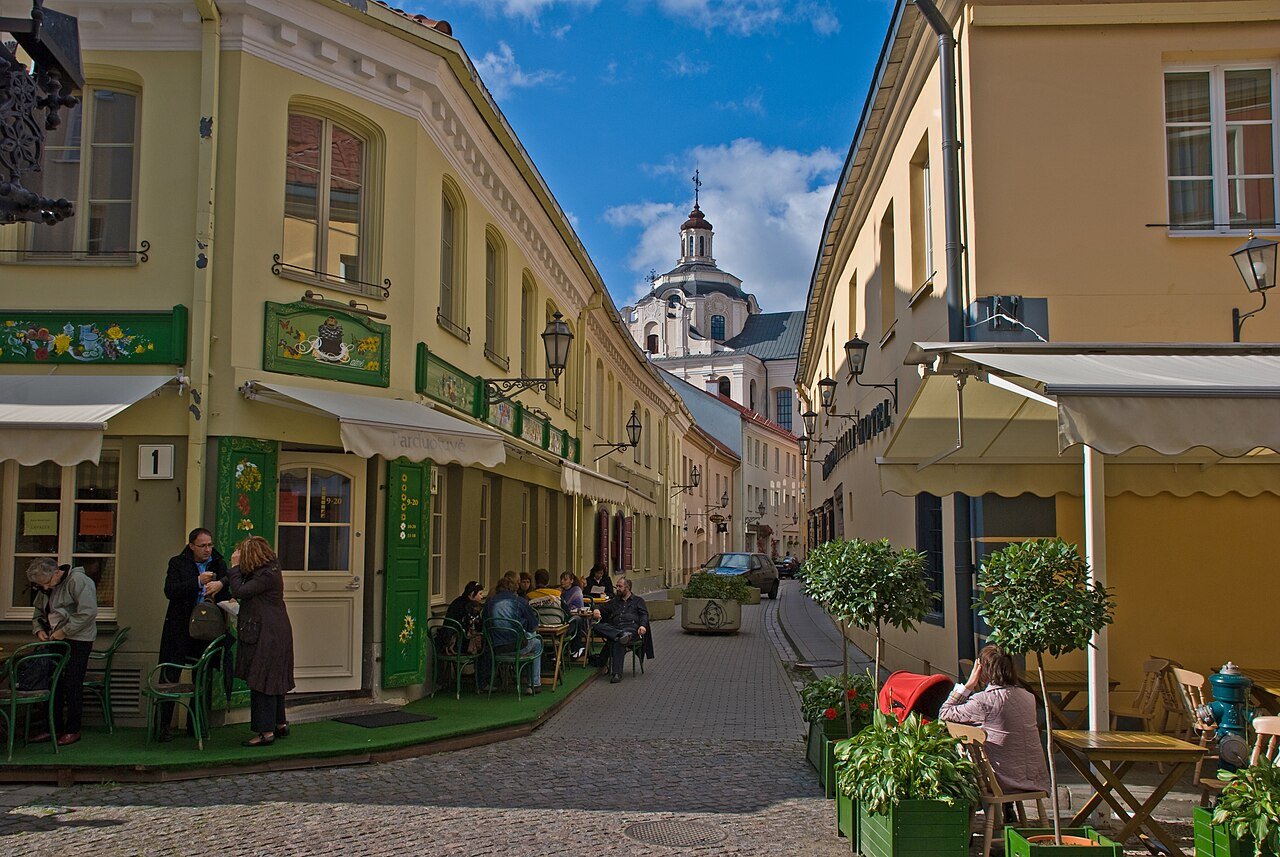
Most speakers live in Lithuania, where Lithuanian is the sole state language and about 86% of residents reported it as their native language in mid-2010s statistics. It is also spoken by Lithuanian communities in neighboring Belarus, Latvia, Poland, and Russia’s Kaliningrad region, and by a large diaspora in the United States, the United Kingdom, Ireland, Canada, Brazil, Argentina, Australia, and elsewhere.
Two main dialects divide the country:
- Aukštaitian (Highland Lithuanian) — the basis of the standard language
- Samogitian (Lowland Lithuanian, žemaičių) — distinctive enough that speakers sometimes struggle with each other if they stay in dialect
Standard Lithuanian is taught in schools, so almost everyone can switch to it. Ethnographic regions still color local speech, and you will hear Samogitian pride as strongly as you hear the dialect itself.
How many people speak Lithuanian?
Roughly three to four million people speak Lithuanian as a native language worldwide. About 2.8 million of them live in Lithuania; another 1.5 million or so live abroad. Several hundred thousand non-Lithuanian residents of Lithuania also use it daily as a second language. It is a mid-size European language — smaller than Polish or Russian, but securely official in an EU member state.
A Short History: From Catechisms to Book Smugglers
Lithuanian was spoken for centuries before it was written. Latin and Ruthenian (and later Polish) handled most chancellery work in the Grand Duchy of Lithuania. The oldest surviving Lithuanian manuscript texts are translations of the Lord’s Prayer, the Hail Mary, and the Creed from about 1503–1525.
The first printed book arrived on 8 January 1547: Martynas Mažvydas’s Catechismusa prasty szadei (“The Simple Words of Catechism”), printed in Königsberg (Karaliaučius). It included a primer, hymns with music, and the first poem in Lithuanian. Written Lithuanian stayed mostly religious for a long time.
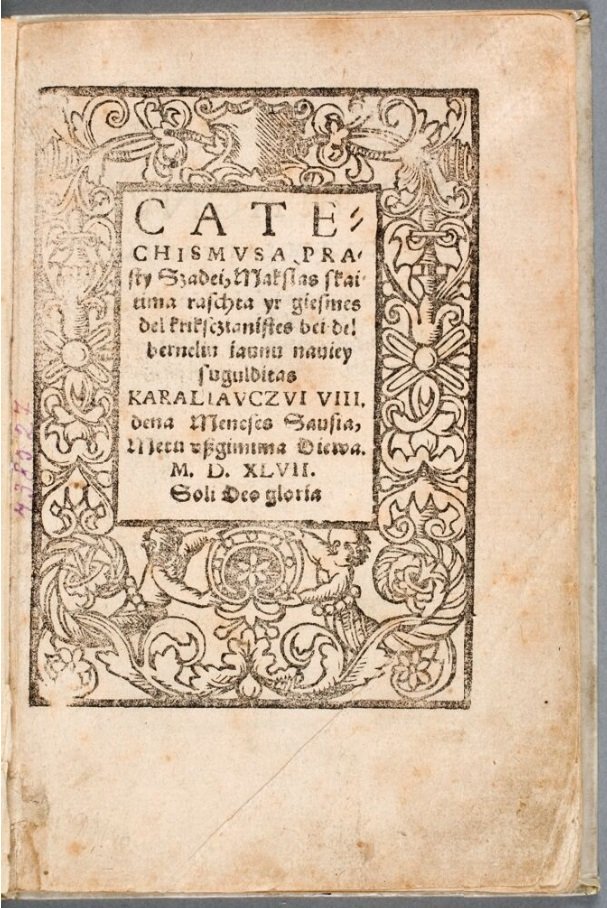
Two later chapters matter for anyone learning the modern standard:
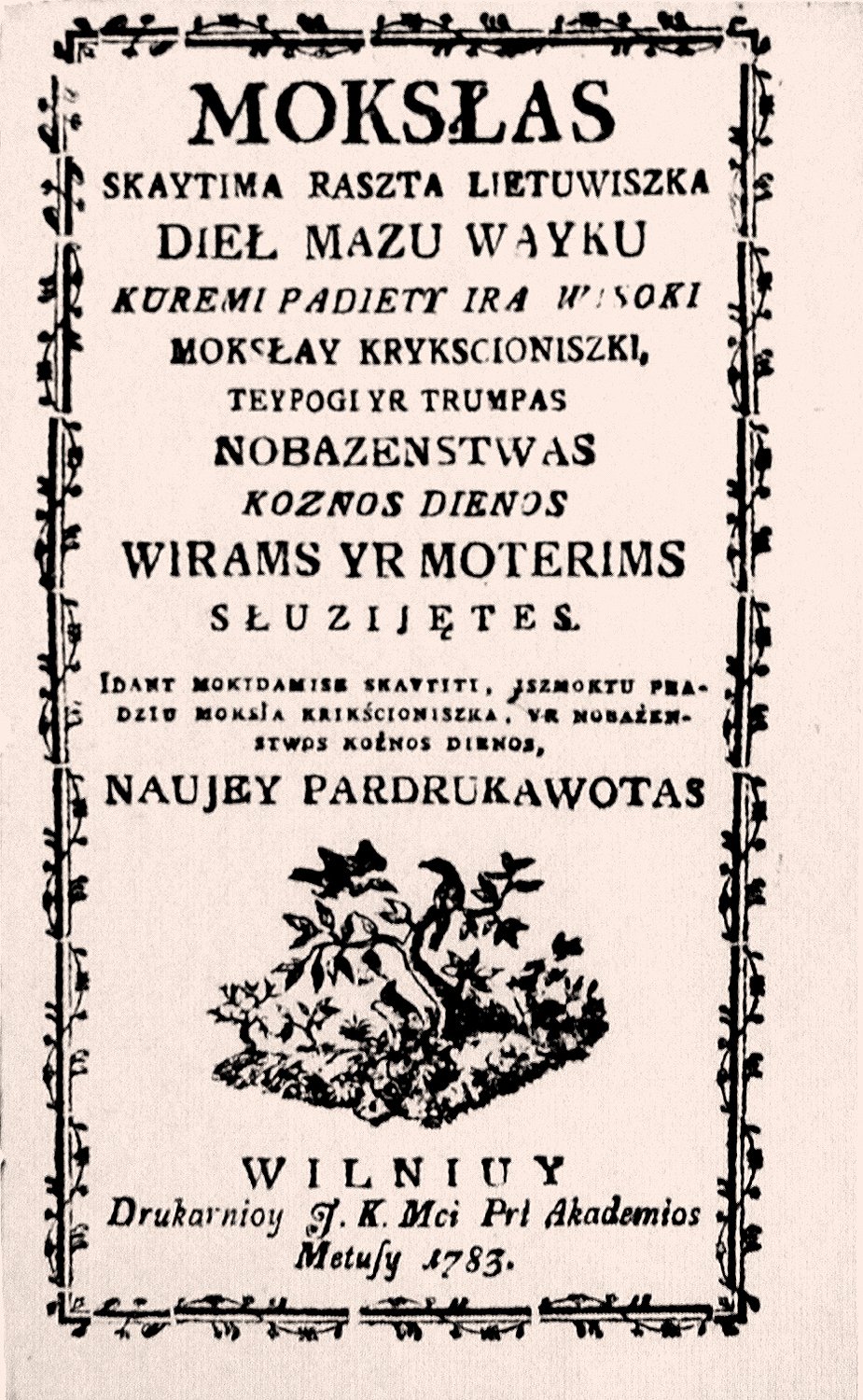
- The press ban (1864–1904). After the January Uprising, the Russian Empire banned Lithuanian books in the Latin alphabet. Printers in East Prussia and the United States kept producing them; knygnešiai (“book smugglers”) carried them across the border at the risk of prison. Literacy stayed surprisingly high through secret home schools.
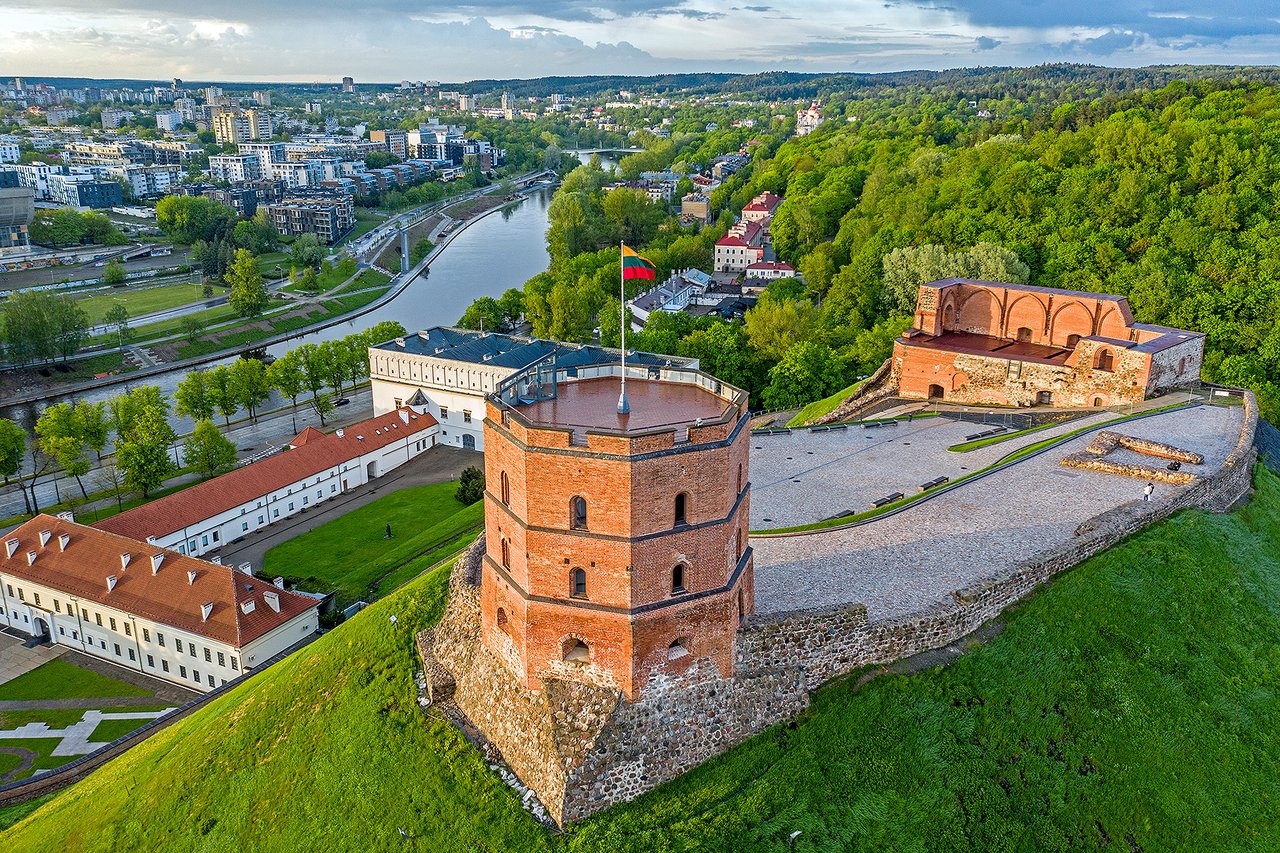
- Jonas Jablonskis (1860–1930). He set the principles of today’s standard on the West High Lithuanian dialect. After independence in 1918, Lithuanian became the official state language. Soviet rule (1940–41 and 1944–90) pushed Russian into public life; Lithuanian was restored as the sole official language in 1988–90 and entered the EU’s official-language list in 2004.
Why Linguists Call It “Conservative”
“Conservative” here does not mean the language never changes. It means Lithuanian kept phonology and morphology that most other living Indo-European languages simplified away. Features often cited:
| Archaic feature | What you notice |
|---|---|
| Pitch accent | Heavy syllables can have a falling (acute) or rising (circumflex) tone; the contrast can change meaning |
| Free stress | Stress is not fixed on one syllable the way it is in Czech or Polish |
| Rich case system | Seven core cases, with extra locative forms still alive in speech |
| Dual remnants | Forms for “two” and “both” (du, abu) still decline specially; some dialects keep more dual forms |
| IE vocabulary | Many basic words stay close to reconstructed Proto-Indo-European shapes |
Conservatism is strongest in the sound system, a bit weaker in morphology, and weaker still in everyday vocabulary, which has taken Slavic, German, and English loans over time. Language planners still prefer native coinages for new tech when they can.
Is Lithuanian the oldest living Indo-European language?
It is not the oldest in the sense of earliest written records — those go to languages such as Hittite and Mycenaean Greek. It is widely described as the most conservative living Indo-European language: the one that still looks most like the ancestral system in key parts of grammar and sound. That is the claim behind this post’s title, and behind Meillet’s famous line about the Lithuanian peasant.
Writing System: 32 Letters and a Few Surprises
Lithuanian uses a Latin alphabet of 32 letters. Spelling is largely phonemic: one letter, one sound, with a few quirks.
| Letter / mark | Role |
|---|---|
| č, š, ž | “ch”, “sh”, “zh” (borrowed from Czech-style orthography in the National Revival) |
| ė | A distinct mid front vowel; a Lithuanian hallmark since Daniel Klein’s 1653 grammar |
| ą, ę, į, ų | Historically nasal; now long oral vowels |
| ū, y / į | Mark long u and long i |
| i before a back vowel | Often silent, only softens the previous consonant (liūtas “lion” vs lūpa “lip”) |
Pitch accents (acute, grave, circumflex) appear in dictionaries and textbooks, not in ordinary writing. Digraphs ch, dz, and dž are treated as letter pairs for sorting. Native words avoid q, w, and x; those show up mainly in foreign names.
Grammar: Seven Cases (and a Few More in Speech)
Grammar is where new learners feel the Baltic character of the language.
Does Lithuanian have seven cases?
Yes. Modern standard Lithuanian officially teaches seven cases. Older texts and everyday speech also keep an illative (“into”) that many speakers still use, especially with place names, even though most school grammars keep the official list at seven.
The seven standard cases
| No. | Case (Lithuanian name) | Main use |
|---|---|---|
| 1 | Nominative (vardininkas) | Subject |
| 2 | Genitive (kilmininkas) | Possession, “of”, many prepositions; also covers ablative-like uses |
| 3 | Dative (naudininkas) | Indirect object, “to/for” |
| 4 | Accusative (galininkas) | Direct object |
| 5 | Instrumental (įnagininkas) | “With”, “by means of” |
| 6 | Locative / inessive (vietininkas) | “In / at” |
| 7 | Vocative (šauksmininkas) | Addressing someone |
Old Lithuanian also had illative (“into”), allative (“toward”), and adessive (“at”) forms. The illative (Vilniun “to Vilnius”, miestan “into the city”) is still common in speech and writing; school grammars usually list the seven cases above as the official set and treat į + accusative as the careful alternative for “into.”
Here is namas (“house”) with a few endings:
| Case | Lithuanian | English |
|---|---|---|
| Nominative | namas | a/the house |
| Genitive | namo | of the house |
| Dative | namui | to/for the house |
| Accusative | namą | house (as object) |
| Instrumental | namu | with the house |
| Locative | name | in the house |
| Vocative | name! | (addressing) |
Colloquial illative forms still appear for direction, especially with place names: Vilniun (“to Vilnius”), miestan (“into the city”), Lietuvon (“to Lithuania”). In careful standard style you will more often see į + accusative (į Vilnių).
Gender, number, and verbs
- Nouns have two genders: masculine and feminine. Adjectives, pronouns, and participles also have a neuter used when there is no gendered noun to agree with.
- Number is singular and plural in the standard language. The dual survives clearly in du / dvi (“two”) and abu / abi (“both”), and more fully in some dialects such as Samogitian.
- Verbs keep an archaic synthetic future with -s- and a rich participle system. Word order is flexible because endings show who does what — similar in spirit to what you see in Czech or Russian, even though the details differ.
Is Lithuanian similar to Russian or Latvian?
Latvian is the closest relative, but everyday mutual understanding is low; think “related family members,” not “two dialects.” Russian and other Slavic languages share some Balto-Slavic heritage and many loanwords from centuries of contact, yet the grammar and core vocabulary are different enough that Russian will not unlock Lithuanian for you. Finnic neighbors such as Estonian and Finnish are unrelated; any shared look is areal contact (for example, extra local cases), not common ancestry.
Common Lithuanian Phrases
| English | Lithuanian | Rough pronunciation |
|---|---|---|
| Hi (informal) | Labas | LAH-bahs |
| Good day (formal) | Laba diena | LAH-bah DYEH-nah |
| Good morning | Labas rytas | LAH-bahs REE-tahs |
| Please / You’re welcome | Prašau | prah-SHOW |
| Thank you | Ačiū | AH-choo |
| Yes / No | Taip / Ne | type / neh |
| Excuse me / Sorry | Atsiprašau | aht-sih-prah-SHOW |
| Goodbye | Viso gero / Iki | VEE-soh GEH-roh / EE-kih |
| Do you speak English? | Ar kalbate angliškai? | ahr KAHL-bah-teh AHN-glihsh-kai |
| I don’t understand | Nesuprantu | NEH-soo-prahn-too |
| My name is… | Mano vardas… | MAH-noh VAHR-dahs |
Ačiū is the word visitors remember first: short, soft, and uniquely Lithuanian to English ears.
Is Lithuanian Hard to Learn?
For English speakers, Lithuanian is a Category III language on the U.S. State Department / Foreign Service Institute scale: about 44 weeks (1,012 class hours) to professional working proficiency. That puts it with Latvian, Czech, Polish, Russian, and Hungarian — harder than Spanish or German, far easier than Arabic, Chinese, Japanese, or Korean.
| Easier than it looks | Harder than it looks |
|---|---|
| Latin alphabet | Seven cases with many declension patterns |
| Mostly phonetic spelling | Free stress and pitch accent |
| Regular sound-letter match | Verb and participle complexity |
| Clear official standard | Dialect speech (especially Samogitian) in the wild |
If you already know a Slavic language, cognates and case thinking help a little. If you know Latvian, you get a head start on Baltic patterns but still have to relearn most words. Absolute beginners should plan for a long, steady climb — and celebrate early wins with phrases and reading.
Tips for Learning Lithuanian
- Learn nouns with gender and a second case form. Namas, namo (house) or knyga, knygos (book) teaches the pattern faster than the nominative alone.
- Treat pitch accent as listening practice first. Mark stress in your notebook; add acute vs circumflex later from a good dictionary.
- Chunk prepositions with their cases. į + accusative (“into”), iš + genitive (“from”), su + instrumental (“with”) — memorize the pair, not the preposition alone.
- Use standard media, then sample dialect. News and LRT content keep you in Jablonskis’s standard; folk songs and Samogitian clips train your ear for real variation.
- Compare with other “conservative” stories carefully. Icelandic is famous for resisting change inside Germanic; Lithuanian plays a similar role inside Indo-European as a whole — useful motivation, not a claim that the two languages are alike.
Translating Lithuanian with AI
Baltic morphology is a stress test for machine translation. One noun can appear in many case and number forms; adjectives must agree; pitch accent is invisible in plain text; and colloquial illatives or dual-tinged phrases may look “wrong” to a model trained mostly on formal news. Word order can also shift for emphasis without changing the core meaning, so a word-for-word English gloss often misses the point.
When you need to read a Lithuanian email, menu, form, or news paragraph, OpenL can translate Lithuanian to and from English and many other languages. It is a practical way to check your own sentences while you study. For contracts, medical text, or anything high-stakes, have a fluent speaker review the result.
Sources
- Lithuanian language — Wikipedia — speakers, classification, history (Mažvydas 1547, press ban, Jablonskis), orthography, phonology, grammar overview
- Lithuanian language — Encyclopaedia Britannica — “most archaic Indo-European language still spoken”; earliest documents; dual; Jablonskis standard
- Lithuanian grammar — Wikipedia — seven cases, dual remnants, gender
- Lithuanian declension — Wikipedia — case inventory and illative status
- Catechism of Martynas Mažvydas — Wikipedia — first printed Lithuanian book, 8 January 1547, Königsberg
- Foreign Language Training — U.S. Department of State (FSI / NFATC) — Lithuanian in Category III, ~44 weeks / 1,012 class hours
- Lithuanian phrasebook — Wikivoyage — common phrases and pronunciation
- The Lithuanian language: history and prospects — Collège de France — why Western linguists study Lithuanian; archaism relative to Latin, Greek, Sanskrit