Greek Alphabet: All 24 Letters, Pronunciation, and History
 Add to Chrome
TABLE OF CONTENTS
The Greek alphabet has only 24 letters, but reading it correctly requires more than matching Alpha to A and Beta to B. This guide separates Modern Greek pronunciation from ancient and English conventions, explains how the script developed, and shows how to type and translate Greek online.
Greek Alphabet Overview
The Greek alphabet is the writing system used for Greek from the first surviving alphabetic inscriptions of the eighth century BCE to the present. Its name, alphabet, comes from the names of its first two letters: alpha and beta.
| Feature | Greek alphabet |
|---|---|
| Number of letters | 24 |
| First and last letters | Alpha (Α α) and Omega (Ω ω) |
| Writing direction today | Left to right |
| Letter case | Uppercase and lowercase |
| Main modern use | Writing Modern Greek |
| Historical source | Adapted from Phoenician writing |
| Defining adaptation | Explicit letters for vowel sounds |
| Wider legacy | An ancestor or major model for Latin, Cyrillic, and Coptic scripts |
The alphabet is not the language itself. Greek has vocabulary, grammar, and spoken varieties; the alphabet is the set of signs used to write them. Our broader guide to the Greek language covers the language beyond its script.
The 24 Greek Letters
The table below separates each letter’s Modern Greek name from its usual sound value inside a word. It also gives a broad Standard Modern Greek transcription for every example word; slashes show phonemic pronunciation rather than every fine phonetic detail. The names and examples were checked against the Dictionary of Standard Modern Greek and a University of Arizona Modern Greek phonetics reference.12 Where a letter has two contextual values, the examples appear in the same order as the values.
| Letter | English and Modern Greek name | Modern value | Greek example and pronunciation | Meaning |
|---|---|---|---|---|
| Α α | Alpha · άλφα /ˈalfa/ | /a/ | άνθρωπος /ˈanθropos/ | person |
| Β β | Beta · βήτα /ˈvita/ | /v/ | βιβλίο /viˈvlio/ | book |
| Γ γ | Gamma · γάμμα /ˈɣama/ | /ɣ/, /ʝ/ | γάλα /ˈɣala/; γη /ʝi/ | milk; earth |
| Δ δ | Delta · δέλτα /ˈðelta/ | /ð/ | δώρο /ˈðoro/ | gift |
| Ε ε | Epsilon · έψιλον /ˈepsilon/ | /e/ | Ελλάδα /eˈlaða/ | Greece |
| Ζ ζ | Zeta · ζήτα /ˈzita/ | /z/ | ζωή /zoˈi/ | life |
| Η η | Eta · ήτα /ˈita/ | /i/ | ήλιος /ˈilios/ | sun |
| Θ θ | Theta · θήτα /ˈθita/ | /θ/ | θάλασσα /ˈθalasa/ | sea |
| Ι ι | Iota · γιώτα /ˈʝota/ | /i/ | ιστορία /istoˈria/ | history |
| Κ κ | Kappa · κάππα /ˈkapa/ | /k/, /c/ | κόσμος /ˈkozmos/; κήπος /ˈcipos/ | world; garden |
| Λ λ | Lambda · λάμδα /ˈlamða/ | /l/ | λέξη /ˈleksi/ | word |
| Μ μ | Mu · μι /mi/ | /m/ | μητέρα /miˈtera/ | mother |
| Ν ν | Nu · νι /ni/ | /n/ | νερό /neˈro/ | water |
| Ξ ξ | Xi · ξι /ksi/ | /ks/ | ξένος /ˈksenos/ | foreigner, stranger |
| Ο ο | Omicron · όμικρον /ˈomikron/ | /o/ | όνομα /ˈonoma/ | name |
| Π π | Pi · πι /pi/ | /p/ | παιδί /peˈði/ | child |
| Ρ ρ | Rho · ρο /ro/ | /r/ | ρόδο /ˈroðo/ | rose |
| Σ σ/ς | Sigma · σίγμα /ˈsiɣma/ | /s/, sometimes /z/ | σπίτι /ˈspiti/; κόσμος /ˈkozmos/ | house; world |
| Τ τ | Tau · ταυ /taf/ | /t/ | τώρα /ˈtora/ | now |
| Υ υ | Upsilon · ύψιλον /ˈipsilon/ | /i/ | ύπνος /ˈipnos/ | sleep |
| Φ φ | Phi · φι /fi/ | /f/ | φίλος /ˈfilos/ | friend |
| Χ χ | Chi · χι /çi/ | /x/, /ç/ | χαρά /xaˈra/; χέρι /ˈçeri/ | joy; hand |
| Ψ ψ | Psi · ψι /psi/ | /ps/ | ψάρι /ˈpsari/ | fish |
| Ω ω | Omega · ωμέγα /oˈmeɣa/ | /o/ | ώρα /ˈora/ | hour, time |
Letter names and letter values are not the same thing. Modern Greek β has the value /v/, and its name βήτα is pronounced /ˈvita/; English pronunciations such as “bay-ta” or “bee-ta” belong to English convention. The contextual letter values in this guide follow the Modern Greek orthography summary by Richard Ishida and the phonetic conventions of the Centre for the Greek Language.31
Greek Pronunciation
Modern Greek has five basic vowel sounds: /a, e, i, o, u/. Its spelling preserves distinctions that pronunciation has lost, so several letters and letter pairs can now represent the same sound. This historical convergence is called iotacism.3
| Sound | Common spellings | Examples |
|---|---|---|
| /i/ | η, ι, υ, ει, οι, υι | ήλιος, είναι, οικογένεια |
| /e/ | ε, αι | Ελλάδα, καιρός |
| /o/ | ο, ω | όνομα, ώρα |
| /u/ | ου | ουρανός |
| /a/ | α | αγάπη |
This is why Greek spelling cannot be reconstructed reliably from sound alone: η, ι, υ, ει, and οι may all sound like /i/, but they are not interchangeable in writing.
Several consonants also need more explanation than an English approximation can provide:
- Β β is /v/, as in English voice. Modern Greek normally writes the /b/ sound with μπ, especially at the beginning of a word.
- Δ δ is /ð/, the sound of th in this. Θ θ is /θ/, the sound of th in think.
- Γ γ is /ɣ/ before back vowels such as α, ο, and ου. Before front vowel sounds such as /e/ and /i/, it becomes the palatal sound /ʝ/.
- Χ χ follows a similar pattern: /x/ before back vowels and /ç/ before front vowels. Neither sound is the English /tʃ/ in chair.
- Κ κ is usually /k/, but it is palatalized to /c/ before front vowel sounds.
- Ρ ρ is a Greek rhotic, commonly realized as a tap or trill rather than the English r.
- Σ σ/ς is normally /s/, but it can become /z/ before certain voiced consonants. That is why the sigma in κόσμος is pronounced /z/.3
Letter Combinations
Greek also uses pairs of letters for sounds that are not obvious from the letters in isolation.
| Combination | Usual Modern Greek value | Example |
|---|---|---|
| αι | /e/ | καιρός (weather) |
| ει | /i/ | είναι (is) |
| οι | /i/ | οικογένεια (family) |
| ου | /u/ | ουρανός (sky) |
| μπ | /b/ initially; often /mb/ medially | μπύρα (beer) |
| ντ | /d/ initially; often /nd/ medially | ντους (shower) |
| γκ, γγ | /g/ or a nasal-plus-stop sequence, depending on position | φεγγάρι (moon) |
The combinations αυ, ευ, and ηυ end in /v/ before a vowel or voiced consonant and /f/ before a voiceless consonant. Compare αύριο (tomorrow, /ˈavrio/) with αυτό (this, /afˈto/). Pronunciation varies somewhat by speaker and context, especially in nasal-plus-stop sequences such as μπ, ντ, and γκ.31
Writing Rules
Uppercase and Lowercase
Greek has a full case distinction, but several lowercase letters look unlike their capitals: Β β, Γ γ, Δ δ, Η η, Λ λ, Μ μ, Ν ν, Ρ ρ, and Ω ω. Shape alone can also mislead readers familiar with Latin letters: Greek Ρ represents /r/, Η represents /i/, Χ represents /x/ or /ç/, and Β represents /v/ in Modern Greek.
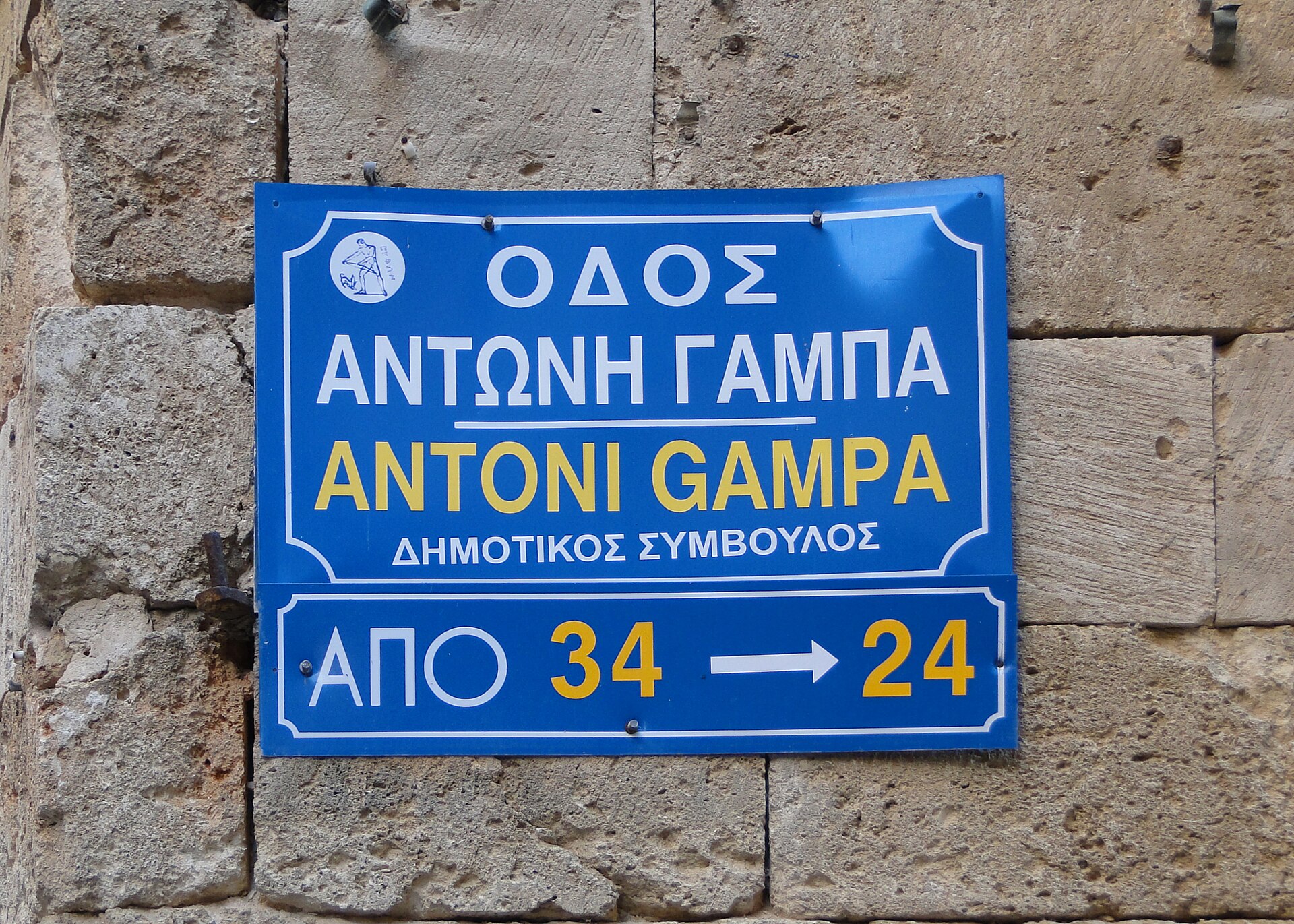
A street sign in Chania pairs uppercase Greek with a Latin-script transliteration. Photo by Bernard Gagnon, CC BY-SA 3.0.4
Sigma
Sigma has one uppercase form and two lowercase forms:
- Σ is uppercase sigma.
- σ is used at the beginning or inside a lowercase word: σπίτι.
- ς is used at the end of a lowercase word: φίλος.
The two lowercase forms represent the same letter and normally the same sound. Unicode encodes final sigma separately as U+03C2, while ordinary lowercase sigma is U+03C3.35
Accents
Modern monotonic Greek mainly uses two marks:
- The tonos marks the stressed vowel: ά, έ, ή, ί, ό, ύ, ώ.
- The dialytika shows that two adjacent vowels are pronounced separately rather than as a digraph: compare καιρός (weather) with καϊμάν (caiman).
Both can appear together, as in ΐ and ΰ. If a whole word is converted to uppercase, the tonos is normally dropped, while the dialytika remains when needed. A capitalized initial vowel can retain its tonos, as in Άννα.3
Punctuation
Most familiar punctuation works as it does in English, with one memorable exception: the Greek question mark looks like a semicolon, ;. Unicode also includes U+037E GREEK QUESTION MARK, canonically equivalent in appearance and use. The raised ano teleia (·, U+0387) separates clauses in a role comparable to a semicolon or colon.5
History
Greek was written before the Greek alphabet existed. Linear B, a syllabic script used for Mycenaean Greek in the second millennium BCE, belongs to an earlier writing tradition. The alphabet that survived into modern Greek instead emerged from contact with Phoenician writing. Scholars broadly agree on the Phoenician connection, while the exact date and place of adoption remain debated.67
The crucial adaptation occurred around the ninth or eighth century BCE. Phoenician writing primarily recorded consonants. Greek speakers reassigned some Phoenician signs for consonants Greek did not need and used them to write vowels. That was not a cosmetic change: Greek has enough meaningful vowel contrasts that recording vowels made words substantially easier to identify.6
The earliest surviving Greek alphabetic inscriptions date to the eighth century BCE. The Dipylon oinochoe from Athens and Nestor’s Cup from Pithekoussai are among the best-known early examples. They already show that there was no single uniform archaic alphabet. Different communities developed epichoric, or local, scripts with different signs and sound values. Early Greek could be written from right to left; some inscriptions also used boustrophedon, reversing direction on alternate lines.67
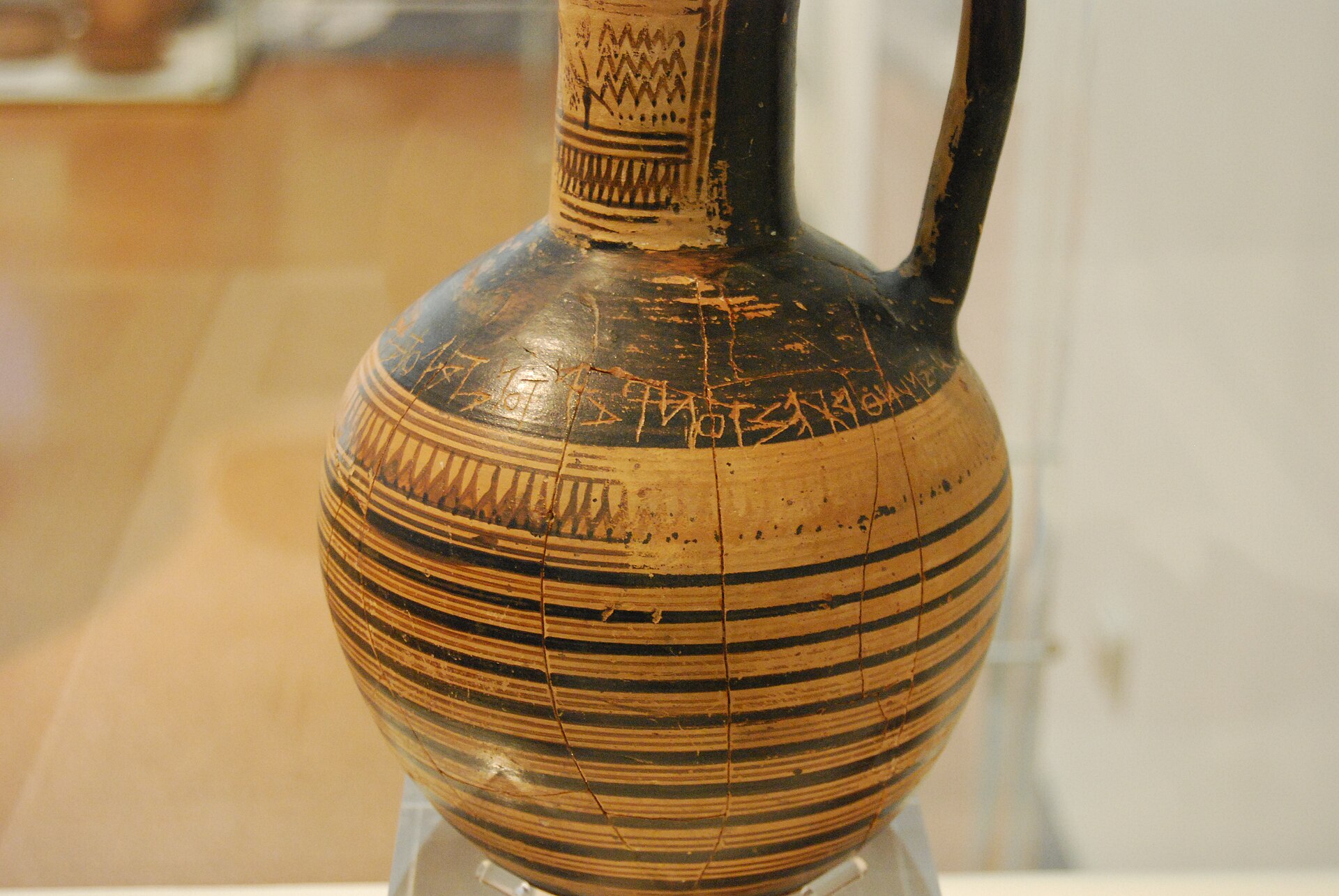
The Dipylon inscription, dated to about 740 BCE, runs around the shoulder of the vessel. Photo by Durutomo, CC BY-SA 4.0.8
The local systems gradually gave way to the Ionic alphabet. Athens made Ionic writing official in 403 BCE, after the restoration of democracy, although Athenians had used it unofficially earlier. By the fourth century BCE, the Ionic system had displaced most local competitors and supplied the familiar sequence of 24 letters from Alpha to Omega.6
The forms changed with the material used for writing. Letters carved into stone remained angular and close to the capital forms readers recognize today. Writing quickly with a pen on papyrus or parchment encouraged rounded, connected, and cursive forms. The development that produced the ancestors of the modern lowercase letters was substantially complete by about the ninth century CE. Greek therefore preserves two histories at once: capitals shaped by inscription and lowercase forms shaped by handwriting.6
Ancient and Modern Greek
Ancient and Modern Greek use the same core 24-letter alphabet, but they do not sound the same. “Ancient Greek pronunciation” is itself an umbrella term: Homeric, Classical Attic, Koine, and later Greek belong to different periods and regions. The table below compares common reconstructions of Classical Attic Greek with Standard Modern Greek rather than claiming one pronunciation for all antiquity.9
| Spelling | Classical Attic value | Modern Greek value |
|---|---|---|
| β | /b/ | /v/ |
| γ | /g/ | /ɣ/ or /ʝ/ |
| δ | /d/ | /ð/ |
| η | /ɛː/ | /i/ |
| θ | /tʰ/ | /θ/ |
| φ | /pʰ/ | /f/ |
| χ | /kʰ/ | /x/ or /ç/ |
| υ | /y/ | /i/ |
| οι | /oi/ | /i/ |
Ancient scholarly editions may also use polytonic writing: acute, grave, and circumflex accents; rough and smooth breathing marks; and the iota subscript. Modern monotonic writing generally needs only the tonos and occasional dialytika. This distinction matters when choosing a keyboard because Modern Greek and polytonic Ancient Greek follow different input conventions.
Several archaic signs sit outside the modern set of 24. Digamma (Ϝ), koppa (Ϙ), and sampi (Ϡ) disappeared from ordinary alphabetic spelling, although forms of them survived in Greek alphabetic numerals. For a fuller treatment of the historical language, see our Ancient Greek guide.
Influence on Other Alphabets
The Greek alphabet became a model because Greek-speaking communities carried different local forms across the Mediterranean and later cultures adapted them to new languages.
- Latin: A western Greek alphabet used by settlers in Italy influenced Etruscan writing; the Romans then adapted the Etruscan alphabet into Latin. The route was therefore Greek → Etruscan → Latin, not a direct copying of today’s standard Greek alphabet.
- Cyrillic: Early Cyrillic drew heavily on Greek manuscript letterforms and added signs for Slavic sounds Greek did not have.
- Coptic: Coptic writing is based mainly on Greek letters, supplemented by signs derived from Egyptian Demotic for Egyptian sounds missing from Greek.
This family resemblance is visible but imperfect. Latin A, B, E, K, M, N, O, T, for example, have recognizable Greek counterparts, while other signs changed shape or value along the way. The influence is historical, not a promise that look-alike letters represent the same sound.37
Greek Letters in Science
Greek letters function as a shared symbol library in mathematics, science, engineering, and statistics. Their meanings come from convention and context, not from the meanings of the letters in Greek words. Germanna Community College’s Greek letter reference sheet documents every convention and unit below except the SI prefix meaning of μ, which is documented by NIST.1011
| Symbol | Field | Specific convention |
|---|---|---|
| α | Mechanics | Angular acceleration, measured in rad/s² |
| β | Statistics | Probability of a Type II error |
| γ | Geometry | A possible angle of a triangle, measured in radians or degrees |
| Δ / δ | Mathematics and chemistry | Change or difference; partial charge, as in δ+ or δ− |
| ε | Mechanics | Strain, a dimensionless ratio |
| ζ | Engineering | Damping ratio |
| η | Fluid mechanics | Dynamic viscosity, measured in Pa·s |
| θ | Geometry and mechanics | Angular position, measured in radians |
| λ | Physics | Wavelength, measured in metres |
| μ | Measurement and statistics | The SI prefix micro, meaning 10−6; population mean |
| ν | Physics | Frequency, measured in hertz |
| ξ | Chemistry | Extent of reaction, measured in moles |
| π | Geometry | The circle constant, approximately 3.14 |
| ρ | Physics | Density, for example in g/cm³ |
| Σ / σ | Mathematics and statistics | Summation; population standard deviation12 |
| τ | Mechanics | Torque, measured in N·m |
| φ | Physics | Phase shift, measured in radians |
| χ | Chemistry | Mole fraction |
| ψ | Quantum mechanics | A wave function |
| ω | Mechanics | Angular velocity, measured in rad/s |
The same letter can mean different things in different disciplines, and capitalization matters: Σ is a summation symbol, while σ commonly represents population standard deviation. English-speaking classrooms also use conventional English letter names, which should not be confused with how those names or letters sound in Modern Greek.1012
How to Type and Translate Greek Online
You do not need to install a system keyboard to enter a short Greek word, quotation, formula label, or search term.
- Open the Greek keyboard. Go to Greek Keyboard Online. It works in the browser without an account or download.13
- Enter the Greek text. Select the virtual keys, use Shift for capitals, and choose σ inside a word or ς at its end.
- Edit and copy the result. Use Space, Enter, and Backspace, then copy the standard Unicode text into a message, document, form, or search box.
- Translate the text. Open the Greek Translator from the keyboard, or paste the copied text into it and select the other language.14
- Reverse-check the meaning. Translate the result back into the language you started with. If the meaning changes, review the ambiguous word or sentence rather than accepting the first output.
- Verify important spelling. Before publishing or submitting the text, check uncertain names, accents, and endings in a trusted dictionary such as the Centre for the Greek Language dictionary used in this guide.1
The virtual keyboard supports all 24 Greek letters, final sigma, uppercase and lowercase input, Space, Enter, Backspace, and one-click copying on desktop and mobile browsers. Text is produced as standard Unicode and keyboard editing happens locally in the browser.13
Key Takeaway
The Greek alphabet is compact, but it carries several layers at once: a 24-letter Modern Greek writing system, a record of more than two millennia of sound change, and a source of symbols and letterforms used far beyond Greek. Learn the Modern Greek names and values separately, remember that σ and ς are one letter, and treat accents as part of correct spelling rather than optional decoration.
FAQ
Is transliteration the same as translation?
No. Transliteration represents Greek letters or sounds in another script, while translation expresses the meaning in another language. The name Γιώργος may be transliterated as Giorgos or Yorgos; translating a Greek sentence requires interpreting its vocabulary and grammar.
Can Greek letters also represent numbers?
Yes. Greek alphabetic numerals assign numerical values to letters and retain additional historical signs such as stigma or digamma, koppa, and sampi. This numeral system is separate from the 24-letter alphabet used for ordinary Modern Greek spelling.6
Can Greek letters spell an English name?
Only approximately. Greek and English do not have identical sound systems, so names should be transliterated by sound, not replaced with visually similar letters. For example, Greek Ρ looks like Latin P but represents an r sound.
Sources
Footnotes
-
Centre for the Greek Language: Dictionary and Phonetic Transcription — Dictionary entries and phonetic conventions used to verify Modern Greek letter names and pronunciation. ↩ ↩2 ↩3 ↩4
-
University of Arizona: Modern Greek Alphabet and Phonetics — Modern Greek alphabet and pronunciation reference. ↩
-
Modern Greek Orthography Notes — Unicode-based reference for the 24 letters, Modern Greek sound values, digraphs, accents, final sigma, and script behavior. ↩ ↩2 ↩3 ↩4 ↩5 ↩6 ↩7
-
Wikimedia Commons: Street sign in Chania — Modern Greek street sign photographed by Bernard Gagnon and licensed under CC BY-SA 3.0. ↩
-
Unicode Greek and Coptic Chart — Code points and official character names for Greek letters and punctuation. ↩ ↩2
-
Mnamon: Greek Alphabets — Scuola Normale Superiore guide to the script’s Phoenician adaptation, local alphabets, Ionic standardization, and lowercase development. ↩ ↩2 ↩3 ↩4 ↩5 ↩6
-
Encyclopaedia Britannica: Greek Alphabet — Overview of the alphabet’s history, forms, and relationship to other scripts. ↩ ↩2 ↩3
-
Wikimedia Commons: Dipylon Inscription — Photograph by Durutomo of the c. 740 BCE inscription, licensed under CC BY-SA 4.0. ↩
-
Cambridge University Press: The Signs and Sounds of Classical Greek — Reconstructed Classical Greek letter and sound values used for the historical comparison. ↩
-
Germanna Community College: Greek Letter Reference Sheet — Reference sheet with examples of Greek letters used as mathematical and scientific symbols. ↩ ↩2
-
NIST: SI Prefixes — Official reference for μ as the symbol for the SI prefix micro. ↩
-
Wolfram MathWorld: Sigma — Reference for uppercase sigma in summation notation and other mathematical uses. ↩ ↩2
-
OpenL Greek Keyboard — Verified keyboard controls, Unicode output, final sigma support, mobile use, and local editing. ↩ ↩2
-
OpenL Greek Translator — Greek text translation tool linked from the keyboard workflow. ↩