Latvian: A Beginner’s Guide to Latvia’s Language
TABLE OF CONTENTS
Latvian is Lithuanian’s only living sister — and the one that changed faster, shifting its stress to the first syllable and wearing down the ends of words until the two languages could no longer understand each other.
Latvian at a Glance
| Native name | latviešu valoda |
| Family | Indo-European → Balto-Slavic → Baltic → East Baltic |
| Speakers | At least 1.5 million native speakers worldwide (Latvian Ministry of Education and Science). In a 2021–2022 official survey of residents aged 18–69, 64.3% named Latvian as a mother tongue |
| Official in | Latvia (sole state language); one of the 24 official languages of the EU |
| Script | Latin alphabet with 33 letters (ā, ē, ī, ū, č, š, ž, ģ, ķ, ļ, ņ; no q, w, x, or y except in loans) |
| Regulated by | Latvian Language Expert Commission of the State Language Centre (Valsts valodas centrs), which codifies the literary language; the Latvian Language Agency promotes the language |
| ISO code | lv / lav |
Classification: An East Baltic Language, Closest to Lithuanian
Latvian is an East Baltic language. Its only living sister is Lithuanian. The other Baltic languages — including Old Prussian — died out centuries ago (Old Prussian by the end of the seventeenth century, according to the Latvian Language Agency). Together, Baltic and Slavic form the Balto-Slavic branch of Indo-European, though linguists still debate whether that means a shared proto-language or a long period of close contact.
Latvian is not a Slavic language, and it is not Germanic. That is worth saying up front, because Latvia sits between Russian and the German-speaking world of the old Baltic provinces, and those neighbors have left deep marks on the vocabulary. The family tree itself points south and east, to Lithuanian and to a lost Baltic world on the southern Baltic coast.
Latvian and Lithuanian began to diverge after about 800 AD. Transitional dialects still connected them into the late Middle Ages, and perhaps later. From that split, Latvian moved faster. Britannica notes that vowel reduction in final syllables has gone much further in Latvian than in Lithuanian, and that contact with Finnic languages helped fix the word accent on the first syllable. Older sources often call that contact “Finnish”; the most important Finnic neighbor on Latvian soil was Livonian, once spoken along the coast.
Is Latvian similar to Lithuanian?
They are as close as two living languages in this branch can be — and still not easy to understand across the border. Our guide to Lithuanian: Europe’s Most Conservative Living Language makes the same point from the other side: think related family members, not two dialects of one language.
You will notice shared grammar (cases, two genders, a richly inflected adjective) and occasional cognates. You will also notice that Latvian has already done many of the things Lithuanian has not: stress has moved to the first syllable, endings have worn down, and centuries of Livonian and German contact have reshaped the lexicon. A Lithuanian speaker does not automatically read a Latvian menu, and the reverse is also true.
Is Latvian similar to Russian?
No. Russian is a Slavic language written in Cyrillic. Latvian is a Baltic language written in a Latin alphabet. The two share a distant Balto-Slavic heritage and many loanwords from long contact, especially in the twentieth century, but the core grammar and everyday vocabulary are different enough that Russian will not unlock Latvian for you.
What Russian will unlock, in Latvia itself, is a large share of daily life. Russian remains a widespread mother tongue and home language, which is why the question comes up so often. Linguistically, though, the closest relative is Lithuanian, not Russian. Latvia’s other Baltic neighbor, Estonian, is not a relative at all: it is a Uralic language, closer to Finnish, and a useful contrast when you meet Finnic traces in Latvian.
Where Latvian Is Spoken
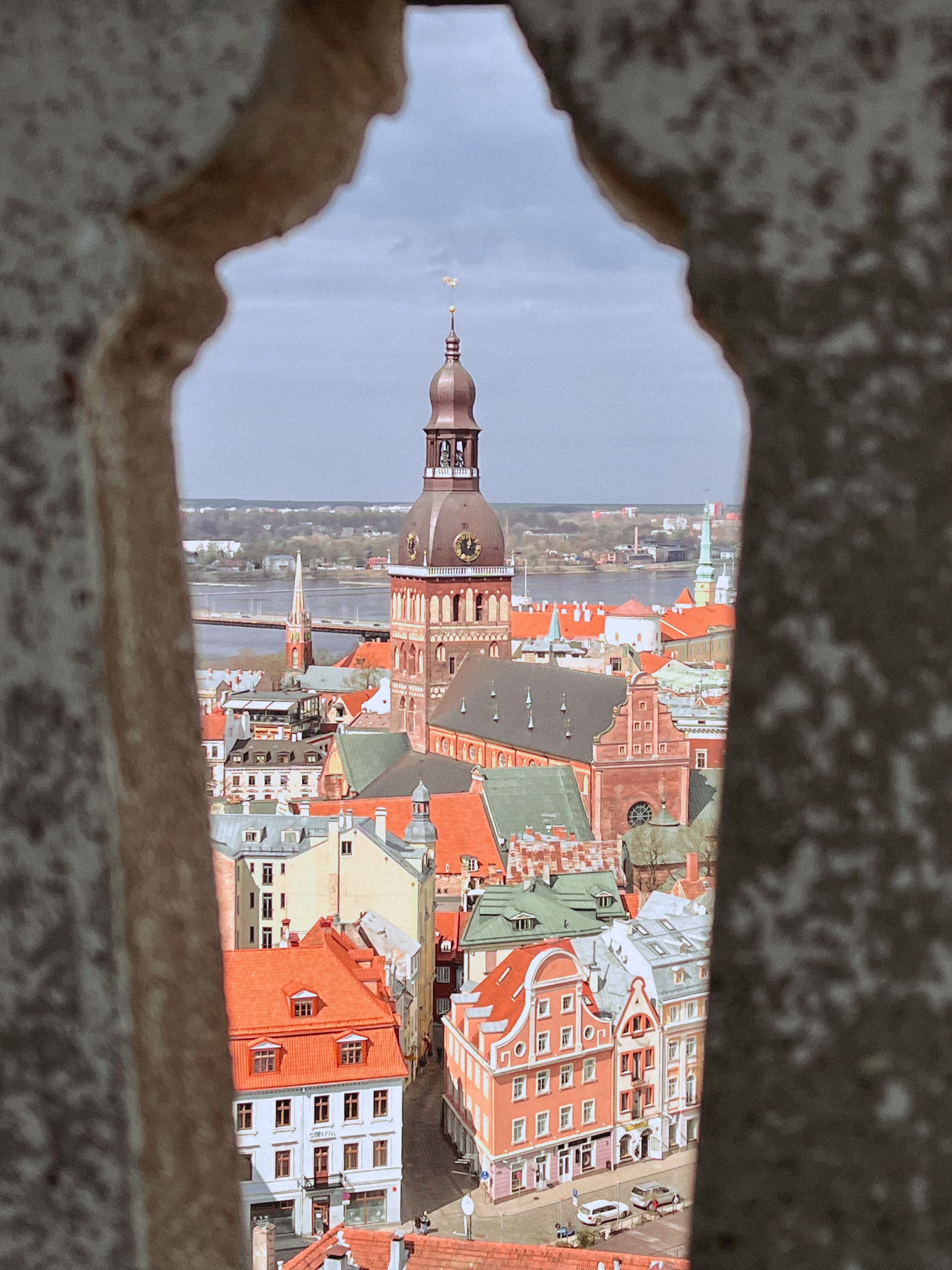
Latvian is the sole state language of the Republic of Latvia, as Article 4 of the Constitution (Satversme) and Section 3 of the Official Language Law both state. When Latvia joined the European Union in 2004, Latvian also became an official EU language. It has been the official language of the Latvian state since independence in 1918.
Most speakers live in Latvia. Communities also exist in other countries — the United States, the United Kingdom, Canada, Australia, Germany, Sweden, and neighboring Lithuania, Estonia, and Russia among them — the result of earlier emigration and of the twentieth-century displacements that marked the Baltic region.
How many people speak Latvian?
There is no neat 2026 census number for mother tongue, and it is better to say so than to invent one. Latvia’s 2021 Population and Housing Census was compiled from administrative registers and did not ask people what language they grew up with. The most recent official figures come from the Central Statistical Bureau’s Adult Education Survey, collected in 2021 and 2022 and published in October 2023.
Among residents aged 18–69:
| Share | |
|---|---|
| Latvian as a mother tongue | 64.3% |
| Russian as a mother tongue | 37.7% |
| Ukrainian as a mother tongue | 1.7% |
| Latgalian as a mother tongue | 1.3% (8.4% in the Latgale region) |
| Latvian used at home | 62.0% |
| Russian used at home | 34.6% |
| Latgalian used at home | 1.2% (8.8% in Latgale) |
The survey allowed more than one mother tongue, so the shares can add up to more than 100%. “Mother tongue” here means a language learned at home in childhood and still understood; “language used at home” is the one language reported for communication in the household at the time of the survey.
For a worldwide total, the Ministry of Education and Science says the number of native Latvian speakers “reaches at least 1.5 million across the world.” A 2022 European Language Equality report, citing the Latvian Language Agency, gave a similar picture: about 1.5 million native speakers, of whom about 1.38 million lived in Latvia, with roughly 500,000 people of other ethnicities speaking Latvian as a second language. Treat those headcounts as the best published estimates, not as a new census.
Dialects, and What Latgalian Is
Standard Latvian is based on the Central dialect (vidus dialekts), spoken in much of Vidzeme, Zemgale, and southern Courland (Kurzeme). Britannica calls this group more conservative than the others and the basis of the modern literary language.
Two other traditional groups matter:
- The Livonic dialect (lībiskais or tāmnieku dialekts), in northwestern Vidzeme and northern Courland, carries a strong Livonian (Finnic) substrate. Many of its speakers’ ancestors shifted from Livonian to Latvian and kept Finnic habits, including shortened endings.
- The High Latvian dialect (augšzemnieku dialekts), in eastern Vidzeme, Sēlija, and Latgale, is the most distinct from the standard. One of its written forms is Latgalian.
Latgalian needs a careful description. Official Latvian policy does not treat it as a separate official language. Section 3(4) of the Official Language Law says the state “shall ensure the maintenance, protection and development of the Latgalian written language as a historic variant of the Latvian language.” Spoken Latgalian belongs, in dialect terms, to High Latvian. Standard written Latgalian has existed since the eighteenth century and is based on southern Latgale varieties.
The 2021–2022 survey still recorded Latgalian separately as a mother tongue and a home language, which tells you it remains a living identity, especially in Latgale, even if the law places the written language inside Latvian rather than beside it.
Livonian itself is treated differently. Section 4 of the same law protects Liv (lībiešu valoda) as the language of the indigenous (autochthon) population. Under Section 5, every other language used in Latvia, except Liv, is a “foreign language” for the purposes of the law. Latvian is the state language; Livonian is a protected indigenous language; written Latgalian is a historic variant of Latvian. Those three legal labels are easy to blur and worth keeping straight.
A Short History: From Catechisms to State Language
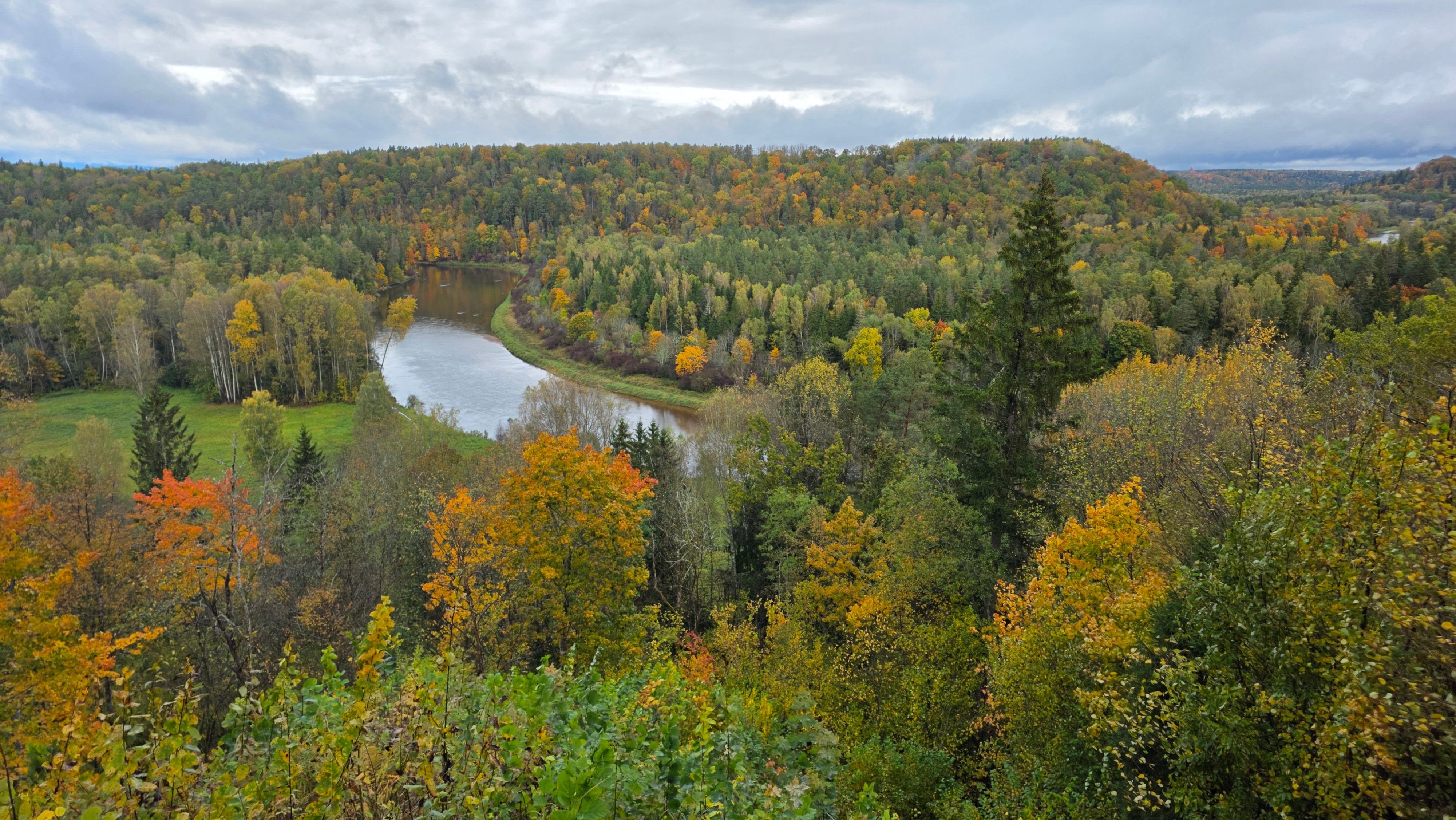
Latvian formed as the languages of Baltic tribes on this territory — Latgalians, Curonians, Semigallians, and Selonians — drew together, in close contact with Finnic-speaking Livonians. The Latvian Language Agency places the start of that consolidation in the tenth to twelfth centuries. The Livonian Crusade in the thirteenth century then created a shared political and religious space in medieval Livonia, under a German-speaking elite.
Writing in Latvian arrived late. Britannica’s earliest texts are a Roman Catholic catechism and a Lutheran catechism, both in Gothic script, from the sixteenth century. The first surviving printed book is usually identified as the 1585 Catholic Catechismus Catholicorum of Petrus Canisius, printed in Vilnius; a Lutheran catechism followed in 1586. A still earlier book, from 1525, is sometimes reported, but it has not been found. The first complete Bible in Latvian was the work of the German pastor Johann Ernst Glück: the New Testament in 1685, the Old Testament in 1689, and the finished work, Tā Svēta Grāmata, issued in 1694.
For a long time, written Latvian was mainly the work of German Lutheran pastors. The first grammar appeared in the eighteenth century. By the end of the nineteenth century, during the Latvian national awakening, the literary language was well developed. In 1908 the linguists Kārlis Mīlenbahs and Jānis Endzelīns worked out the modern alphabet, which gradually replaced the older German-based spelling; a modified Latin alphabet was adopted in 1922.
Independence in 1918 made Latvian the official language of a state for the first time. Soviet occupation later stripped away that status, narrowed the language’s public role, and expanded the use of Russian. During the Third Awakening, official-language status was restored in 1988. The current Official Language Law was adopted on 9 December 1999 and came into force on 1 September 2000. EU official status followed in 2004.
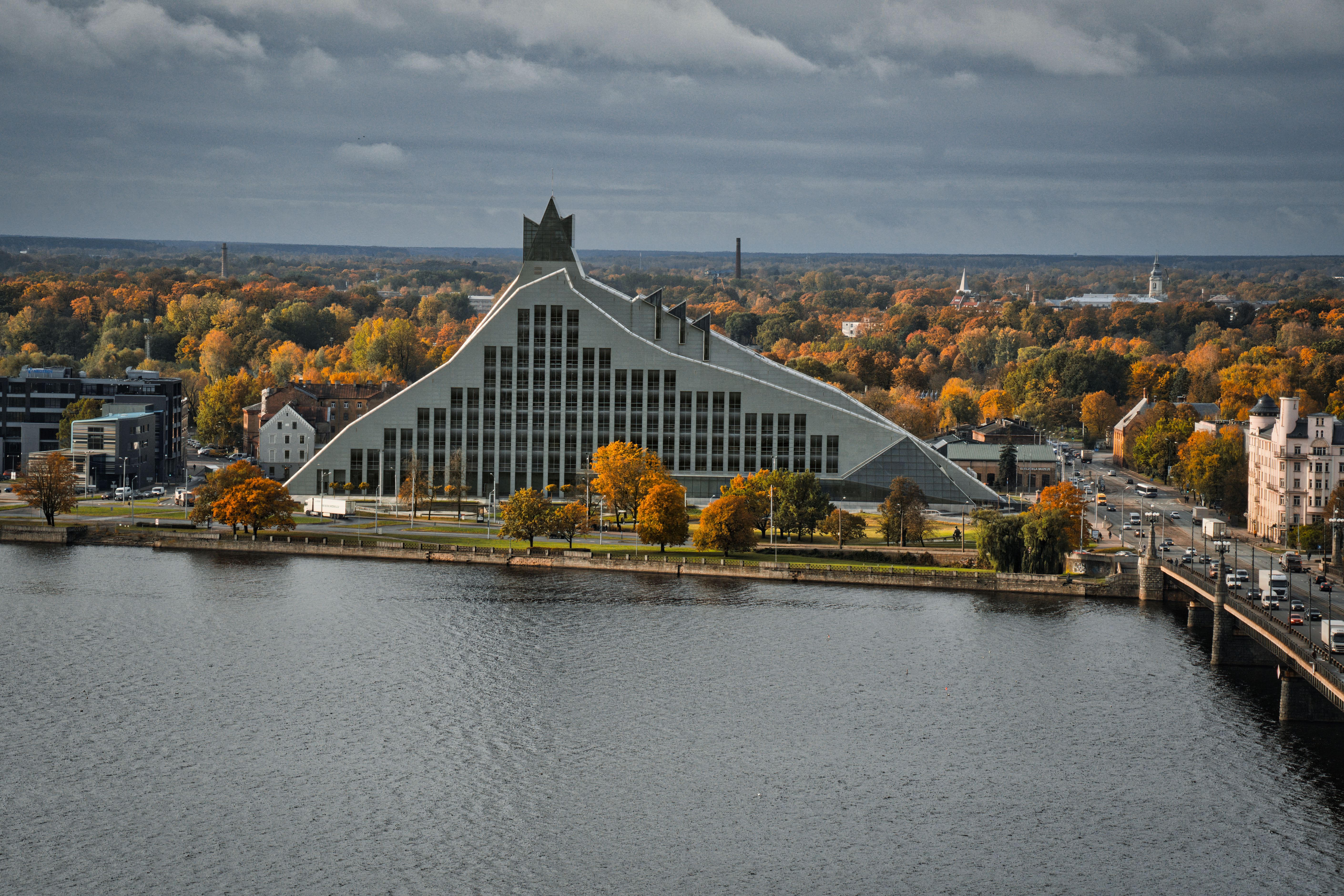
Writing System: 33 Letters, No Q, W, X, or Y
Modern standard Latvian uses a 33-letter Latin alphabet:
A Ā B C Č D E Ē F G Ģ H I Ī J K Ķ L Ļ M N Ņ O P R S Š T U Ū V Z Ž
Twenty-two of those letters are unmodified Latin letters. The four missing ones — q, w, x, and y — appear only in loans, foreign names, or set phrases such as status quo. Eleven more letters are built with diacritics:
- A macron marks a long vowel: ā, ē, ī, ū. The unmarked vowel is short. Length can change the word, so the bar is not decoration.
- A caron marks č, š, ž (roughly ch, sh, and the s in pleasure).
- A comma-like mark (a cedilla in typographic terms, though it sits under the letter, or above lowercase ģ) marks the palatal consonants ģ, ķ, ļ, ņ.
The letters c, s, and z without a caron are [ts], [s], and [z]. Digraphs such as dz and dž also appear. The result is a largely phonetic spelling: once you know the letters, you can usually read a new word aloud, even if you do not yet know what it means.
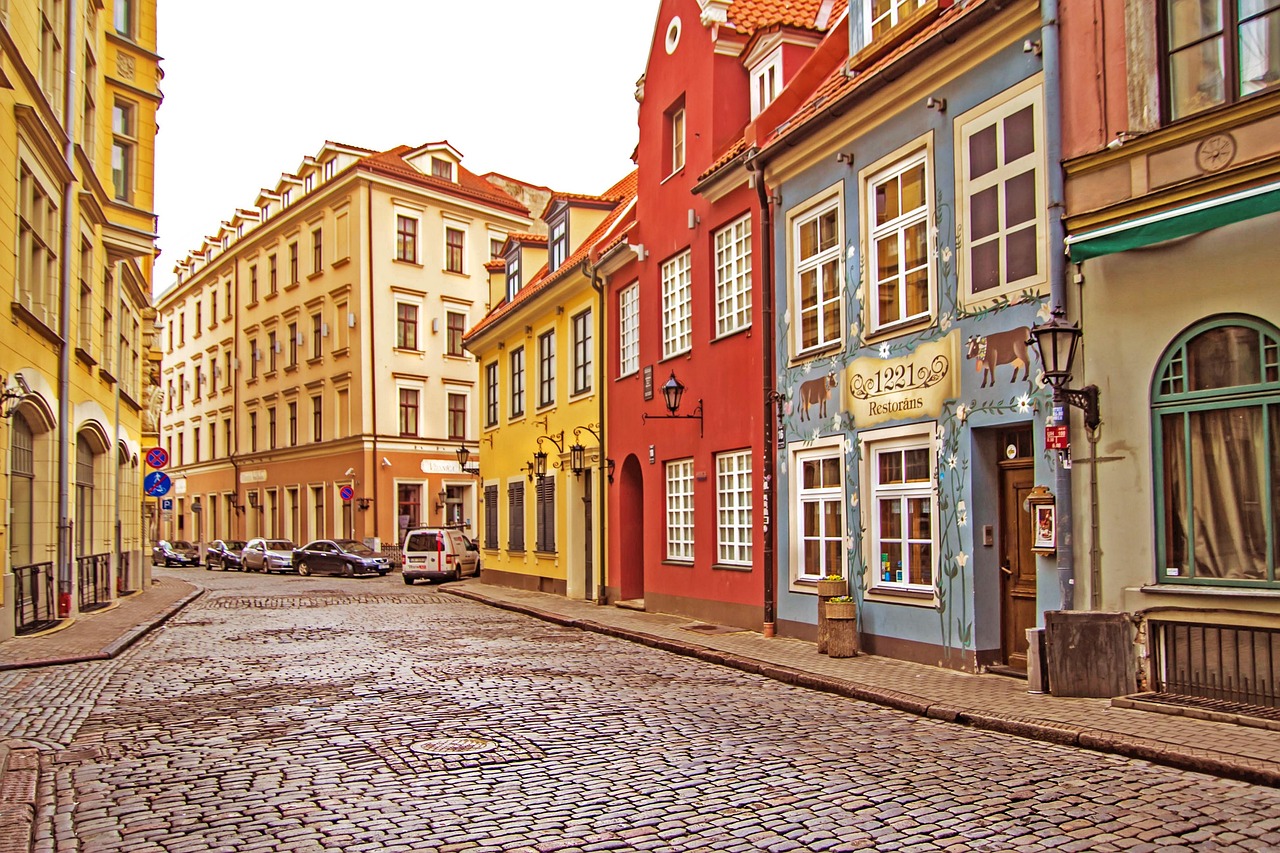
You will see this orthography on street signs as soon as you arrive. A restaurant is a restorāns; the long ā is part of the spelling, not an optional accent.
Sound: First-Syllable Stress and a Broken Tone
If you already know some Lithuanian, the first surprise is stress. Latvian words are almost always stressed on the first syllable. Exceptions exist, but they are few (and often flagged in dictionaries). Lithuanian keeps a free, mobile stress. The Latvian pattern is widely attributed to Finnic contact.
On long syllables — syllables with a long vowel, a diphthong, or a short vowel plus a sonorant such as r, l, ļ, m, n, ņ — Latvian can also distinguish tones, or syllable intonations. The traditional literary set has three:
- the level or drawn-out tone (stieptā intonācija)
- the falling tone (krītošā intonācija)
- the broken tone (lauztā intonācija), which rises and then breaks or weakens in the middle of the syllable, sometimes with a creaky quality
Not every dialect keeps all three. In much of western Latvia the broken tone has merged with the falling tone; in the east, the level and falling tones have often merged. Ordinary spelling does not mark any of them. Learners meet the contrast by ear, and even many fluent speakers, depending on where they grew up, distinguish only two patterns in practice.
Grammar: Seven Cases and Two Adjective Endings
Latvian is a classic inflected Baltic language. Nouns, adjectives, pronouns, and declinable participles change their endings for case, gender, and number. There are no articles. Basic word order is subject–verb–object, but the order is relatively free, because the endings already show who did what. Moving a phrase often changes emphasis rather than meaning.
There are two genders, masculine and feminine, and two numbers, singular and plural. Standard Latvian does not use a dual. Nouns fall into six declension classes (three masculine, three feminine).
Does Latvian have seven cases?
Yes. School and reference grammars list seven cases: nominative (nominatīvs), genitive (ģenitīvs), dative (datīvs), accusative (akuzatīvs), instrumental (instrumentālis), locative (lokatīvs), and vocative (vokatīvs).
The instrumental is a special case in more than one sense. In the singular it is always identical to the accusative; in the plural it is identical to the dative. In modern Latvian it is used as a free-standing case only in highly restricted contexts. The everyday way to say “with” is the preposition ar plus that shared form: ar māju, “with the house.”
Here is māja (“house”), a regular feminine noun in -a. The same pattern appears with sieva (“woman, wife”). Māja is also a Livonian loanword (Livonian mōj), which we will come back to.
| Case | Latvian | English |
|---|---|---|
| Nominative | māja | a/the house (subject) |
| Genitive | mājas | of the house |
| Dative | mājai | to/for the house |
| Accusative | māju | the house (object) |
| Instrumental | (ar) māju | with the house |
| Locative | mājā | in the house |
| Vocative | māja! | (addressing) |
A masculine example from the first declension, vīrs (“man, husband”), takes a different set of endings (vīrs, vīra, vīram, vīru, vīrā…). The locative singular often ends in a long vowel: mājā, vīrā.
Gender, adjectives, and verbs
Because Latvian has no articles, definiteness shows up on the adjective. Adjectives have two sets of endings: indefinite and definite. The adjective zils (“blue”) is a clear pair: zils is the indefinite masculine form (a blue…); zilais is the definite form (the blue…). Feminine forms follow the same logic (zila / zilā). Adjectives agree with the noun in gender, number, and case.
That one fact is as practical as it is typological. English speakers look for a and the. Latvian speakers change the adjective instead.
Verbs fall into three conjugation classes and are conjugated for person, tense, mood, and voice. You do not need the whole verb chart on the first day, but you should expect endings to do a lot of work that English does with extra words.
Vocabulary: Livonian, German, and Later Russian
The family tree is Baltic. The word-stock is a record of who lived next door.
Finnic, mainly Livonian and also Estonian, contributed several hundred loans — commonly estimated at about 500 to 600. Everyday words sit in this layer: māja (“house,” Livonian mōj), puika (“boy,” Livonian pūoga), sēne (“mushroom,” Livonian sēņ).
Middle Low German, from the long Baltic German period, left a large practical vocabulary: amats (“profession”), būvēt (“to build”), bikses (“trousers”), dambis (“dam”). Swedish rule in part of Livonia added words such as skurstenis (“chimney”).
Russian and other Slavic languages added later layers, especially in administration, everyday urban life, and the Soviet period. At a deeper time depth, Latvian also has loans from other Baltic languages, including ķermenis (“body”) from Old Prussian and veikals (“store”) from Lithuanian.
The point for a learner is not to memorize the etymologies. It is to recognize why a “conservative” Baltic language can still feel mixed: the grammar keeps a Baltic shape, while many of the most ordinary nouns have walked in from Livonian or German.
Common Latvian Phrases
Stress falls on the first syllable in these words. The pronunciations below are rough English guides, not phonetic transcriptions. Spellings follow standard Latvian.
| English | Latvian | Rough pronunciation |
|---|---|---|
| Hello (general) | Sveiki | SVEH-kee |
| Good day | Labdien | LUHB-dyen |
| Good morning | Labrīt | LUH-breet |
| Good evening | Labvakar | LUHB-vah-kahr |
| Please / You’re welcome | Lūdzu | LOO-dzoo |
| Thank you | Paldies | PUHL-dyehs |
| Yes / No | Jā / Nē | yah / neh |
| Excuse me | Atvainojiet | UHT-vay-noh-yeht |
| Sorry | Piedodiet | PYEH-doh-dyeht |
| Goodbye | Uz redzēšanos | ooz REHD-zeh-shuh-nohs |
| Do you speak English? | Vai jūs runājat angliski? | vai yoos ROO-nah-yat AHN-glis-kee |
| I don’t understand | Es nesaprotu | es NEH-sah-proh-too |
| My name is… | Mani sauc… | MAH-nee sowts |
| Help! | Palīgā! | PAH-lee-gah |
Lūdzu does double duty, like bitte in German: it is “please,” “you’re welcome,” and the word you say when you hand something over. Paldies is the word most visitors learn first.
Is Latvian Hard to Learn?
For English speakers, Latvian is a Category III language on the U.S. State Department / Foreign Service Institute scale: about 44 weeks (1,012 class hours) of full-time study to professional working proficiency. That is the same band as Lithuanian, Estonian, Russian, Polish, and Czech — harder than Spanish or German, far easier than Arabic, Chinese, Japanese, or Korean.
The FSI figure describes English-speaking adults in an intensive classroom, aiming for an Interagency Language Roundtable score of 3. It measures distance from English, not how “hard” Latvian is in the abstract. A self-taught learner will usually need more clock hours; someone who already knows Lithuanian or another case language will need fewer.
| Easier than it looks | Harder than it looks |
|---|---|
| Latin alphabet, largely phonetic spelling | Seven cases and several declension classes |
| Stress almost always on the first syllable | Definite vs. indefinite adjective endings |
| No new script to learn | Palatal letters (ģ, ķ, ļ, ņ) and long vowels |
| A clear official standard | Tones that spelling does not mark |
| Close typological kinship with Lithuanian, if you know some already | Everyday vocabulary that often does not match Lithuanian or Russian |
If you already speak Lithuanian, ignore most of the headline FSI estimate. You are not starting from zero; you are learning a sister standard, a new stress pattern, and a lot of new words. If you are starting from English, the cases and the adjective system will take the most time. The writing system will not.
Tips for Learning Latvian
- Learn nouns with their gender and a second case form. Māja, mājas (house) or vīrs, vīra (man) teaches the pattern faster than the nominative alone.
- Learn adjectives as a pair. When you write zils, also write zilais. Definite and indefinite endings are part of the word, not an optional extra.
- Trust first-syllable stress from day one. If you have studied Lithuanian, you will have to unlearn free stress. Mark the first syllable and only note the rare exceptions.
- Write the diacritics even in your notes. Labrīt is not Labrit; restorāns is not restorans; lūdzu is not ludzu. The macron and the palatal marks are part of the spelling.
- Use Lithuanian and Russian as contrast, not as substitutes. Lithuanian helps you see Baltic grammar. Russian may help you in the street in Riga. When you speak or write Latvian, switch to the Latvian forms on purpose.
- Leave the tones for your ear. You do not need to transcribe stieptā and lauztā in the first month. Listen to standard news and to speakers from different regions, and let the broken tone become a sound you recognize rather than a rule you fear.
Translating Latvian with AI
Latvian is a friendly language for machines in one respect: it uses a regular Latin orthography, and a missing macron is at least visible on the page. It is still a fusional language. One noun can take many endings; adjectives must agree and also choose a definite or indefinite form; word order can shift for emphasis; and Latgalian or strongly dialectal text may not match the standard data a model has seen. The tones that distinguish some words never appear in ordinary spelling, so they cannot help a translator either.
When you need to read a Latvian email, menu, form, or news paragraph, OpenL can translate Latvian to and from English and many other languages. It is also a practical way to check a sentence you have just written. For contracts, medical text, or anything high-stakes, have a fluent speaker review the result.
Latvian rewards that kind of careful reading. It is a small official language with a long memory — Baltic in its grammar, Livonian and German in many of its everyday words, and no longer quite the same language as the sister just across the southern border.
Sources
- Latvian is mother tongue of 64% of the population — Official Statistics Portal / Central Statistical Bureau of Latvia — Adult Education Survey 2021–2022 (published 23 October 2023): mother-tongue and home-language shares for residents aged 18–69, including Latgalian
- Population and Housing Census 2021 — Centrālā statistikas pārvalde — the 2021 census was based on administrative data and did not collect mother-tongue information
- State Language — Ministry of Education and Science of Latvia — official state-language status, Constitution Article 4, “at least 1.5 million” native speakers worldwide, EU official status since 2004
- Official Language Law — likumi.lv (English translation) — official language (Section 3); Latgalian written language as a historic variant (Section 3(4)); Liv as the indigenous language (Section 4); literary norms codified by the Latvian Language Expert Commission (Section 23); supervision by the State Language Centre (Section 26)
- About us — State Language Centre (Valsts valodas centrs) — the Centre supervises compliance with the Official Language Law
- About Us — Latvian Language Agency — agency role in promoting the official language
- Vēsture (History) — Latvian Language Agency — tribal origins and Finnic contact; first surviving printed books (1585, 1586); 1525 book reported but not found; restoration of official status in 1988; Official Language Law 1999
- Latvian language — Encyclopaedia Britannica — East Baltic classification; official since 1918; 16th-century catechisms in Gothic script; first grammar in the 18th century; Latin alphabet adopted in 1922; Central dialect as the literary base; more innovating than Lithuanian; first-syllable accent and Finnic (“Finnish”) influence
- Latvian language — Wikipedia — classification, 33-letter alphabet, loanwords (including Livonian māja, puika, sēne and German amats, būvēt, bikses), 1908 Mīlenbahs–Endzelīns orthography
- Matthew 2:1–6, translated by Johann Ernst Glück — Linguistics Research Center, University of Texas at Austin — New Testament published in 1685, Old Testament in 1689; distribution of the complete Bible began in 1694
- Tā Svēta Grāmata — Latvian Wikipedia — New Testament published in 1685; Old Testament printing begun in 1689, with the title page often dated 1689; complete Bible finished and issued in 1694
- The Translation of ˁāpār ‘Dust’ in the Latvian Bible — Aaron Shryock and Kaspars Ozoliņš, Ceļš 70 — New Testament in 1685, Old Testament in 1689; completed work Ta Śwehta Grahmata released in 1694
- Latvian declension — Wikipedia — seven cases, six declension classes, instrumental syncretism with accusative (singular) and dative (plural)
- Latvian phonology — Wikipedia — fixed initial stress; level, falling, and broken tones, and regional mergers
- Stress and intonations in Latvian — valoda.ailab.lv — first-syllable stress; description of the level, falling, and broken intonations
- Adjectives — Latvian Grammar (valoda.ailab.lv) — indefinite vs. definite adjective endings, with zils / zilais paradigms
- Foreign Language Training — U.S. Department of State (FSI / NFATC) — Latvian in Category III, about 44 weeks / 1,012 class hours
- Latvian phrasebook — Wikivoyage — standard phrases and pronunciation guides
- Useful Latvian phrases — Omniglot — cross-check of greetings, lūdzu, paldies, and related phrases
- Latvian Grammar (University of Latvia, 2021) — three dialects (Central, Livonic, High Latvian); Standard Latgalian as a historical variety of Latvian since the 18th century
- Language Report Latvian (European Language Equality, 2022) — about 1.5 million native speakers, 1.38 million in Latvia, and about 500,000 second-language speakers, citing the Latvian Language Agency
- Flower Colors icon — SVG Repo — CC0 cover thumbnail from the Ecology Green Vectors pack