Malay vs Indonesian: What's the Difference?
 Add to Chrome

TABLE OF CONTENTS
Malay and Indonesian are close enough that speakers can usually keep a conversation going — and different enough that Malaysian television sometimes subtitles Indonesian dramas.
Are Malay and Indonesian the same language?
It is a fair question, and it does not have a one-word answer that satisfies everyone.
Indonesian (bahasa Indonesia) and Standard Malay (bahasa Melayu, also called the Malaysian language / bahasa Malaysia in some official Malaysian usage) are standardized varieties of Malay, an Austronesian language. Encyclopaedia Britannica describes the dialect of the southern Malay Peninsula as the basis of both standard Malay and of Indonesian. Linguists typically treat them as closely related standards in a pluricentric Malay world, not as distant, unrelated languages.
What you call the language depends on where you are standing:
- In Indonesia, Article 36 of the 1945 Constitution states that the national language is Indonesian. In everyday Indonesian usage, “Malay” (bahasa Melayu) usually refers to regional Malay varieties — especially in parts of Sumatra and Kalimantan — not to the national standard. Indonesian is the unifying language of a highly multilingual country.
- In Malaysia, Article 152 of the Federal Constitution and the National Language Act 1967 establish Malay as the national and official language. The government’s official portal describes it as “the Malay language, also known as the Malaysian language.”
- In Singapore, the Constitution (Article 153A) names Malay, Mandarin, Tamil, and English as the four official languages, and states that the national language shall be Malay, in the Roman script.
- In Brunei, section 82 of the Constitution provides that the official language is Malay.
ISO and Ethnologue list Indonesian (ind) and Standard Malay (zsm) as separate language codes inside the Malay macrolanguage (msa). That catalog choice is a practical way to keep the two standards distinct. It is not a verdict that they are “completely different languages,” and it does not settle political arguments about whether they are “the same language.”
A precise description is this: they are closely related standardized varieties with high mutual intelligibility, especially in formal writing, and they are official in different states under different names. For translation and localization, you still need to choose a standard.
How many people speak Malay and Indonesian?
Speaker counts depend on what is being counted. Ethnologue treats Indonesian and Malay as individual languages, not as one combined macrolanguage total. According to Ethnologue’s 2025 figures, as reported by The Indian Express in May 2025, Indonesian has about 252.4 million speakers and ranks among the world’s ten most spoken languages. A large share of those users speak Indonesian as a second language alongside a regional mother tongue. Standard Malay is the national or official language in Malaysia, Brunei, and Singapore. Adding those populations to the Indonesian total would mix two different cataloging decisions, so this article keeps the figures separate.
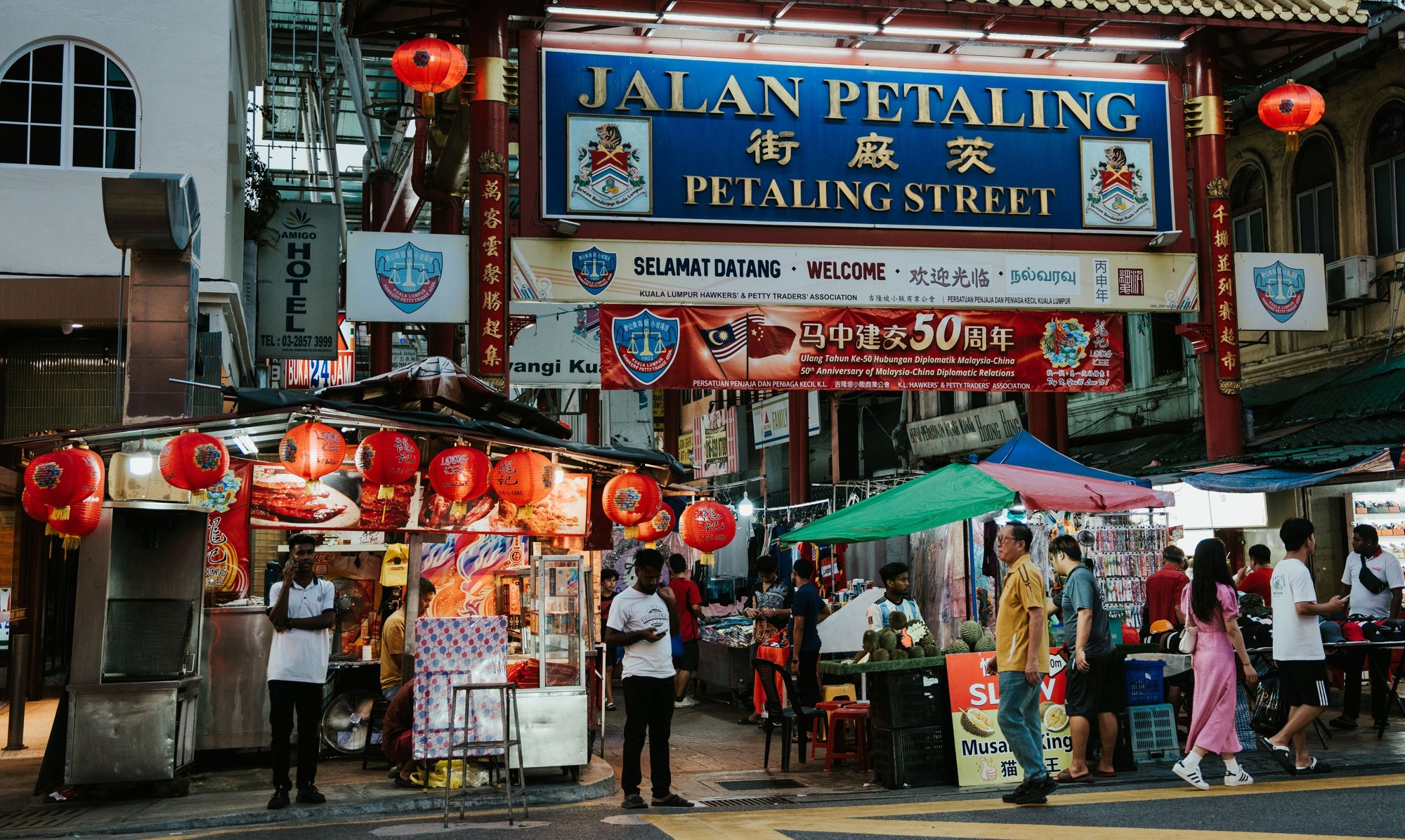
Public signage in Kuala Lumpur often places Malay first, then other official or community languages — a visible reminder that Standard Malay is the national language of a multilingual country.
How similar are Malay and Indonesian?
In formal registers, the two standards share a great deal: a Latin (Rumi) writing system, largely the same core grammar, and a large common vocabulary inherited from Malay. Typical features of Malay grammar, as Britannica outlines, include affixes and reduplication to mark grammatical and semantic changes — for example, beli (“buy”) and membeli (“to buy”), or rumah (“house”) and rumah-rumah (“houses”).
Speakers of the two standards can often understand one another, especially in writing and in careful speech. The gap is still noticeable. Differences show up in vocabulary, pronunciation, some spelling, and the main source of loanwords. Informal, colloquial speech — Jakarta slang on one side, colloquial Peninsular Malay on the other — is harder to follow than a news broadcast or an official document. That is one reason Malaysian television has provided Malay subtitles for Indonesian dramas (sinetron), and the other way around.
The two sides also do not always describe the relationship in the same terms. Comparative overviews often note that Malaysians are more likely to treat Malay and Indonesian as varieties of one language, while Indonesians more often treat Indonesian as a language in its own right — closely related to Malay, but not called “Malay” in everyday national use. Neither view is a reason to ignore the practical differences.
If you already know Indonesian and want a fuller picture of it as Indonesia’s national standard, see our guide to Bahasa Indonesia. This article stays with the comparison.

A Kuala Lumpur bookstore: formal written Malay is usually the easier layer for an Indonesian reader to follow; informal speech and local vocabulary are where the gap widens.
Vocabulary: Dutch vs English loanwords
Why do Malay and Indonesian use different words for the same things?
The most useful everyday differences are often lexical, and many of them follow colonial history. After the Anglo-Dutch Treaty of 1824 divided much of the archipelago between British and Dutch control, Indonesian borrowed heavily from Dutch, while Standard Malay in Malaysia, Singapore, and Brunei more often borrowed from English.
| English | Standard Malay | Indonesian | Why they differ |
|---|---|---|---|
| car | kereta | mobil | Indonesian mobil is the everyday word for a car (KBBI). In Malay, kereta is the everyday word for a car (Kamus Dewan). |
| office | pejabat | kantor | Indonesian kantor comes from Dutch kantoor. Malay uses the Malay-based word pejabat. |
| post office | pejabat pos | kantor pos | The same contrast. In Indonesian, pejabat more often means an official, so pejabat pos suggests a postal official, not the building. |
| doctor | doktor | dokter | English-influenced vs Dutch-influenced spelling. KBBI lists dokter; Kamus Dewan lists doktor. |
| police | polis | polisi | See also the false-friend table below. |
| tax | cukai | pajak | In Indonesian, pajak is the ordinary word for tax (KBBI). Kamus Dewan treats that tax sense as Indonesian and records pajak in Malay chiefly as a lease, concession, or pawn-related term. |
| university | universiti | universitas | English-style -iti vs a Latin/Dutch-style -itas. |
| quality | kualiti | kualitas | The same pattern appears in kuantiti / kuantitas and majoriti / mayoritas. |
| television | televisyen | televisi | From English television vs Dutch televisie. |
| secretary | setiausaha | sekretaris | A Malay compound vs a Dutch loan (secretaris). |
Indonesian also uses a decimal comma, spoken as koma, following Dutch practice, while Malaysian Malay uses a decimal point, spoken as perpuluhan. Time expressions can diverge too: Indonesian pukul setengah tujuh, modeled on Dutch half zeven, means 6:30, whereas Malay pukul tujuh setengah means 7:30.
The Dutch layer in Indonesian is one reason a background in Dutch can occasionally explain a word that Standard Malay does not share. It is still not a shortcut around choosing the right standard.
False friends that can trip you up
What are some false friends between Malay and Indonesian?
Some words look the same and do not mean the same thing in everyday use. Dictionaries sometimes record overlapping senses, so the safest examples are ones where official dictionaries clearly mark a dominant or labeled difference.
| Word | Typical Standard Malay use | Typical Indonesian use | How we checked |
|---|---|---|---|
| bisa | venom, poison | can, be able (KBBI also records the “poison” sense) | Kamus Dewan lists the “can” sense as Indonesian (Id). In Malay, “can” is usually boleh or dapat. |
| kereta | car (and, more broadly, a wheeled vehicle) | a carriage or wagon; also short for kereta api, “train” | KBBI: a (usually horse-drawn) wheeled vehicle, or a train. Kamus Dewan: a wheeled vehicle, including a motorcar. |
| pajak | lease, concession, or pawn-related senses | tax | Kamus Dewan marks the “tax / cukai” sense as Indonesian. |
| pejabat | office (the workplace or building) | a government official | KBBI’s primary sense is an official; a “office” sense is marked classical/literary. Kamus Dewan treats the “official” sense as Indonesian. |
| polis / polisi | polis = police; polisi = a policy, including an insurance policy | polisi = police | KBBI: polisi is the police. Kamus Dewan: polisi is a policy or insurance document. |
A few well-known pairs are messier than listicles suggest. Percuma is often cited as “free of charge” in Malay and “useless” in Indonesian. Both KBBI and Kamus Dewan actually record both senses. In practice, Indonesian speakers more often use gratis or cuma-cuma for “free of charge,” and percuma for “in vain.” If a word is not clean in the dictionaries, it is safer not to treat it as a hard false friend.
The comparison is not unlike Brazilian vs European Portuguese: mutual understanding is real, and so are the words that can send a sentence sideways.
Spelling: what the 1972 reform fixed — and what still differs
Do Malay and Indonesian use the same spelling?
Until the late twentieth century, the two standards used different Latin spelling systems shaped by English and Dutch. In British Malaya, Wilkinson’s romanization used forms such as ch for the sound in cucu (“grandchild”). In the Dutch East Indies, Van Ophuijsen’s system used Dutch-influenced spellings such as tj and oe, so the same word could appear as tjoetjoe. Indonesia had already replaced oe with u in the 1947 Republican spelling, but many differences remained.
On 16 August 1972, Indonesia and Malaysia officially announced a shared spelling system — Ejaan yang Disempurnakan (Perfected Spelling, or EYD) in Indonesia and Ejaan Rumi Bersama (Joint Rumi Spelling) in Malaysia. Under the new system, older tj / ch became c, Indonesian dj became j, and Indonesian j for the semivowel became y, matching Malay. The word for “grandchild” is now cucu in both standards.
That reform removed most systematic spelling gaps, but not all differences. Arabic and European loans still often diverge, as in universiti / universitas and kualiti / kualitas. Coordination of terminology continues through MABBIM (Majlis Bahasa Brunei Darussalam-Indonesia-Malaysia), the trilateral language council in which Malaysia’s Dewan Bahasa dan Pustaka (DBP) and Indonesia’s Badan Pengembangan dan Pembinaan Bahasa (the Agency for Language Development and Cultivation, which maintains the Kamus Besar Bahasa Indonesia, or KBBI) take part. Brunei is a member of MABBIM. Singapore’s official standard is Malay, not Indonesian.

The National Library of Indonesia in Jakarta: Indonesian is the language of national education, media, and official life, even though hundreds of regional languages are spoken at home.
Pronunciation: same letters, different sounds
Even when the spelling matches, the spoken standards can sound distinct. A widely described contrast is between Johor–Riau pronunciation, common on the Malay Peninsula, and Bahasa Baku (“standard language”) pronunciation, in which words are spoken more nearly as written. Bahasa Baku is associated with Standard Indonesian, and also with formal pronunciation in East Malaysia and in Standard Singapore Malay.
In Johor–Riau pronunciation, a final written a often sounds like a schwa /ə/, so kereta may sound closer to kerete. In Indonesian and other Bahasa Baku varieties, that final a is typically /a/. Other Johor–Riau patterns include lowering i and u toward e and o in certain final closed syllables (kambing sounding more like kambeng, tahun more like tahon), and a final r that may be dropped. Indonesian generally keeps those consonants and vowels closer to the spelling.
Letter names also follow different models: Indonesian letter names come from Dutch, Malaysian Malay letter names from English. The first three letters of the alphabet are roughly a-be-ce in Indonesian and e-bi-si in Malay.
Which should I learn / use in translation?
Choose the standard your audience actually uses.
- Translating or localizing for Indonesia — including product interfaces, help centers, marketing, and official communication — use Indonesian. Do not assume a Malay translation will also work in Jakarta. Dutch-derived everyday words (kantor, mobil, dokter, polisi, pajak) are part of what makes a text sound native there, and pejabat will usually be read as an official, not as an office.
- Translating or localizing for Malaysia — and, in most cases, for Standard Malay in Brunei and Singapore — use Standard Malay. English-influenced forms and Malay-based official terms (pejabat, universiti, polis, cukai) are the expected standard. Singapore’s national language is Malay, but much public and business communication is in English; when you do use Malay there, follow the Standard Malay norm, not Indonesian.
- Learners should start with the standard of the country they will live, work, or travel in. The grammar you learn will transfer well. The vocabulary, pronunciation, and false friends will not transfer automatically. If you later need the other standard, you are not starting from zero — but you are not finished, either.
- One formal text is not a substitute for the other. Formal writing is the most mutually intelligible layer. Colloquial speech, humor, advertising, and legal or academic terminology are where small differences become expensive.
This is the same practical rule that applies to other closely related standards: match the official variety, then have a fluent speaker of that variety review anything high-stakes.
Translating Malay and Indonesian
Because the two standards share so much, a generic “Malay” setting in software can hide a real choice. For a news paragraph, a menu, or a short email, it helps to translate into the standard you actually need. OpenL treats the two as separate language options: use OpenL Translate for Malay when your audience is in Malaysia (or you need Standard Malay in Brunei or Singapore), and OpenL Translate for Indonesian when your audience is in Indonesia. The short codes /translate/ms and /translate/id redirect to those pages.
Machine translation is a fast way to compare a sentence in both standards or to check a word you have just learned. For contracts, medical or legal text, or public-facing brand copy, have a fluent speaker of the target standard review the result.
Sources
- Malay language — Encyclopaedia Britannica — Austronesian classification; southern Malay Peninsula dialect as the basis of standard Malay and Indonesian; affixes and reduplication
- Comparison of Indonesian and Standard Malay — Wikipedia — official-status overview; mutual intelligibility and television subtitling; loanword contrasts; pronunciation (Johor–Riau vs Bahasa Baku); decimal and time-expression differences
- Indonesian–Malaysian orthography reform of 1972 — Wikipedia — 16 August 1972 announcement of EYD / Ejaan Rumi Bersama; pre-1972 Wilkinson and Van Ophuijsen systems
- The 1945 Constitution of the Republic of Indonesia (official English translation) — Article 36: “The national language is Indonesian.”
- Official language — Government of Malaysia — Article 152 and the National Language Act 1967; “Malay language, also known as the Malaysian language”
- Constitution of the Republic of Singapore, Article 153A — four official languages; Malay as the national language in the Roman script
- Constitution of Brunei Darussalam, section 82 — Constitute — official language is Malay
- KBBI VI Daring — official Indonesian dictionary (Badan Pengembangan dan Pembinaan Bahasa): entries for bisa, kereta, pajak, pejabat, polisi, percuma, kantor, mobil, and dokter
- Pusat Rujukan Persuratan Melayu / Kamus Dewan — official Malay dictionary of Dewan Bahasa dan Pustaka: entries for bisa, kereta, pajak, pejabat, polis, polisi, percuma, and doktor
- MABBIM — Dewan Bahasa dan Pustaka — trilateral language council of Brunei, Indonesia, and Malaysia
- Indonesian — Ethnologue — official national language of Indonesia; Austronesian family; part of the Malay macrolanguage
- Top 10 most spoken languages in 2025 — The Indian Express — reports Ethnologue 2025 figure of about 252.4 million Indonesian speakers, ranked as an individual language rather than a macrolanguage
- Books icon — SVG Repo — CC0 cover thumbnail from the School Set 2 collection
- Interior of BookXcess RexKL — Pexels — Kuala Lumpur bookstore photograph by Theodore Nguyen
- Silhouette of a person reading in a Jakarta library — Pexels — National Library of Indonesia photograph by Isnania Isnania
- Petaling Street, Kuala Lumpur — Pexels — multilingual street-signage photograph by G N