Mongolian: The Language Written Vertically
 Add to Chrome
TABLE OF CONTENTS
Mongolian can look like two different languages: Cyrillic text in Ulaanbaatar and vertical columns of traditional script in Inner Mongolia. They are part of one wider language world shaped by migration, script reform, and a grammar that builds meaning through endings.
Mongolian at a Glance
Mongolian belongs to the Mongolic language family. The main standard of the independent state of Mongolia is Khalkha Mongolian, while related varieties are spoken across northern China and parts of Russia.
| Question | Short answer |
|---|---|
| Language family | Mongolic; Khalkha is the national standard of Mongolia |
| Main country | Mongolia |
| Other major areas | Inner Mongolia in China; Buryat and other Mongolic-speaking communities in Russia |
| Official status | Mongolia’s statutory national language under Article 8(1) of the 1992 Constitution |
| Current population baseline | Mongolia had 3,568,978 residents in the World Bank’s 2025 estimate; this is a country figure, not a speaker count |
| Best dated speaker estimate | 5.2 million speakers in 2005; no directly comparable 2026 total covers all varieties |
| Writing systems | Mongolian Cyrillic in Mongolia; traditional Mongolian script remains central in Inner Mongolia and in Mongolia’s script-revival work |
That last distinction matters. A country’s population is not the same thing as the number of people who speak one language, and an ethnic census is not automatically a language census. The clearest dated public estimate records 5.2 million speakers in 2005. It is useful as a scale, not as a 2026 census: newer sources divide Khalkha, Inner Mongolian varieties, Buryat, Oirat, and second-language users differently.
Where Mongolian Is Spoken
Mongolian is best understood as a language continuum, not a border that stops at Mongolia’s frontier.
- Mongolia: Khalkha Mongolian is used in government, education, media, and everyday life. It is the variety most language courses mean when they say “Mongolian.”
- Inner Mongolia, China: Traditional Mongolian script remains visible in schools, publishing, public signs, and cultural institutions. Chakhar, Ordos, Buryat-related, and other varieties are part of the region’s wider Mongolic landscape.
- Russia: Buryat and Kalmyk are separate Mongolic languages or major varieties with their own literary histories and language policies. They are related to Mongolian, but a Khalkha learner should not assume they are interchangeable.
The practical rule is simple: choose Khalkha Mongolian for most travel, study, or business content aimed at Mongolia. Specify the region before translating family, school, or government material from Inner Mongolia or Russia.
Language and culture meet directly in Mongolia’s largest public traditions. The Naadam Festival guide explains Mongolian terms such as naadam, deel, and uukhai in the settings where people actually use them.
One Language, Two Major Writing Systems
The memorable feature of Mongolian is not just that it uses more than one script. The scripts also arrange text in different visual directions.
| Script | Where you are most likely to see it | Visual character |
|---|---|---|
| Mongolian Cyrillic | Mongolia’s everyday print, web, education, and government text | Horizontal lines; adds ө and ү to the familiar Cyrillic set |
| Traditional Mongolian script | Inner Mongolia, heritage writing, calligraphy, and Mongolia’s script-revival work | Vertical columns written from top to bottom |
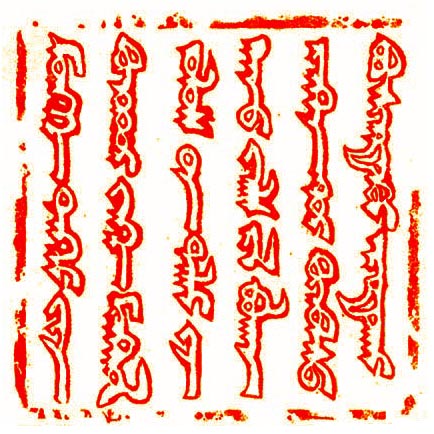
Traditional Mongolian script on Güyük Khan’s 1246 seal. Public-domain image via Wikimedia Commons.
The same phrase can therefore look radically different. In Cyrillic, “Mongolian language” is Монгол хэл (Mongol khel). In traditional script, it appears as ᠮᠣᠩᠭᠤᠯ ᠬᠡᠯᠡ. The letters are not a decorative font swap: traditional Mongolian has positional forms, ligatures, and shaping rules that depend on where a character occurs in a word.
Nor is conversion a mechanical one-letter substitution. Traditional spelling preserves older forms, and written usage in Inner Mongolia does not always match modern Khalkha vocabulary or pronunciation. Reliable conversion may require choosing a regional standard and resolving the word before changing its script.
Unicode treats Mongolian as a dedicated script with positional forms and special shaping behavior. That is why a traditional-script document can contain the right code points yet still display badly in an app that lacks a suitable font or text renderer.
Mongolia’s script revival is also current rather than purely historical. Reintroduction efforts have continued since 1994, and the traditional script is taught to some extent while Cyrillic remains dominant. Traditional script still carries institutional, cultural, and cross-border importance.
The contrast is useful when comparing language histories. Azerbaijani also has a modern story involving Arabic, Latin, and Cyrillic scripts, while Georgian shows what happens when one language community keeps a distinctive script tradition rather than switching to a regional alphabet.
How Mongolian Reached These Scripts
Traditional Mongolian script was adapted from the Old Uyghur alphabet around the beginning of the thirteenth century, during the period of Chinggis Khaan. It became the shared written tradition across much of the Mongolian cultural world, while Oirat communities later developed the more phonetic Todo script for their own variety.
The modern divide came from politics rather than from Mongolian suddenly becoming two unrelated languages. Mongolia’s twentieth-century alignment with the Soviet Union brought a short Latin experiment followed by a Cyrillic-based alphabet in the 1940s. Inner Mongolia did not follow the same institutional switch, so the vertical script kept a much larger role there.
After Mongolia’s democratic transition, traditional script returned to schools, public symbolism, design, and official language planning without displacing Cyrillic from everyday reading. That is why script choice now hints at a document’s audience: Cyrillic usually points to modern Mongolia, while traditional script often points to Inner Mongolia, heritage material, or a formal bilingual setting. It is a clue, not a perfect geographic label.
What Mongolian Sounds Like
Mongolian pronunciation rewards attention to vowels more than memorization of long spelling lists.
Vowel harmony
Many suffixes change their vowel to match the vowel class of the word. The front/back labels below are a classroom shortcut: modern linguistic analyses often describe Khalkha harmony through tongue-root or pharyngeal contrasts rather than literal tongue position alone.
| Group | Common vowels | Rough description |
|---|---|---|
| Back | а, о, у | Produced with the tongue farther back |
| Front | э, ө, ү | Produced with the tongue farther forward |
| Neutral | и | Often does not determine the harmony class by itself |
The letters ө and ү deserve early practice. Ө is a front rounded vowel, somewhat like the vowel in French peu; ү is a front rounded high vowel, similar to German ü. English does not have exact equivalents, so listening matters more than a one-letter pronunciation guide.
Vowel length can change meaning. Compare будах (budakh, “to paint or dye”) with буудах (buudakh, “to shoot”): the doubled vowel is not decorative spelling. Mongolian also uses consonants such as х that may sound unfamiliar to English speakers. Romanization is useful for a first encounter, but it hides distinctions that become obvious in Cyrillic.
Grammar That Builds Words Like Blocks
Mongolian is agglutinative: a word can take a sequence of suffixes, with each suffix contributing a fairly specific piece of meaning.
| Feature | What it means for a learner |
|---|---|
| Subject-object-verb order | The verb commonly comes at the end: “I book read.” |
| Case suffixes | Noun endings mark location, direction, possession, and source |
| No grammatical gender | Nouns do not divide into masculine and feminine classes as French nouns do |
| Postpositions | Some relationships expressed by English prepositions come after the noun |
| Vowel harmony | Suffix vowels adjust to the word they attach to |
The case pattern is easier to see with one noun:
| Form | Transliteration | Meaning |
|---|---|---|
| гэр | ger | house |
| гэрт | ger-t | in/at the house |
| гэрээс | ger-ees | from the house |
| гэрийн | ger-iin | of the house |
A simple sentence follows the same logic. Би ном уншиж байна (Bi nom unshij baina) means “I am reading a book”: би “I” + ном “book” + уншиж байна “am reading.” The important lesson is not to translate each word in English order and expect the sentence to survive.
Vocabulary and Loanwords
The core vocabulary is Mongolic, but Mongolian has absorbed words through religion, trade, empire, and modern geopolitics. Tibetan and Sanskrit layers appear in Buddhist vocabulary; Chinese contact is especially important in Inner Mongolia; Russian and international terms are prominent in modern Mongolia.
Loanwords are not random decoration. They can help date a text or identify its region, but they can also mislead a translator. A familiar-looking international word may have a local ending, a different pronunciation, or a meaning narrowed by Mongolian usage.
Common Mongolian Phrases
These phrases use modern Mongolian Cyrillic. The romanization is a learning aid, not a single universal pronunciation standard.
| English | Mongolian | Romanization |
|---|---|---|
| Hello | Сайн уу? | Sain uu? |
| How are you? | Сонин сайхан юу байна вэ? | Sonin saikhan yu baina ve? |
| Thank you | Баярлалаа | Bayarlalaa |
| Sorry | Уучлаарай | Uuchlaarai |
| Yes | Тийм | Tiim |
| No | Үгүй | Ügüi |
| Goodbye | Баяртай | Bayartai |
| How much is it? | Энэ ямар үнэтэй вэ? | Ene yamar unetei ve? |
If you remember only one greeting, start with Сайн уу?. It is short, widely recognizable, and easier to pronounce than the longer formal greeting Сайн байна уу?.
Is Mongolian Hard to Learn?
For an English speaker, Mongolian is challenging mainly because several unfamiliar systems arrive together:
- Writing: Cyrillic is learnable, but ө and ү need new sound-spelling habits; traditional script adds a separate reading system.
- Grammar: suffix chains and case endings put information inside words rather than in separate English-style function words.
- Pronunciation: vowel harmony and vowel length make small sound differences meaningful.
- Resources: learning materials are easier to find for Khalkha Cyrillic than for traditional-script Mongolian or smaller Mongolic varieties.
The difficulty is front-loaded. Once the Cyrillic alphabet and the most common endings become familiar, sentences stop looking like isolated symbols and start revealing a consistent pattern.
Practical Learning Tips
- Choose Khalkha Cyrillic first. It gives you the widest access to current Mongolian media and beginner materials.
- Learn ө and ү with audio. Do not replace both with the nearest English vowel and hope context will repair the difference.
- Study endings as families. Learn location, source, possession, and plural patterns with several nouns instead of memorizing one word at a time.
- Read one short sentence in two passes. Identify the suffixes first, then rebuild the English meaning in the sentence’s subject-object-verb order.
- Add traditional script after the foundation. Start with signs, names, and parallel Cyrillic examples so the vertical layout has a known reference.
AI Translation and Mongolian
Mongolian is a useful stress test for translation systems because it combines low-resource data, rich suffixation, and a genuine two-script problem. A system can produce fluent-looking English while missing a case ending, normalizing a name inconsistently, or reading an ambiguous traditional-script form incorrectly.
A July 2026 arXiv preprint, CoPiT, treats traditional-script Mongolian as a digraphic low-resource problem. Its proposed workflow first resolves traditional-script ambiguity through Cyrillic and then translates, rather than treating both scripts as equally well-resourced. A separate MM-Eval benchmark found that tested language models handled syntactic tasks better than deeper semantic tasks in Modern Mongolian. These are research findings, not a guarantee that any particular translator will perform well on your document.
OpenL’s Mongolian translator supports Mongolian as a target language, while OpenL’s multi-format workflow covers text, images, screenshots, PDFs, and Word files. Use it for a first pass, then review the script, names, and endings. For traditional-script scans, check the OCR output before translating; how to translate text from images and photos covers that preparation step. For editable reports or study materials, how to translate a Word document helps preserve the file structure.
Always review:
| Check | Why it matters |
|---|---|
| Script | Cyrillic and traditional text may need different OCR and rendering paths |
| Case endings | A suffix can change who did what, where, or to whom |
| Names | Romanization and transliteration can vary across sources |
| Regional variety | Khalkha, Inner Mongolian, and Buryat material should not be mixed casually |
| Formatting | Vertical text can break when copied into a horizontal document |
Mongolian is not “just Cyrillic” and not “just the language of the steppe.” It is a modern national language, a family of related varieties, and a writing tradition that still moves vertically when the context calls for it.
Sources
- World Bank: Mongolia population, total — 2025 population baseline; this is a country population figure, not a speaker count.
- Wikidata: Mongolian language — structured record for the dated estimate of 5.2 million speakers in 2005; used with an explicit age warning.
- Glottolog 5.3: Halh Mongolian — classification, Khalkha status, and 2025 language-resource metadata.
- Ministry of Foreign Affairs of the People’s Republic of China: Mongolia country profile — official country profile identifying Khalkha Mongolian as Mongolia’s main language.
- Unicode Standard, Chapter 13 — history, direction, and shaping requirements of the Mongolian script.
- Wikimedia Commons: Güyük Khan’s Stamp 1246 — public-domain vertical Mongolian script image used in the article.
- Omniglot: Mongolian alphabet, pronunciation and language — script history, varieties, Cyrillic notes, and sample text.
- Oxford University Press: The Phonology of Mongolian — linguistic reference for Khalkha vowel harmony and vowel length.
- WALS: Khalkha — comparative grammatical references for Khalkha Mongolian.
- Grambank: Halh Mongolian — structured grammar metadata and source bibliography.
- Omniglot: Mongolian phrases — phrase forms and romanization used in the common-phrases table.
- CoPiT: Cognitive Pivot Translation for Digraphic Low-Resource Mongolian in the Traditional Script — July 2026 preprint on traditional-script ambiguity and pivot translation.
- MM-Eval: A Hierarchical Benchmark for Modern Mongolian Evaluation in LLMs — benchmark findings on syntax, semantics, knowledge, and reasoning in Modern Mongolian.
- OpenL: Translate to Mongolian — official product page for Mongolian and multi-format translation support.