
Old Norse: Viking Language, Runes, Grammar & Sagas

TABLE OF CONTENTS
Old Norse left more than sagas: it gave English everyday words such as “sky” and “law,” and even the pronouns “they,” “them,” and “their.” This guide explains the language through sourced texts, grammar, runes, and a practical translation workflow.
Old Norse at a Glance
| Question | Answer |
|---|---|
| What was it? | A group of closely related medieval North Germanic language varieties |
| Main period | Approximately the 8th–14th centuries; scholarly periodization varies |
| Core area | Scandinavia, Iceland, the Faroe Islands, Greenland, and Norse settlements overseas |
| Main divisions | Old West Norse, Old East Norse, and Old Gutnish |
| Writing systems | Younger Futhark runes and, later, the Latin alphabet |
| Major texts | Eddic and skaldic poetry, sagas, laws, histories, and religious works |
| Modern descendants | Icelandic, Faroese, Norwegian, Danish, and Swedish; Norn is extinct |
| Language code | ISO 639-2 and ISO 639-3: non |
| Status today | A historical language with no native-speaking community |
According to the University of Texas at Austin’s Old Norse Online introduction, Old Norse developed within the North Germanic branch and is a collective label for closely related varieties rather than one uniform spoken standard. It was used during the Viking Age and early Middle Ages, with regional differences becoming more pronounced over time.
Old Norse, Old Icelandic, and Modern Icelandic
Several terms are regularly treated as synonyms even though they refer to different things.
| Term | What it means |
|---|---|
| Old Norse | The broad conventional label for medieval Scandinavian language varieties |
| Old West Norse | The western group, especially Old Icelandic and Old Norwegian |
| Old East Norse | The eastern group associated with medieval Denmark and Sweden |
| Old Gutnish | The medieval variety associated with Gotland |
| Old Icelandic | The best-preserved literary variety and the usual basis of many introductory courses |
| Modern Icelandic | A modern descendant with conservative grammar and spelling, but changed pronunciation, vocabulary, and usage |
| Norse | A broader historical and cultural term, not a precise language label by itself |
| Futhark | A runic alphabet, not a language |
Old Icelandic dominates many textbooks because medieval Iceland preserved an unusually rich written record. That documentary advantage can make “Old Norse” look more uniform and more Icelandic than the spoken reality was. If you want to understand the modern descendant most closely connected to this literary tradition, our guide to Icelandic explains what it retained and what changed.
What Old Norse Actually Looks Like
The following sentence opens the Prologue of Snorri Sturluson’s Edda in the normalized text presented by the University of Texas at Austin:
Almáttigr guð skapaði himin ok jǫrð.
The UT translation is: “Almighty God created heaven and earth.”
| Word | Form and function | Meaning |
|---|---|---|
Almáttigr | Nominative singular adjective agreeing with guð | almighty |
guð | Nominative singular; subject | God |
skapaði | Third-person singular past indicative of the weak verb skapa | created |
himin | Accusative singular; first direct object | heaven |
ok | Conjunction | and |
jǫrð | Accusative singular; second direct object | earth |
This sentence is useful because it shows three features at once. Word endings identify grammatical roles; skapaði carries person, number, and tense; and the letters ð and ǫ belong to the normalized spelling used by modern editors. The sentence is medieval Christian prose, not a reconstructed Viking greeting, so its source and context are clear.
Where and When Old Norse Was Used
Old Norse was centered in Scandinavia, but migration, settlement, trade, and political expansion carried related varieties much farther. The University of Texas at Austin’s language history traces westward settlement through Britain and the North Atlantic as well as eastward travel along rivers toward Byzantium. Old West Norse was used in Norway, Iceland, the Faroe Islands, Greenland, and Norse communities in parts of Britain and Ireland. Old East Norse was associated mainly with Denmark and Sweden and with Scandinavian settlement in eastern England. Old Gutnish was used on Gotland.
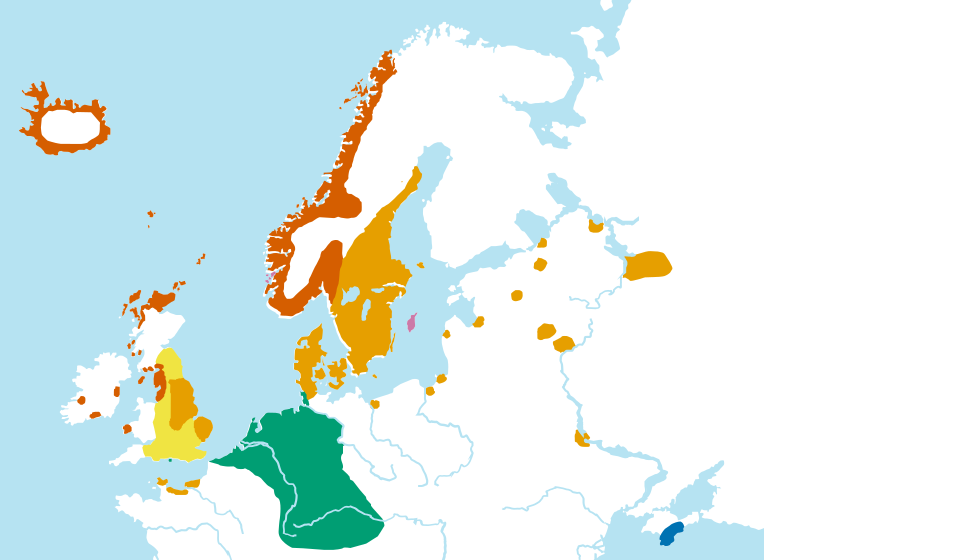
Approximate distribution of Old Norse varieties and neighboring Germanic languages around AD 900. Map by Wiglaf, Wikimedia Commons, licensed under CC BY-SA 3.0.
Norse speakers also traveled through the Baltic and along eastern European river routes. Personal names, inscriptions, place names, and contact vocabulary document that presence. This does not mean that every society connected to those routes generally spoke Old Norse; “Norse linguistic evidence reached the region” is a more defensible claim than treating the entire Kievan Rus’ sphere as one Old Norse speech area.
Dates require the same care. The UT overview places the emergence of recognizably distinct Old Norse around AD 700, while also stressing that linguistic change did not happen on one exact date. By the later Middle Ages, regional changes had produced recognizably separate North Germanic languages. Different academic traditions draw the boundaries differently, so “approximately the 8th–14th centuries” is more honest than a single exact start or end date.
Dialects and Modern Descendants
A simple family diagram is helpful as long as it is not mistaken for the full history:
Proto-Norse
    |
Old Norse / Old Scandinavian dialect continuum
    |-- Old West Norse --> Icelandic, Faroese, Norwegian, Norn
    |-- Old East Norse --> Danish, Swedish
    `-- Old Gutnish
The branches continued to interact. As the UT classification discussion cautions, the relative uniformity of surviving literary traditions can conceal a more intricate network of spoken varieties. Norwegian, for example, cannot be described as an untouched continuation of one western line, and continental Scandinavian languages were later affected by extensive contact with Middle Low German. Written standards also developed long after the earliest splits.
Icelandic and Faroese preserve conspicuous parts of older morphology, while their sound systems changed substantially. Danish, Norwegian, and Swedish moved in other directions and continued to influence one another. No modern Nordic language is a transparent recording of Viking Age speech.
How Old Norse Was Written
Old Norse appears in both runic inscriptions and Latin-script manuscripts. These systems overlap historically, but they do different jobs and cannot be converted by replacing one modern letter with one rune.
Younger Futhark: the Viking Age runes
Younger Futhark was the main runic system used in Scandinavia during the Viking Age. It reduced the earlier 24-rune Elder Futhark to 16 basic runes. That smaller inventory had to represent more sounds, so one rune could stand for several phonetic values. Long and short vowels were not consistently distinguished.
There were also graphical traditions such as long-branch and short-twig runes. A keyboard can provide the characters, but choosing historically plausible runes still requires a date, region, and linguistic form. The Younger Futhark Keyboard supplies the 16 long-branch Unicode runes for manual typing and copying; it does not automatically transliterate English or reconstruct an inscription.
A real example: the Jelling Stone
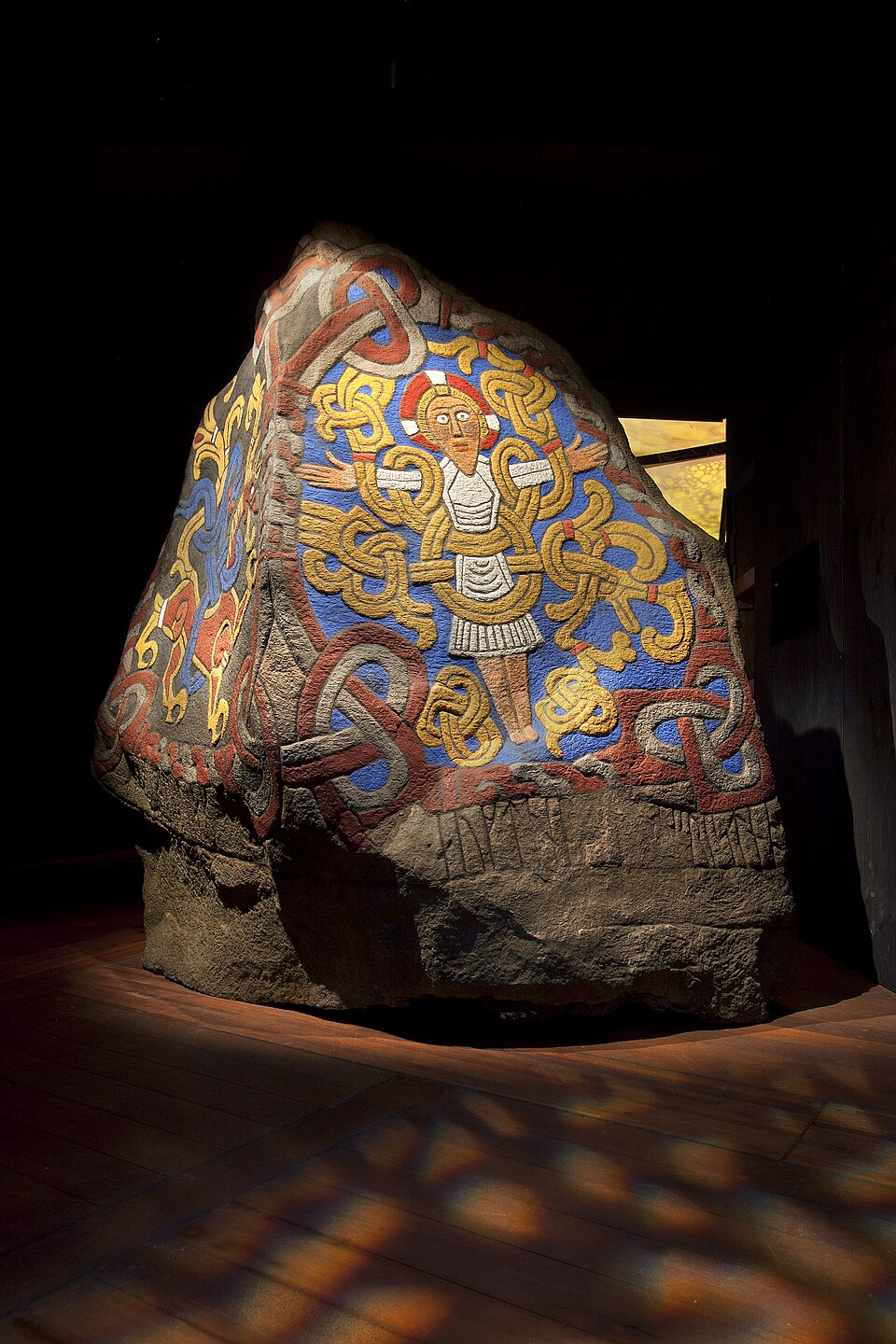
The larger Jelling Stone, whose inscription commemorates Harald Bluetooth’s parents and records his achievements. Photo: National Museum of Denmark/John Lee, Wikimedia Commons, licensed under CC BY-SA 2.0.
The University of Copenhagen’s Danish runic inscription database dates the larger Jelling Stone to 965–970 and classifies its language as Old Danish. Its opening six words read:
ᚼᛅᚱᛅᛚᛏᚱ ᚴᚢᚾᚢᚴᛦ ᛒᛅᚦ ᚴᛅᚢᚱᚢᛅ ᚴᚢᛒᛚ ᚦᛅᚢᛋᛁ| Layer | Text |
|---|---|
| Rune transliteration | haraltr kunukR baþ kaurua kubl þausi |
| Scholarly transcription | Haraldr kunungR bað gørva kumbl þǿsi |
| Meaning | “King Haraldr ordered these kumbls [memorial monuments] made…” |
The changing forms show why rune reading is not a visual letter swap: kunukR is interpreted as kunungR, while kaurua corresponds to gørva (“to make”). The National Museum of Denmark explains that Harald Bluetooth raised the stone in memory of his parents and used the inscription to state his achievements.
Elder Futhark came earlier
| System | Approximate period | Basic inventory | Relevance to Old Norse |
|---|---|---|---|
| Elder Futhark | Roughly the 2nd–8th centuries | 24 runes | Important for earlier Germanic and Proto-Norse inscriptions |
| Younger Futhark | From around the 8th century | 16 runes | The principal Viking Age runic system for Old Norse |
The Elder Futhark Keyboard is useful when comparing earlier inscriptions or entering its 24 Unicode runes. It should not be presented as the default alphabet for Viking Age Old Norse merely because it has more characters.
Latin-script Old Norse
Medieval manuscripts used the Latin alphabet with additional letters and varying scribal conventions. There was no single medieval spelling standard. The normalized orthography in dictionaries, courses, and editions is a modern scholarly aid that makes forms easier to compare. The Menota Handbook distinguishes facsimile, diplomatic, and normalized levels of text, which is why a manuscript transcription and a teaching edition may legitimately spell the same passage differently.
| Character | Practical reading note |
|---|---|
þ | Thorn; represents a dental fricative, broadly like English th |
ð | Eth; another dental-fricative spelling in normalized texts |
æ | A front vowel letter |
ǫ | An open/back rounded vowel in normalized Old Icelandic spelling |
ø, œ | Rounded front-vowel spellings found in normalized editions |
á, é, í, ó, ú, ý | Acute marks generally signal long vowels in normalized spelling |
Use the Old Norse Keyboard when you need these normalized Latin characters for notes, searches, or transcription. It includes þ, ð, æ, ǫ, ø, œ, and accented vowels.
How Old Norse Was Pronounced
There is no surviving recording and no single pronunciation valid for every region and century. Linguists reconstruct sound systems from spelling, rhyme, grammatical treatises, comparative evidence, inscriptions, and later descendants. The phonology chapters in the Viking Society’s free A New Introduction to Old Norse: Grammar explicitly separate orthography, sound values, stress, and historical changes. A course should therefore tell you which period and convention it follows.
For a practical beginning:
- Stress normally falls on the first syllable of the lexical stem.
- Short and long vowels contrast; normalized spelling usually marks long vowels with an acute accent.
- Common diphthongs include
ei,au, andey. þandðrepresent dental-fricative sounds, but their medieval spelling distribution is not simply the modern English rule forthinversusthis.- Consonant length can distinguish forms, so a doubled consonant should not automatically be ignored.
Modern Icelandic is a useful reading bridge, not a time machine. Its spelling is conservative, but its vowel system and other pronunciation features changed. Any English-friendly pronunciation guide is an approximation, especially if it does not identify a reconstructed period.
Old Norse Grammar Through One Real Sentence
Return to Almáttigr guð skapaði himin ok jǫrð. English readers can follow the familiar subject–verb–object order, but the endings provide evidence that English no longer supplies. The analysis below follows the UT Austin lesson and the inflectional framework in the Viking Society grammar.
Four cases
Nouns, adjectives, and pronouns use four main cases:
| Case | Common function |
|---|---|
| Nominative | Subject and citation form |
| Accusative | Direct object and uses governed by certain prepositions |
| Dative | Recipient, instrument, location, and uses governed by certain verbs or prepositions |
| Genitive | Possession, relationship, partitive meaning, and other constructions |
In the example, guð is nominative because it is the subject. himin and jǫrð are accusative because they are what God created. A reader should identify these forms before rearranging the sentence into natural English.
Here is one complete strong masculine pattern. The forms are adapted from the hestr (“horse”) paradigm in section 3.1.8 of A New Introduction to Old Norse: Grammar:
| Case | Singular | Plural |
|---|---|---|
| Nominative | hestr | hestar |
| Accusative | hest | hesta |
| Genitive | hests | hesta |
| Dative | hesti | hestum |
This is a pattern, not a universal ending chart. Other noun classes differ, but the exercise is the same: separate the stem hest- from the ending, identify the possible case and number, then use the sentence to choose among forms that overlap.
Gender and agreement
Old Norse nouns belong to masculine, feminine, or neuter classes. Adjectives and some pronouns change to agree with gender, case, and number. Gender is grammatical; it cannot reliably be guessed from whether an object is biologically male or female.
Strong and weak verbs
Strong verbs form their principal tense distinctions partly through vowel alternation, comparable in principle to English sing–sang–sung. Weak verbs use a dental past-tense suffix. In skapaði, the -aði pattern marks a weak past form: “created.”
From an inflected form to a dictionary entry
Do not search only for the exact surface form. Work backward from the ending:
| Step | What to do with skapaði | Result |
|---|---|---|
| 1. Use the clause | guð is singular and skapaði is its finite verb | Expect third-person singular |
| 2. Recognize the ending | -aði is a weak past-tense pattern | Read it as past indicative |
| 3. Recover the headword | Remove the inflection and test the infinitive ending | skapa |
| 4. Verify the entry | The Viking Society glossary lists skapa, past skapaði, past plural skǫpuðu, past participle skapaðr | “create, shape” |
This method is safer than guessing from an English look-alike. A glossary that lists principal parts tells you whether the form is regular, where the stem changes, and which headword to search in a larger dictionary.
Word order still matters
Inflection allows more flexibility than modern English, but Old Norse word order is not random. Clause type, finite-verb placement, pronouns, and information structure all matter. The endings reduce ambiguity; they do not remove syntax.
Literature and Words That Survived
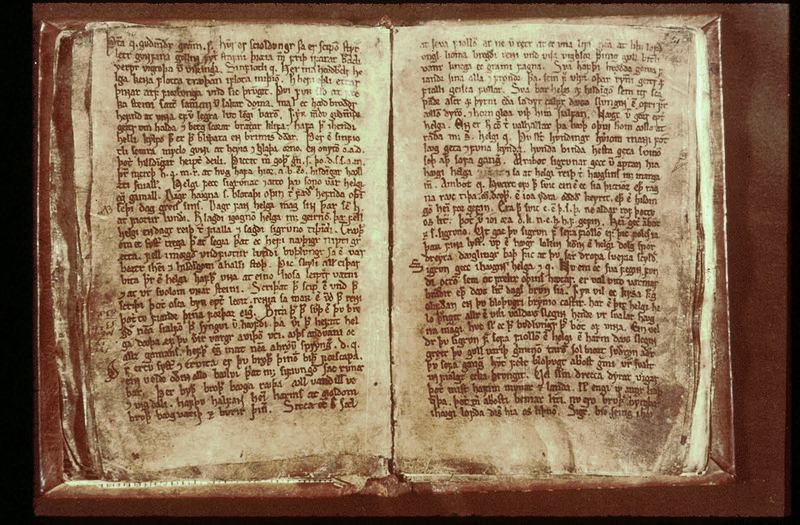
A page from the 13th-century Codex Regius, which contains Eddic poems. Wikimedia Commons, public domain.
Old Norse survives in more than mythological poems. The Viking Society’s A New Introduction to Old Norse: Reader samples 27 texts across major genres, including saga prose, Eddic poetry, skaldic verse, laws, Christian writing, histories, East Norse texts, and runic inscriptions.
- The Poetic Edda preserves mythological and heroic poems.
- The Prose Edda explains poetic diction, mythology, and meters.
- Sagas narrate families, kings, legendary figures, travel, feuds, and law.
- Skaldic poetry uses strict meters, compressed syntax, and kennings—multi-part poetic descriptions that rarely survive literal translation intact.
- Laws, histories, and religious texts reveal administration and intellectual life beyond the popular Viking image.
The surviving corpus is heavily shaped by Icelandic manuscript preservation. It records medieval authors and scribes looking back at earlier periods, not an unfiltered transcript of Viking Age speech.
Old Norse words in English
Research archived by the University of Iceland documents how contact between Scandinavian and English speakers left ordinary vocabulary, not only words about ships and warfare. Many borrowings became prominent in northern and eastern English before spreading more widely. The history sits between Old English and the later developments described in our Middle English guide.
| Modern English | Related Old Norse form | Basic historical meaning |
|---|---|---|
| sky | ský | cloud; later sky |
| window | vindauga | literally “wind-eye” |
| knife | knífr | knife |
| law | lǫg | laws, established rules |
| husband | húsbóndi | master of a household |
| skill | skil | distinction, discernment, knowledge |
| they / them / their | forms related to þeir / þeim / þeira | third-person plural pronouns |
The pronouns are especially memorable: language contact affected a core grammatical set, not merely a list of colorful nouns. Etymologies still require care because forms, routes, and meanings can vary by date and dialect.
Attested words, not invented “Viking phrases”
Words such as maðr (“person, man”), kona (“woman”), hús (“house”), skip (“ship”), vinr (“friend”), and konungr (“king”) are useful dictionary entries. Turning them into a modern phrasebook is harder. Historical texts do not guarantee that a line promoted online as “hello, Viking” functioned like a present-day greeting. Reliable study starts with an attested form, its grammar, and its textual context.
How to Read Old Norse Step by Step
- Identify the text. Record its work, manuscript or edition, date, dialect, and whether the spelling is diplomatic or normalized.
- Find the finite verb. In the sample,
skapaðigives past tense, third person, and singular number. - Mark noun phrases.
guðis the nominative subject;himinandjǫrðare accusative objects. - Check agreement. Match adjectives and pronouns to the gender, number, and case of the words they modify.
- Separate compounds. A word such as
vindaugabecomesvind(“wind”) +auga(“eye”). The final element is normally the semantic head: a window is a kind of “eye,” not a kind of wind. - Treat poetry separately. Saga prose and skaldic poetry may use the same language, but kennings, meter, and rearranged syntax demand different tools.
- Compare two translations. Keep a literal gloss for grammar and a natural translation for meaning. Do not force one version to do both jobs.
Applied to the sample, the process is short: find skapaði, identify guð as its subject, group himin ok jǫrð as coordinated objects, then translate. More difficult passages use the same method, only with more clauses and less familiar vocabulary.
How to Type and Translate Old Norse Online
Use the tools according to the writing system and task—not as interchangeable “Viking text” generators.
1. Type normalized Old Norse letters
Open the Old Norse Keyboard and enter the Latin-script text exactly as your edition gives it. Preserve accents and characters such as þ, ð, and ǫ; replacing them can make dictionary searches less reliable.
2. Enter Viking Age runes manually
Use the Younger Futhark Keyboard when you need the 16 long-branch runes as Unicode text. Choose runes only after deciding which Old Norse sounds or historically reconstructed form you mean. The keyboard types runes; it does not resolve linguistic ambiguity for you.
3. Compare an earlier runic system
Use the Elder Futhark Keyboard for earlier Germanic or Proto-Norse material. Do not choose Elder Futhark simply because its 24 signs map more neatly to modern Latin letters.
4. Generate a first-pass translation
Paste a short normalized passage into the OpenL Old Norse Translator. Treat the result as a working hypothesis: identify the main verb, compare dictionary headwords, and note where the system may have guessed a case or proper name.
5. Verify before quoting
Check prose against the Dictionary of Old Norse Prose, a grammar, and a reliable edition or facing translation. Poetry, runic inscriptions, legal text, and academic quotations need specialist review. A fluent sentence can still hide a wrong case, an invented sense, or a flattened kenning.
Is Old Norse Hard to Learn?
Difficulty depends on what you want to do.
| Goal | Relative difficulty | What you need first |
|---|---|---|
| Recognize names and frequent words | Beginner | Normalized letters and a small vocabulary |
| Read short saga prose with notes | Intermediate | Cases, common verb forms, and a glossary |
| Read Eddic poetry | Advanced | Grammar, poetic vocabulary, and cultural context |
| Parse skaldic poetry | Specialist | Meter, kennings, textual notes, and rearranged syntax |
| Interpret runic inscriptions | Specialist | Runology, historical phonology, dating, and inscription context |
The most efficient starting goal is reading normalized prose, not attempting to “speak Viking.” A historical pronunciation can be practiced, but there is no native community from which to learn a single modern conversational norm.
A practical learning sequence
- Learn
þ,ð,æ,ǫ,ø,œ, and the long-vowel marks. - Memorize one noun paradigm for each gender and learn to identify the four cases.
- Learn common strong-verb principal parts and weak past-tense endings.
- Read a short annotated prose passage with a glossary and translation.
- Move to Eddic poetry only after basic prose parsing feels routine.
- Study runic inscriptions as a separate skill rather than a font conversion exercise.
Free resources by learning goal
| Free resource | Best for | What it provides |
|---|---|---|
| UT Austin Old Norse Online | A guided first course | Ten sourced texts with translations, grammar notes, vocabulary, a base-form dictionary, and recordings |
| Viking Society Grammar | Systematic grammar study | Phonology, inflection, syntax, paradigms, and exercises |
| Viking Society Reader | Moving beyond isolated examples | Twenty-seven selections across prose, poetry, laws, and inscriptions, with notes |
| Viking Society Glossary | Looking up forms in the reader | Headwords, principal parts, meanings, and text references |
| Dictionary of Old Norse Prose | Checking attested prose usage | Dictionary entries linked to citations from the prose corpus |
| Menota Handbook 3.0 | Understanding editions and manuscripts | Standards for facsimile, diplomatic, and normalized medieval Nordic text |
Start with the UT lessons if you want a sequence. Use the three Viking Society volumes together when you are ready to read longer passages, and use the Dictionary of Old Norse Prose to verify how a word is attested rather than relying on a one-line modern gloss.
Frequently Asked Questions
Can modern Icelanders read Old Norse?
Modern Icelandic preserves much of the older inflectional system and a conservative spelling tradition, so an Icelandic reader starts with substantial advantages. That does not make every medieval manuscript immediately transparent: normalized spelling, changed meanings, unfamiliar syntax, scribal abbreviations, and historical context still matter.
Can English be converted directly into Viking runes?
Not historically. A visual substitution can encode modern English letters with rune-shaped characters, but an authentic-looking Viking Age inscription requires a historically plausible language form, sound analysis, rune row, date, and regional convention.
Can Old Norse pronunciation be known exactly?
No. It can be reconstructed systematically from strong evidence, but not recovered as one exact recording. Good pronunciation guides identify their period, dialect, and reconstruction conventions.
How reliable is AI translation for Old Norse?
It is useful for orientation, vocabulary candidates, and comparing possible readings. It is least dependable where evidence is sparse or structure is compressed: unusual spelling, poetry, kennings, damaged inscriptions, proper names, and ambiguous case forms. Verify any consequential use against specialist resources.
Bottom Line
Old Norse is best understood as a documented historical language continuum, not a mythology aesthetic or a rune cipher. Start with a sourced normalized text, parse its grammar, use the appropriate keyboard or translator, and verify the result against a dictionary and edition. That workflow turns the language from an intimidating wall of unfamiliar letters into evidence you can inspect one form at a time.
Sources
- Old Norse Online: Series Introduction — University of Texas at Austin — language history, geographic context, literary genres, dialect cautions, lessons, and audio.
- From the Prologue of Snorra Edda — University of Texas at Austin — source text, translation, vocabulary, and grammatical analysis for the example sentence.
- A New Introduction to Old Norse, Part I: Grammar — Viking Society for Northern Research — phonology, inflection, syntax, paradigms, and exercises.
- A New Introduction to Old Norse, Part II: Reader — Viking Society for Northern Research — academically edited selections across Old Norse genres, with notes and runic material.
- A New Introduction to Old Norse, Part III: Glossary — Viking Society for Northern Research — headwords, principal parts, meanings, and references for the companion reader.
- Dictionary of Old Norse Prose — University of Copenhagen — specialist dictionary for prose vocabulary and attested usage.
- Menota Handbook 3.0 — Medieval Nordic Text Archive — scholarly conventions for representing and encoding medieval Nordic texts.
- Old Norse Influence in Modern English — University of Iceland — research on Norse influence on English vocabulary.
- Jelling-sten 2 — University of Copenhagen Runer.ku.dk — dating, rune transliteration, scholarly transcription, language classification, and translation of the larger Jelling Stone.
- The Jelling Stone — National Museum of Denmark — historical context and translation of Harald Bluetooth’s inscription.
- Old Norse dialect map — Wikimedia Commons — map by Wiglaf, licensed under CC BY-SA 3.0.
- The Jelling Stone — Wikimedia Commons — photograph by the National Museum of Denmark/John Lee, licensed under CC BY-SA 2.0.
- Codex Regius of Eddaic Poems — Wikimedia Commons — 13th-century manuscript image in the public domain.


.jpg)
