Latin: The Language That Never Died
TABLE OF CONTENTS
Latin is called a dead language — yet it powers the Vatican ATM, fills every page of a biology textbook, and hides inside roughly 60% of every English sentence you speak.
Classification
Latin (Lingua Latīna) belongs to the Italic branch of the Indo-European language family. It originated in Latium (modern-day Lazio), the region around Rome, where it was originally spoken by the Latins — one of several Italic tribes that inhabited central Italy in the 1st millennium BC.
Its closest Italic relatives — Oscan and Umbrian — were spoken in neighboring regions but were eventually absorbed as Latin spread with Roman power. More distantly, Latin shares a common ancestor with Greek, Sanskrit, Persian, and the Germanic, Slavic, and Celtic languages.
Today, linguists classify modern Romance languages as the direct descendants of Latin’s spoken form — making Latin one of the few languages whose “death” was actually a transformation into dozens of living tongues.

Where Latin Is Used Today
Latin has had no native speakers since approximately AD 700, yet it remains in active daily use in one remarkable place: Vatican City — the only country in the world where Latin is an official language.
The Catholic Church still publishes its official journal (Acta Apostolicae Sedis) in Latin. Canon law courses at pontifical universities are taught in Latin. In a detail that never fails to surprise, Vatican City has the world’s only ATM with Latin instructions — where you select Deductio ex pecunia (“withdrawal”) instead of “withdraw cash.”
Beyond the Vatican:
| Domain | How Latin Is Used |
|---|---|
| Science & medicine | Biological taxonomy (Linnaean binomial names), anatomical terminology, medical abbreviations |
| Law | Legal maxims (habeas corpus, subpoena, pro bono, amicus curiae) |
| Education | Taught in secondary schools worldwide; ~500,000 students study Latin annually in Germany alone; compulsory in Italian liceo classico |
| Mottos & inscriptions | National mottos (E pluribus unum), military slogans (Semper Fidelis), university seals (Harvard: Veritas) |
| Living Latin movement | Growing initiative teaching Latin as a spoken, communicative language at the University of Kentucky, Oxford, and Princeton |
| Modern media | The Latin Wikipedia (Vicipaedia) has over 140,000 articles. Radio Bremen and Vatican Radio broadcast in Latin. Harry Potter, The Hobbit, and Winnie the Pooh all have Latin translations |
Is Latin still spoken today?
Yes, but not as a native language. The last native Latin speakers likely died out around AD 700, when the spoken vernacular had diverged enough to be considered early Romance languages rather than Latin. Today, an estimated 100 to 2,000 people worldwide can speak Latin fluently as a learned language, while millions more can read it at varying levels. The Living Latin movement actively promotes conversational Latin through immersion events and online communities — it’s entirely possible to hear people ordering coffee in Latin at a conventiculum.

A Language That Transformed, Not Died
Linguists classify Latin as a dead language — meaning it has no native speakers. But this label is misleading. Latin didn’t simply stop being spoken; it evolved into the modern Romance languages.
The spoken form — known as Vulgar Latin (sermo vulgaris, “the speech of the masses”) — gradually diverged across the Roman Empire. A soldier stationed in Gaul spoke differently from a merchant in Hispania or a farmer in Dacia. Over centuries, those regional variants crystallized into distinct languages.
Today, the Romance language family has nearly 1 billion native speakers:
| Language | Native Speakers (approx.) |
|---|---|
| Spanish | ~485 million |
| Portuguese | ~230 million |
| French | ~80 million |
| Italian | ~65 million |
| Romanian | ~24 million |
| Catalan | ~10 million |
Among these, Sardinian (specifically the Logudorese dialect) is considered the most phonologically conservative — the closest living echo of how Latin actually sounded. Italian is the closest to Latin in vocabulary.
History
Latin evolved through distinct phases across more than 2,700 years. Each period left its mark on the language we study today.
| Period | Time Frame | Key Characteristics |
|---|---|---|
| Old Latin | 753 BC – 75 BC | Earliest attested form. Inscriptions and early comedies by Plautus and Terence. Writing initially went right-to-left or boustrophedon before settling left-to-right |
| Classical Latin | 75 BC – AD 200 | The “Golden Age.” A consciously refined literary language used by Cicero, Caesar, Virgil, Ovid, and Horace. This is the form taught in schools |
| Vulgar Latin | Ongoing | The everyday spoken register of soldiers, merchants, and common people. Not a separate language, but the informal variant that eventually diverged into the Romance languages |
| Late Latin | 3rd–6th century AD | Written form that began diverging from Classical norms. Greater use of prepositions; word order shifted closer to modern Romance |
| Medieval Latin | c. 700–1500 AD | The lingua franca of Western Christendom — scholarship, law, theology, and diplomacy. Spread into Germanic and Slavic lands that had never spoken Latin natively |
| Renaissance Latin | 1300–1700 AD | A classicizing revival led by humanists like Petrarch and Erasmus. Isaac Newton’s Principia Mathematica (1687) was written in Latin. Until ~1700, most European academic books were published in Latin |
| Contemporary Latin | 1700–present | No native speakers, but maintained in specific domains. The Code of Canon Law (1983) was promulgated in Latin. Botanical and zoological nomenclature remains Latin-based |
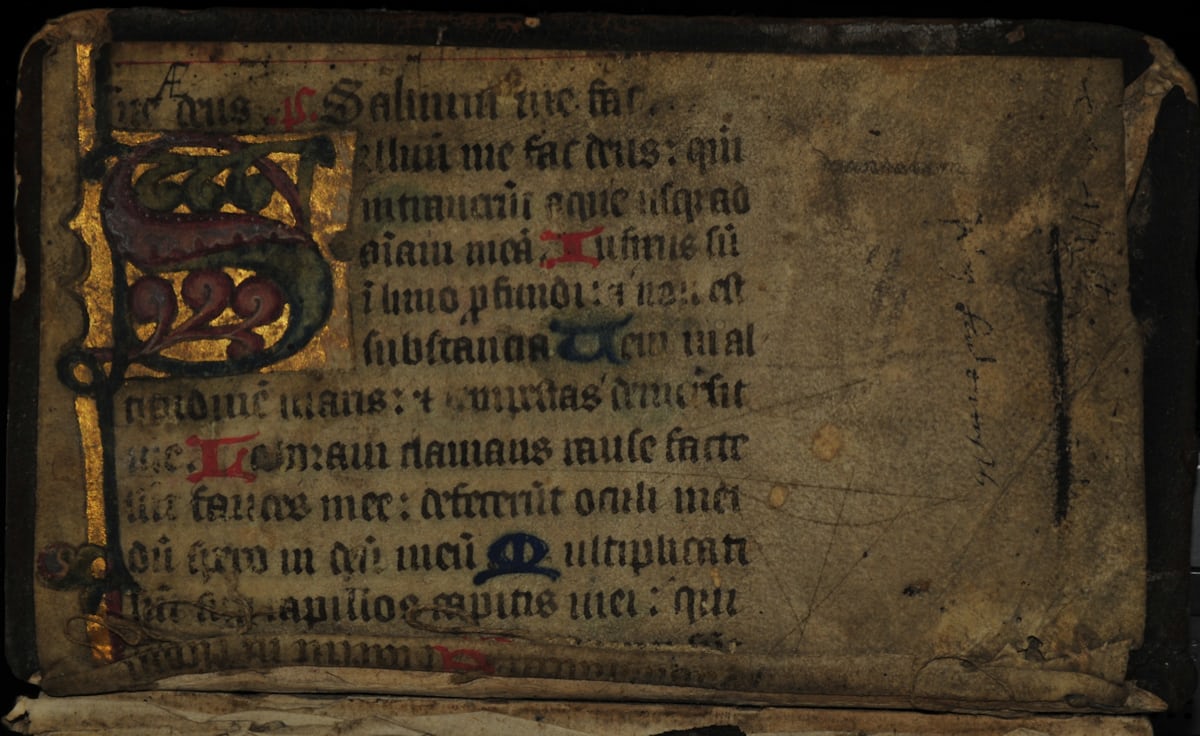
The Latin Alphabet: The World’s Most Successful Script
The Latin alphabet is today the most widely used writing system in the world — used by over 70% of the world’s population. But it started as a local adaptation.
The Romans derived their alphabet from the Etruscan alphabet, which came from the Greek alphabet (specifically the Cumaean variant used in Greek colonies in Italy), which ultimately descended from Phoenician. The chain is: Phoenician → Greek → Etruscan → Latin.
The original Latin alphabet had just 21 letters:
A B C D E F Z H I K L M N O P Q R S T V XKey developments:
- G was added around 230 BC by modifying C (the Romans originally used C for both /k/ and /g/ sounds)
- Y and Z were borrowed from Greek in the 1st century BC to write Greek loanwords
- J, U, and W were medieval additions — Classical Latin used I for both vowel /i/ and consonant /j/, and V for both vowel /u/ and consonant /w/
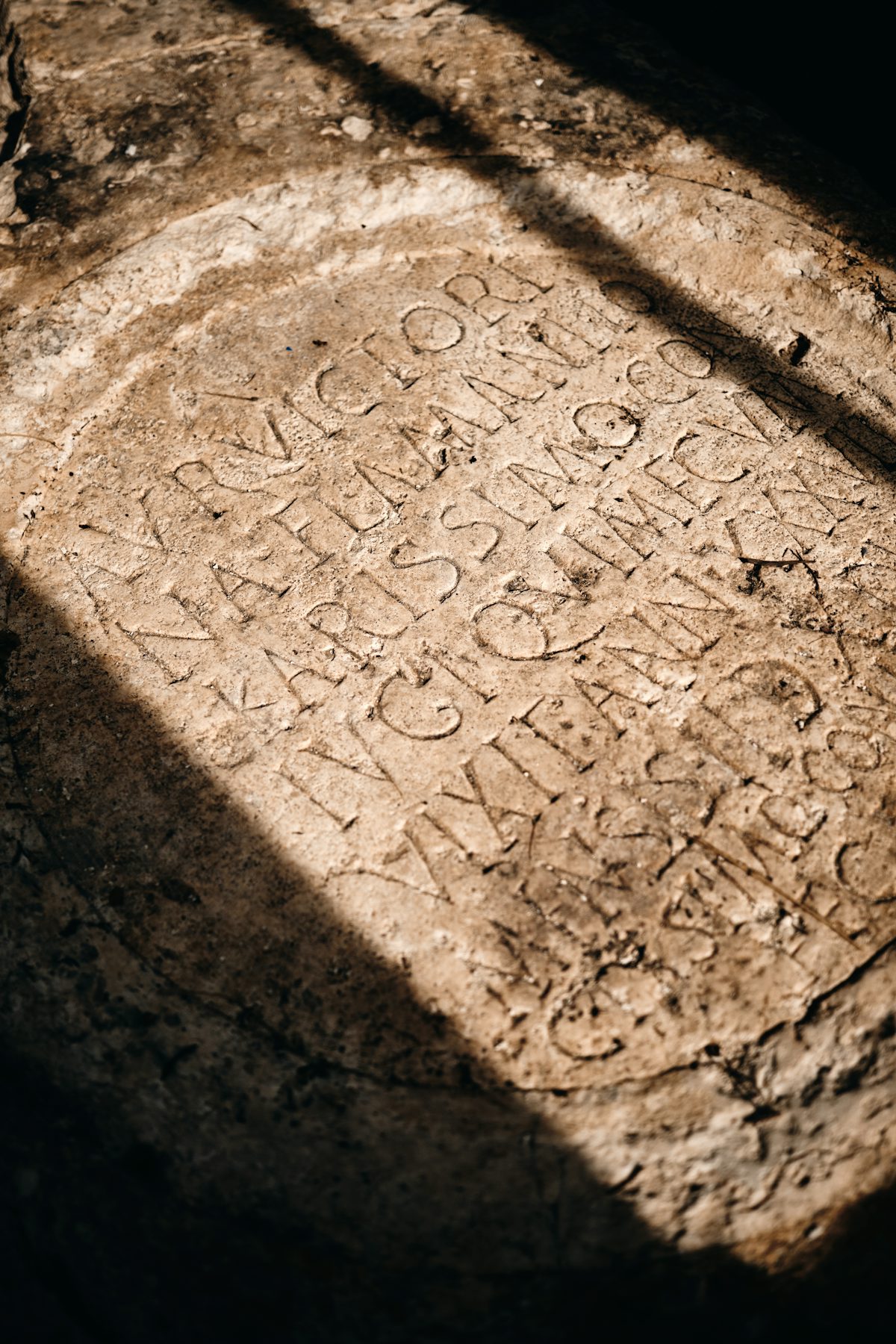
- Classical Latin had no lowercase letters, no spaces between words, and no punctuation — reading a Roman inscription meant parsing a solid block like SENATVSPOPVLVSQVEROMANVS
Is Latin script the same as the English alphabet?
Not quite. Classical Latin used 23 letters (no J, U, W). Medieval scribes added J and U as distinct letters, and W developed from doubling V or U in Germanic languages. The 26-letter English alphabet is a direct extension of the Latin script.
Pronunciation: Two Competing Traditions
There are two main pronunciation systems for Latin, and which one you learn depends on where and why you study it.
Classical Pronunciation (Restored)
The reconstructed pronunciation of the 1st century BC Roman elite. Key rules:
- C is always /k/: Caesar = “KAI-sar” (not “SEE-zer”)
- V is always /w/: veni, vidi, vici = “WAY-nee, WEE-dee, WEE-kee”
- G is always hard /g/: gemma = “GEM-ma” (never “JEM-ma”)
- AE is like “eye”: Caesar = “KAI-sar”
- OE is like “oy”: poena = “POY-na”
- R is trilled (rolled), as in Spanish or Italian
Ecclesiastical (Church) Pronunciation
Developed in the medieval Church under Italian influence. Follows Italian pronunciation rules:
- C before E/I/AE/OE = “ch”: caelum = “CHEH-loom”
- G before E/I/AE/OE = “j”: regina = “reh-JEE-nah”
- V = /v/: vita = “VEE-tah”
- AE/OE = “eh”: caelum = “CHEH-loom”
- TI before a vowel = “tsee”: gratia = “GRAH-tsee-ah”
Which pronunciation should you use?
- Classical — if you’re studying ancient Roman literature, history, or linguistics
- Ecclesiastical — if you’re singing in a choir, studying Church history, or using Latin in a Catholic context
- Both are “correct” — even professional classicists switch between them depending on context
Grammar
This is where Latin gets its reputation. The grammar is both the hardest part of learning Latin and the most fascinating thing about it.
Latin is a highly inflected, fusional language. This means word endings change to encode grammatical information — the job a word performs in a sentence is signaled by its ending, not by its position.
The Case System
A case is a grammatical category that shows what role a noun plays in a sentence. Latin has six main cases (seven if you count the rare Locative):
| Case | Function | English Equivalent |
|---|---|---|
| Nominative | Subject | The boy runs |
| Genitive | Possession | The book of the boy |
| Dative | Indirect object | Give the book to the boy |
| Accusative | Direct object; motion toward | He sees the boy |
| Ablative | Means, manner, location, separation | with a sword, in the forest, from Rome |
| Vocative | Direct address | O Marcus! |
| Locative | Location (cities, small islands, domus, rus) | at Rome (Romae) |
Each noun belongs to a declension — a family of nouns that share the same pattern of case endings. There are five declensions, and you identify which one a noun belongs to by its genitive singular ending.
The Five Declensions
First Declension (genitive singular: -ae) — mostly feminine Example: puella, puellae (girl)
| Case | Singular | Plural |
|---|---|---|
| Nominative | puella | puellae |
| Genitive | puellae | puellārum |
| Dative | puellae | puellīs |
| Accusative | puellam | puellās |
| Ablative | puellā | puellīs |
| Vocative | puella | puellae |
The remaining four declensions:
| Decl. | Gen. Sg. | Gender | Example | Notable |
|---|---|---|---|---|
| 2nd | -ī | M / N | servus, servī (slave) / bellum, bellī (war) | Neuter rule: Nom. = Acc., plural ends in -a |
| 3rd | -is | M / F / N | rēx, rēgis (king) / nōmen, nōminis (name) | Largest group; nom. sg. unpredictable — memorize genitive |
| 4th | -ūs | mostly M | manus, manūs (hand) | Small but common: domus (home), cornū (horn) |
| 5th | -eī | mostly F | rēs, reī (thing) | Tiny; rēs and diēs (day) are everywhere |
Verb Conjugations
Latin verbs belong to four conjugations, distinguished by their infinitive ending:
| Conjugation | Infinitive | Example |
|---|---|---|
| 1st | -āre | amāre (to love) |
| 2nd | -ēre | vidēre (to see) |
| 3rd | -ere | dūcere (to lead) |
| 4th | -īre | audīre (to hear) |
A full Latin verb can encode all of this in a single word:
- 6 tenses: Present, Imperfect, Future, Perfect, Pluperfect, Future Perfect
- 3 moods: Indicative, Subjunctive, Imperative
- 2 voices: Active, Passive
- 3 persons: 1st, 2nd, 3rd
- 2 numbers: Singular, Plural
This means a single verb like amāverant packs in: “they had loved” (3rd person, plural, pluperfect, active, indicative).
Latin also has deponent verbs — verbs with passive forms but active meanings. For example, hortor looks passive (“I am urged”) but means “I urge.”
Word Order: Flexible but Not Random
The default Latin word order is Subject-Object-Verb (SOV):
Puer puellam amat. “The boy loves the girl.” (Literally: Boy girl loves.)
But because case endings tell you what role each word plays, you can rearrange the sentence for emphasis without changing the meaning:
- Puellam puer amat. — Still “The boy loves the girl,” but the girl is emphasized by fronting
- Amat puer puellam. — “He LOVES her” (the verb is emphasized)
This flexibility lets Latin writers create effects impossible in English — like enclosing a long phrase between a noun and its adjective (magna cum laude, “with great praise,” literally “great with praise”).
No Articles
Latin has no definite or indefinite articles — no words for “a,” “an,” or “the.” When reading puella, you decide from context whether it means “a girl” or “the girl.”
This feature was inherited by most Romance languages (which later developed their own articles), but it’s a constant puzzle for English speakers learning Latin.
How Latin Shaped English Vocabulary
Roughly 60% of English words have Latin roots — either directly borrowed or filtered through French after the Norman Conquest of 1066.
Two layers of Latin entered English:
| Layer | When | Examples |
|---|---|---|
| Direct borrowing | Medieval–Renaissance | agenda, memorandum, curriculum, alibi, veto, census |
| Via French | After 1066 | beef (from bōs/bovis), liberty (lībertās), justice (iūstitia), school (schola) |
Latin and Greek roots overwhelmingly dominate the technical vocabulary of science, medicine, law, and theology — an estimated 90% of scientific and technical English terms derive from Latin or Greek. When you study human anatomy, you encounter femur, patella, scapula, and cerebrum — all unchanged Latin words. When a lawyer argues pro bono, they’re speaking Latin. When a scientist names a new species as Homo neanderthalensis, they’re following Linnaeus’s Latin binomial system.
This is why learning Latin often improves English vocabulary and reading comprehension — you gain the root meanings behind thousands of English words. For a deeper look at how languages like Latin influence learning, see our guide on how to learn a new language in 30 days.
Why does English have so many Latin words?
English never descended from Latin (it’s a Germanic language), but it absorbed Latin vocabulary through three main routes: the Roman occupation of Britain (43–410 AD), the Christianization of Anglo-Saxon England (7th century), and most importantly, the Norman Conquest (1066), which brought Old French — itself a direct descendant of Latin — into English courts, government, and literature. Later, the Renaissance triggered a wave of direct Latin borrowing for scholarly and scientific terms.
Famous Latin Phrases
Some Latin phrases are so embedded in English that we use them without thinking:
| Phrase | Literal Meaning | Modern Usage |
|---|---|---|
| Carpe diem | ”Pluck the day” | Seize the moment (Horace, Odes 1.11) |
| Veni, vidi, vici | ”I came, I saw, I conquered” | Swift, decisive victory (Julius Caesar, 47 BC) |
| Cogito, ergo sum | ”I think, therefore I am” | Philosophical certainty (Descartes, 1637) |
| Ad astra per aspera | ”To the stars through hardship” | Perseverance; Kansas state motto |
| Alea iacta est | ”The die is cast” | Point of no return (Julius Caesar, 49 BC) |
| E pluribus unum | ”Out of many, one” | Unity from diversity; US motto |
| Semper fidelis | ”Always faithful” | US Marine Corps motto |
| Sic semper tyrannis | ”Thus always to tyrants” | Virginia state motto |
| Quid pro quo | ”Something for something” | A reciprocal exchange |
| Et cetera (etc.) | ”And the rest” | And so on |
| In vino veritas | ”In wine, truth” | People speak honestly when drunk |
| Memento mori | ”Remember you must die” | Reminder of mortality |
Common Latin Phrases
If you want to try speaking Latin, here are practical phrases to start with:
| Latin | English |
|---|---|
| Salvē! / Salvēte! | Hello! (singular / plural) |
| Valē! / Valēte! | Goodbye! (singular / plural) |
| Quid agis? | How are you? |
| Grātiās tibi agō | Thank you |
| Quid est nōmen tibi? | What is your name? |
| Nōmen mihi est… | My name is… |
| Ubi est…? | Where is…? |
| Intellegō / Nōn intellegō | I understand / I don’t understand |
| Ita / Minimē | Yes / No |
| Quaesō | Please |
Latin numbers (1–10)
| Number | Latin |
|---|---|
| 1 | ūnus, ūna, ūnum |
| 2 | duo, duae, duo |
| 3 | trēs, tria |
| 4 | quattuor |
| 5 | quīnque |
| 6 | sex |
| 7 | septem |
| 8 | octō |
| 9 | novem |
| 10 | decem |
Is Latin Hard to Learn?
For an English speaker, Latin is moderately difficult. The FSI (Foreign Service Institute) doesn’t officially rank Latin since they only teach modern spoken languages, but linguists generally estimate it falls into Category II — similar to German — requiring roughly 900 class hours plus self-study to reach reading proficiency.
Is Latin harder than Spanish?
Yes, significantly. Spanish, French, and Italian are Category I languages (600–750 class hours). Latin adds several layers of complexity absent from modern Romance languages:
- Case system: Modern Romance languages lost noun cases entirely. In Latin, every noun, adjective, and pronoun changes form depending on its grammatical role
- No native speakers: You can’t immerse yourself in spoken Latin the way you can with Spanish
- Flexible word order: Context-based parsing is harder than fixed-order languages
- Multiple reading traditions: You’re learning to read — not just speak — from day one, often tackling complex literary texts
Is Latin harder than Russian?
About equal in difficulty, but for different reasons. Russian (FSI Category III, ~1,100 hours) has a similar case system and complex verbal aspect, but it also requires learning the Cyrillic alphabet and has less shared vocabulary with English. Latin uses the same alphabet and shares massive cognate overlap with English — roughly 60% of English words have Latin roots, giving learners a built-in vocabulary advantage.
How long does it take to learn Latin?
| Study Pace | Approximate Time to Reading Proficiency |
|---|---|
| Full-time (25 hrs/week) | ~9 months |
| Part-time (5–10 hrs/week) | 2–3 years |
| Casual (1–2 hrs/week) | 4–5+ years |
“Reading proficiency” here means the ability to pick up most Classical texts with a dictionary and work through them — not necessarily reading Caesar or Virgil at speed without help.
Tips for Learning Latin in 2026
1. Master the declensions and conjugations early. This is the foundation everything else builds on. Use spaced-repetition apps like Anki to drill noun and verb endings until they’re automatic.
2. Read from day one. The best modern Latin textbooks — Lingua Latina Per Se Illustrata (Ørberg) — use the “natural method”: you read simple Latin from the first page and build up gradually, the way you’d learn any living language. No translation drills.
3. Use digital tools. Apps like Legentibus and the Logeion dictionary app make Latin resources accessible on your phone. The Perseus Digital Library and the Packard Humanities Institute provide free access to nearly every surviving Classical text with built-in morphological analysis.
4. Join the Living Latin community. Conventicula (Latin immersion weekends) like the Paideia Institute’s Living Latin in Rome and the Conventiculum Bostoniense let you practice speaking Latin with other learners. The online Latin Discord community is active and welcoming to beginners.
5. Start with medieval, not Classical. Medieval Latin is simpler: shorter sentences, more familiar word order, less complex subordination. Beginning with 12th-century chronicles or saints’ lives builds reading fluency faster than plunging straight into Cicero.
6. Listen to spoken Latin. Podcasts like Quomodo Dicitur and Satura Lanx provide regular Latin audio content. Hearing the language — even passively — reinforces grammar patterns and vocabulary. The YouTube channel ScorpioMartianus produces high-quality spoken Latin content.
For a comparison with another classical language, see our guide to Ancient Greek. If you’re interested in how Latin transformed into the languages spoken today, our Romanian guide covers the Romance language that preserves the most Latin grammatical features.
AI Translation and Latin
Machine translation for Latin sits at an interesting crossroads in 2026. Unlike modern languages, Latin is a low-resource language for AI training — there simply isn’t the same volume of parallel translated text that powers models like DeepL or Google Translate for Spanish or Chinese.
Several specific challenges make Latin uniquely difficult for AI translation:
- Morphological complexity: Latin’s case system means a single noun can take 10+ distinct forms. A verb can appear in over 100 different conjugated forms. AI models trained primarily on English — a lightly inflected language — struggle with this combinatorial explosion
- Flexible word order: When word position doesn’t signal grammar, models that rely heavily on positional encoding can misidentify subjects and objects
- Text diversity: Surviving Latin spans over 2,000 years of writing across poetry, law, philosophy, medicine, inscriptions, and medieval scholasticism. A legal formula from the Twelve Tables (450 BC) and a love poem by Catullus (60 BC) share a language but little else
- Cultural-conceptual gaps: Key Roman concepts like pietas, dignitas, or auctoritas don’t have clean one-word English equivalents. Translating them requires understanding Roman culture, not just Latin vocabulary
A 2026 study at the University of Bologna conference “Translating Latin in the Contemporary World” highlighted these issues as active research problems. The new FRED metrics (Fertility Ratio, Retrieval Proxy, Exposure, Diversity) revealed that much of what looked like AI progress on Latin translation was actually data contamination — models memorizing test-set snippets from their training data rather than genuinely understanding Latin morphology.
In practice, AI can produce serviceable Latin-to-English translations of straightforward prose. But for poetry, complex argumentation, or texts with cultural depth, human expertise remains irreplaceable. For modern languages with abundant training data, neural machine translation — the same technology powering tools like OpenL across 100+ languages — achieves far higher reliability. The gap between Latin and Spanish in MT quality ultimately comes down to data: a billion living speakers generate more training material than two millennia of manuscripts.
Sources
- Latin — Wikipedia — Comprehensive overview of Latin language history, grammar, and modern usage
- Latin — Britannica — Scholarly entry covering classification, history, and linguistic features
- Romance languages — Britannica — The evolution of Latin into modern Romance languages
- Latin alphabet — Wikipedia — History and development of the Latin script
- Latin Wikipedia (Vicipaedia) — 140,000+ articles demonstrating active Latin use
- Foreign Service Institute Language Difficulty Rankings — FSI category system for language learning difficulty
- Translating Latin in the Contemporary World — University of Bologna (2026) — Academic conference on AI and Latin translation
- Translation or Recitation? — arXiv (2026) — FRED metrics for evaluating machine translation of low-resource languages
- Can LLMs Translate Italy’s Language Varieties? — LoResMT (2026) — LLM performance on low-resource Romance language varieties
- Lingua Latina Per Se Illustrata — Ørberg — The natural-method Latin textbook
- The Perseus Digital Library — Free digital library of Classical texts with morphological tools